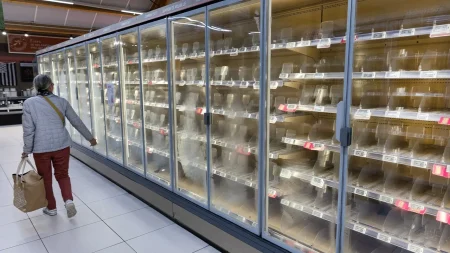



Thursday will not be an ordinary morning. Across the country, in large cities and small towns, more than 220 demonstrations are expected to spill onto streets, parks, and squares. This is not a sudden eruption; it is the continuation of weeks of anger that have been simmering beneath everyday routines. The cause is as simple as it is devastating: people can no longer afford to live. Groceries cost more. Rent is higher. Electricity bills arrive with numbers that seem like cruel jokes. The cost of living crisis has moved from news bulletins into kitchen tables, where parents quietly subtract items from shopping lists and hope the car can last another year. When thousands of strangers gather separately, in different places, with the same ache in their chests, something profound is happening. It is not just a protest; it is a shared confession that the system is breaking. The demonstrators will be teachers, nurses, shop assistants, bus drivers, pensioners, students. Some will carry neatly printed banners; others will hold cardboard signs scribbled in marker. Many will be nervous, because public speaking is hard and being seen feels risky. But they will come. They will stand in the cold, or maybe the rain, because staying home is more painful. They will chant and cheer and sometimes fall silent when someone talks about losing a home or feeding children with nothing left. These demonstrations are not statistics. Each one is a group of human beings deciding that their quiet suffering is no longer acceptable. The number 220 tells us scale, but not texture. The texture is a retired woman holding a sign that says “I worked all my life and now I choose between food and medicine.” It is a young father with a baby on his shoulders, carrying a rucksack with bottles and nappies, while his other hand grips a placard demanding fair wages. It is the smell of coffee from a thermos, the murmur of strangers exchanging stories, the awkward shuffle of people who are not used to raising their voices. On Thursday, the country will witness something uncomfortable: the visible face of struggle.
The cost of living crisis did not arrive overnight. It was built over years of policy choices, global shocks, and quiet neglect. When the pandemic ended, supply chains were still tangled; when conflict broke out in Europe, energy prices soared; when governments printed money or failed to regulate markets, inflation took hold. Wages did not keep up. For many workers, a pay rise of a few percent felt generous, while the actual price of everything climbed at double that pace. Slowly, savings were drained. Credit cards were maxed out. Payday loans became a last resort for people who once considered themselves comfortable. Now, a single unexpected expense — a broken fridge, a child’s dental bill, a car repair — is enough to push a family into crisis. Food banks have reported record demand. Landlords have raised rents because they too face higher mortgage costs, but the human consequence is that evictions are rising. Old people sit in unheated living rooms, wrapped in blankets. Young workers share overcrowded apartments with strangers. Parents skip meals so their children can eat. This is not hyperbole; it is the daily arithmetic of survival. The people who will demonstrate on Thursday are not lazy or unrealistic. They are the same people who kept hospitals running, who delivered parcels, who stacked shelves, who taught classes through lockdowns. They worked hard and followed the rules, and now they are being told that their work is not worth enough to live on. There is a particular kind of exhaustion that comes from doing everything right and still falling behind. It is the exhaustion of checking a bank balance after midnight, subtracting bills that are already overdue, and realizing that no amount of budgeting can create money that isn’t there. The protests on Thursday will carry that exhaustion into public space. There will be anger, yes, but also bewilderment: how did we get here? How is it possible that a country with so much wealth has so many people in despair? The question hangs over every banner.
Look closely at the crowds on Thursday and you will see a mosaic of ordinary life. In one city, a group of rail workers in fluorescent jackets stands beside nurses in scrubs, their shift ending just before the rally. In another, a cluster of gig-economy couriers leans on bicycles, phones mounted to handlebars, waiting to join a chant. There are grandmothers who remember the miners’ strikes, holding hands with teenagers who have never been to a protest before. A primary school teacher carries a sign decorated with crayon drawings from her class: “Please make it fair for my students.” A warehouse worker explains to a neighbour that his pay, adjusted for inflation, is lower than it was ten years ago. A nurse says she has started using the staff food bank. A student says she can no longer afford her rent and is thinking of dropping out. These stories are not unusual. They are the point. The demonstrations are organised by different unions and community groups, with no single leader or uniform message. Some demand a real increase in wages. Others call for rent controls, cheaper energy, and taxes on the record profits of corporations. The signs reflect this diversity: “End fuel poverty,” “Renters need rights, not hikes,” “Tax the super-rich,” “Bread and roses,” “We are not machines.” There is also humour. A middle-aged man in a tweed cap holds a placard: “I was going to buy a sign, but I can’t afford it.” Laughter ripples through the crowd. For a moment, the weight lifts. Then the speeches begin, and the mood turns serious. A woman talks about losing her cleaning job after she had to take time off to care for her father. A disabled man talks about the extra costs of living that no one sees. A local priest talks about the queue at the food pantry that now stretches around the block. The crowd listens. Some wipe their eyes. Then they march, or at least they try to. The streets are wide and the pace is slow, because many people are older or carrying children. They chant in ragged unison. Drivers honk. Some wave; some turn away. It is not a revolution. It is a plea. But it is a plea made together, and that changes things.
The human cost of the cost of living crisis is not only financial. It is the tightness in the chest when the electricity meter runs down. It is the shame of telling a child that there is no money for the school trip. It is the sleepless nights when the landlord’s letter arrives, or when a partner stays silent because they are afraid to speak the fear out loud. Doctors say they are seeing more patients with anxiety, depression, and stress-related illness. Teachers say children come to school hungry, unable to focus. Charity workers say that demand for help has doubled, tripled, multiplied beyond their capacity. Behind every protest sign is a biography of small humiliations: the voucher at the food bank, the unpaid bill, the phone call to a helpline, the pitying glance from a friend. People do not talk about these things easily. That is why the demonstrations matter. They transform private shame into public protest. When a person stands in a crowd and shouts that they are struggling, they are no longer alone. The act of showing up is itself a kind of healing. It says: this is not my fault. It says: we will not be silent. It says: we deserve to live, not just survive. There is also grief. Many older protesters feel they have worked their entire lives for a promise that has been broken. A pensioner who paid taxes for fifty years might wonder why she must now choose between a warm home and a hot meal. A middle-aged man who played by the rules — got a job, bought a house, saved for his children — might find himself drowning in debt through no fault of his own. The grief is for the future that will not come: the comfortable retirement, the family holiday, the security that parents once hoped to pass on. The demonstrations are a way of mourning that future while refusing to accept it. There is anger, too, raw and legitimate. Anger at corporations that report record profits while workers struggle. Anger at politicians who seem to live in another world. Anger at a system that rewards wealth and punishes work. On Thursday, this anger will not be destructive. It will be disciplined, channeled into slogans and marches. But the anger is real. It is the sound of people who have been patient for too long.
The scale of Thursday’s protests — more than 220 demonstrations — tells us that this is not a fringe movement. It is a broad, decentralised expression of discontent that cuts across political affiliations and social classes. In the weeks leading up to this day, smaller protests and strikes have tested the waters. Workers in various sectors have walked out, not for fun, but because a day’s pay lost is worth the chance of a better future. Communities have organised mutual aid groups, food banks, and warm banks. Now they are moving into the streets to demand systemic change. The message to those in power is clear: the patience is running out. People do not want charity; they want justice. They want wages that cover the cost of living. They want homes that are safe and affordable. They want energy that does not force a choice between heat and food. They want the wealth of the country to be shared fairly, not hoarded at the top. These are not unreasonable demands. They are the basic conditions of a dignified life. The demonstrations also signal something deeper: a revival of collective action. For decades, many people have been taught to believe that their problems are personal, that they should work harder, budget better, and pull themselves up by their own bootstraps. The crisis has made a lie of that. Millions of people are doing everything right and still falling behind. The only logical response is to join together. This is what is happening on Thursday. In 220 places, strangers will become neighbours. They will sing songs that are older than they are, and invent new chants for the moment. They will learn that their own struggles are shared. That knowledge is dangerous, in the best sense. It cannot be ignored by politicians. It cannot be absorbed by corporate PR. It is the beginning of a conversation that must be answered with policy, not promises. Whether the government listens remains to be seen. But after Thursday, it will be harder to pretend that everything is fine.
When the demonstrations end, the streets will be cleaned, the banners folded, the voices hoarse. People will go home to the same bills, the same worries, the same impossible arithmetic. Thursday alone will not solve the cost of living crisis. No single day of protest can undo the damage of years. But something will have changed. The person who marched will look at their kitchen table and know that across town, or across the country, others are sitting at their kitchen tables, thinking the same thoughts. There is power in that knowledge. It is the power of solidarity, of shared struggle, of refusing to be isolated in suffering. The 220 demonstrations are not an end. They are a beginning, or perhaps a middle, of a long movement that will continue until the demands are met. Some protesters will be disappointed if nothing happens immediately. Others will be inspired to do more: to join a union, to run for local office, to start a mutual aid group, to knock on doors and talk to their neighbours. The crisis has a way of revealing what really matters. It reveals the fragility of life, the inadequacy of old answers, and the strength of ordinary people when they choose to act together. In the crowd, there will be a moment — perhaps when a chant rises and is answered by another chant from the back, or when an elderly woman raises a papery fist, or when a child falls asleep on a parent’s shoulder and no one wants to go home — that will be remembered for a long time. It will be remembered as the day when the country saw itself, in all its struggle and stubbornness. And it will be remembered as the day when thousands of people, in 220 different places, stood up and said: we are here, we matter, and we will not be silent. That is not the whole story of change. But it is the first page.