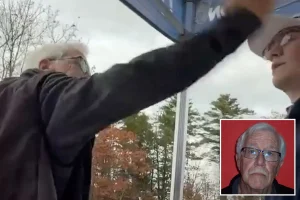



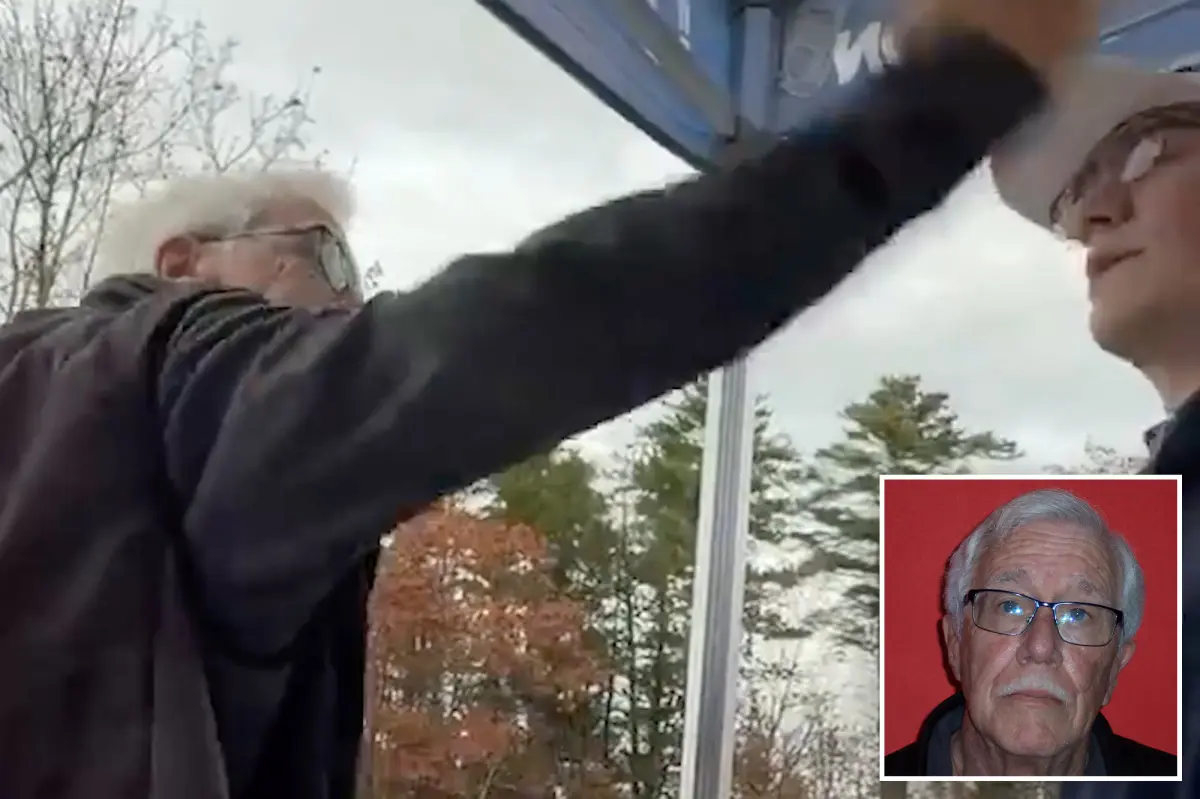
On a crisp New Hampshire election morning, the quiet streets of Laconia were meant to be filled with the simple rhythms of civic duty—parents walking toward the local elementary school, volunteers holding signs, neighbors exchanging small talk before casting their ballots. Instead, that familiar scene was shattered by a moment of raw, startling anger that would soon ripple across the internet. Outside the school, where voters were lined up to make their voices heard, a 70-year-old poet named Stephen Redic approached a tent set up by Turning Point Action, a conservative youth organization. Witnesses say he wanted to read a poem about rich people. What began as an odd, perhaps quixotic gesture quickly curdled into something far darker. Within minutes, the elderly man was shouting, gesturing rudely, and finally slapping an 18-year-old volunteer across the face. The viral video that emerged from the scene captured not just the violence, but the disbelief in the voices of onlookers, the sudden hush, and the chaos that followed. By Wednesday morning, police had arrested Redic, charging him with simple assault and disorderly conduct, and a community was left to wonder how a poem could have ended in such an ugly confrontation.
The footage from the incident is difficult to watch, not because it is gruesome, but because it is so uncomfortably human. The video shows the young Turning Point Action member attempting to engage in debate, standing his ground as the older man grows increasingly agitated. Redic’s voice rises, becoming hoarse with frustration, as he leans into the volunteer’s face. “You sit there and dare to look me in the face and say I don’t know anything?” he shouts, his anger boiling over. He shoves a finger in the young man’s direction, then delivers the line that seems to sum up his contempt: “That’s what I know.” And with that, he backhands the volunteer across the face. The slap is quick, almost casual in its dismissiveness, but its impact is immediate. Onlookers gasp audibly. Someone mutters about calling the police. The older man, seemingly unmoved, storms away, muttering an obscenity as he goes. Notably, the poem he had wanted to recite—the apparent spark for the entire confrontation—is nowhere in the footage. Whatever verses he had prepared about the wealthy, they were lost in the heat of the moment, swallowed by rage and replaced by a gesture that said more than any poem could. Laconia Police Chief Matthew Canfield later told reporters that Redic was unknown to them, that he had no prior contacts with law enforcement. In other words, this was not a man with a history of violence, but someone who, in a single flash of fury, crossed a line.
Who is Stephen Redic? In the aftermath of the incident, the public has been left to piece together a portrait of a man who seems an unlikely candidate for a viral assault video. Redic is a poet, and in 2023 he published a book of verse titled “Tying My Shoes.” In that book, according to reports, he boasted of having met every U.S. president since Dwight D. Eisenhower. It is a strange detail, one that conjures images of a man who has lived a long and varied life, someone who has moved through different circles and collected stories along the way. Perhaps he saw himself as a kind of elder statesman, a man with wisdom to share and truths to speak. That self-image makes the video all the more jarring. The man on screen is not a dignified orator but a furious figure, his voice cracking, his gestures wild, his patience gone. The contrast between the poet who wrote about lacing up his shoes and the man who lashed out at a teenager outside a polling place is stark. It suggests a deep well of frustration, perhaps political, perhaps personal, that had been building for a long time. Whatever the cause, the consequences are now real. Redic faces a misdemeanor charge of simple assault and a disorderly conduct violation. He is scheduled to appear in court for an arraignment on December 10. As of Wednesday afternoon, it was unclear whether he had retained an attorney, and he did not respond to attempts to reach him for comment. The legal process will now take over, and a man who once traded on his connections to presidents will have to answer for what happened in that schoolyard.
Yet this incident did not occur in a vacuum. It came fourteen months after a similar confrontation involving Charlie Kirk, the founder of Turning Point USA and its affiliate, Turning Point Action, at Utah Valley University. In that case, Kirk was reportedly attacked under a tent at a campus event, and a man named Tyler Robinson was arrested. Robinson has pleaded not guilty, and he is due in court for a hearing that could set a trial date. The parallels between the two episodes are hard to ignore: both involve Turning Point, both involve tents at public or campus gatherings, and both involve moments of political tension that escalated into physical violence. For many, these incidents feel like symptoms of a broader sickness—a culture in which political differences are no longer debated but fought, where anger is always simmering just beneath the surface, waiting for a trigger. The fact that the latest confrontation happened on an election day, outside a school where people were simply trying to vote, adds an extra layer of melancholy. Voting is supposed to be the ultimate peaceful act, the foundation of democracy. To see that sacred space violated by a slap, shouted obscenities, and the threat of police involvement is deeply unsettling. It reminds us that the divisions in this country are not confined to cable news segments or social media arguments. They spill out into our streets, our schools, our neighborhoods, and our ordinary lives.
The incident also raises uncomfortable questions about the nature of political engagement in America. Turning Point Action is a group that thrives on passionate, often confrontational advocacy. Its young volunteers are trained to engage with critics, to defend their beliefs, and to stand firm in the face of opposition. But being ready for a debate is not the same as being ready for a slap. The 18-year-old at the center of this incident was reportedly attempting to debate Redic when things spiraled out of control. It is impossible to know exactly what was said in the moments before the video begins, or what the poem about rich people was supposed to accomplish. Perhaps Redic was trying to provoke a reaction, to make a point about economic inequality, or to challenge the young conservative in a way he thought was clever. Instead, he let his emotions get the better of him, and in doing so, he became the very caricature of the angry, unreasonable opponent that many people fear. For the young volunteer, the encounter must have been terrifying—not just because of the physical slap, but because of the realization that a simple conversation about politics could turn violent in an instant. That fear is a corrosive force. When people are afraid to engage with those who disagree with them, they retreat into echo chambers. When they are afraid for their physical safety, they stop listening altogether. And when that happens, democracy suffers.
In the end, this story is not really about a poem, or a tent, or even about politics. It is about a man who, at seventy years old, allowed his anger to define him in a single, regrettable moment. It is about a teenager who showed up to do something he believed in and found himself on the wrong end of a stranger’s rage. It is about a community that watched it all unfold and was left to pick up the pieces. There is something profoundly sad about the image of Redic, a man who claims to have met every president since Eisenhower, reduced to shouting obscenities and slapping a kid outside an elementary school. Wherever his anger came from—whether it was rooted in genuine frustration with the wealthy, disgust at the political group in front of him, or something more personal—it did not serve him. It will now cost him time, money, and likely his reputation. For the rest of us, the incident is a warning. It is a reminder that words matter, that actions have consequences, and that the people we encounter in the heat of political battle are human beings with their own fears and hopes. The young volunteer may have been an opponent to Redic, but he was also someone’s son, someone’s friend, someone who had every right to stand there without being struck. As the court date approaches, one can only hope that both men take a step back and reflect on what happened. Maybe, in time, they will see each other not as enemies, but as two flawed people caught in a moment that got away from them. That might be the most human outcome of all.