







Discovering Shadows at Home
In the quiet suburbs of Searcy, Arkansas, where the Hoggatt family had built a life filled with routine joys and small comforts, an unsettling mystery began to unfold. Dutch Hoggatt, a professor at Harding University, was a man rooted in academia and family—his days spent in lectures on faith and ethics, his evenings shared with his wife Sharon and their grown daughter Cherisee, who lived nearby with her husband Mark Gregory. Their home, a well-kept house on a peaceful street, had always felt like a sanctuary, a place where laughter echoed from family gatherings and weekend barbecues. But one ordinary day, Dutch noticed something odd: a pair of his favorite old shoes, the ones he casually kicked off by the back door after a long day, had vanished. “I asked my wife if she had thrown them away, and she hadn’t,” he recounted later with a mix of confusion and mild irritation. What started as a fleeting thought soon snowballed. Food from the pantry began disappearing—snacks, half-eaten sandwiches vanished overnight. Chairs in the living room shifted subtly, as if someone had rearranged them in the dark. Doors creaked when no one was around, and a faint smell of unwashed clothes lingered in the air. Sharon dismissed it at first as forgetfulness, perhaps her own absent-mindedness in their busy lives, but Dutch felt a prickle of unease. He imagined pranksters or nosy neighbors, but deep down, a gnawing worry crept in, making him double-check locks and peer out windows at night. Mark and Cherisee, when told, shared nervous glances; Cherisee joked half-heartedly, “We’re going crazy together—doesn’t that mean we’re sane?” But the unease deepened, turning their home into a place of whispered suspicions, where every shadow seemed alive with hidden eyes watching.
The family’s mounting anxiety peaked when Dutch attended church one Sunday morning in late April, leaving Sharon alone with the growing list of peculiarities. Eager to ease her mind, Sharon decided to investigate a storage closet under the basement stairs, a seldom-used spot cluttered with old boxes and forgotten holiday decorations. As she opened the door and stepped inside, her heart raced with anticipation and fear—a mother’s instinct perhaps, honed over years of protecting her family. Deeper in, past the cobwebs and dust, her eyes widened in shock: a human leg, clad in jeans, protruded from behind a stack of storage bins. “There’s someone in there,” she gasped, her voice trembling as she backed out slowly, clutching the doorframe. Her legs felt weak, and she called for help, her mind racing with terrifying possibilities—was it a burglar? A deranged intruder? Or something even more sinister lurking in the damp corners of their basement? Mark, who had come over to visit, rushed downstairs with a baseball bat gripped tightly, his protective instincts kicking in as a husband and soon-to-be father. “Stay here,” he told his stunned wife and mother-in-law, his voice firm but laced with adrenaline. Confronting the intruder, he banged the bat against the frame, demanding, “Come out now!” The figure finally emerged, hands raised in surrender—a man looking disheveled and defeated, with wide eyes pleading for calm. In that tense moment, the family’s world tilted; they saw not a monster, but a human being, worn down by life’s hardships, huddled in their space like a ghost seeking refuge.
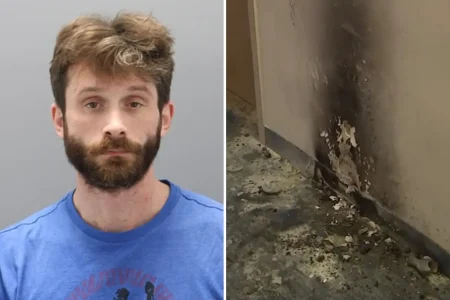
Preston Landis, as he introduced himself, was the unwelcome guest who had invaded their privacy. Authorities would later uncover his story: a homeless man with no fixed address, he had first slipped into the Hoggatts’ crawl space on April 27, perhaps lured by the open crawlspace vents or an unlocked window, a common flaw in older homes. He spent that night cramped and cold, surviving on scraps from the pantry he pilfered when the family slept. The next day, emboldened or desperate for more space, he migrated to the basement, transforming a tiny supply closet into a makeshift lair. He scavenged cushions for bedding, using empty boxes as walls, and stayed silent through hearings of footsteps overhead, his heart pounding with fear of discovery. When deputies from the White County Sheriff’s Office arrived with sirens blaring, Landis stepped out willingly, his shoulders slumped in resignation. He confessed to seeking shelter from the elements, the biting Arkansas nights that could freeze a man without a roof. Charged with residential burglary and theft of property, with a $15,000 bond set, Landis faced legal consequences that mirrored the family’s turmoil. But in the basement’s dim light, as handcuffs clicked shut, the Hoggatts glimpsed his humanity—the exhaustion etched into his face, the apologetic murmurs of a man who had trespassed not out of malice, but survival. Sharon’s hands shook as she recounted the encounter, tears welling up; she imagined her own vulnerabilities, how one bad turn could lead anyone to such depths.
For Cherisee and Mark, the revelation hit like a nightmare they couldn’t wake from. Cherisee, a devoted mom to their young children, felt violated yet sympathetic, flashing back to stories she’d heard of homelessness on the news—families torn apart, lives reduced to shadows. “I thought we were losing our minds,” she admitted, her voice breaking in interviews, “but seeing that leg… it was real. terrifying. And then, the guy comes out, scared and starving, and you just feel this pit in your stomach.” Mark, wielding the bat with protective fury one minute, felt remorse the next; he shared how the man had obeyed, emerging like a trapped animal, and in that instant, their home’s safety felt fragile. The family huddled together afterward, doors locked and alarms set, but conversations turned reflective. Dutch, ever the educator, pondered the ethics of it all—how a man could descend into such straits, and how their empathy, though tested, endured. They felt a strange gratitude that nothing valuable had been taken; tools and heirlooms remained untouched, a small mercy in the storm. Yet, the experience lingered, prompting late-night talks about security cameras, neighborhood watches, and the broader crises of poverty and mental health that could bring strangers into one’s world uninvited. Cherisee’s kids, blessedly spared the full fright, still sensed the tension, asking innocent questions that forced adult reassurances: “Monsters aren’t real, right, Mommy?” But for the Greggorys, it was a wake-up call, a reminder that danger lurked not just in news headlines, but in the quiet spaces beneath their feet.
As the days passed and Landis faced the courts, the Hoggatts’ story rippled outward, drawing sympathy from friends, neighbors, and even strangers who contacted them with stories of their own eerie run-ins with squatters. Dutch, in his thoughtful way, expressed a profound conflict: anger at the intrusion battled with pity for a fellow soul adrift. “I’m not angry at this man,” he said publicly, his words measured and kind, born from years of teaching compassion and faith. “I feel sorry for him. We’re glad we discovered him before this went on longer—it could have escalated, hurt someone.” Sharon echoed this, her matriarchal softness emerging; she baked extra cookies and donated to local shelters, channeling shock into action. Cherisee, meanwhile, grappled with vulnerability, her home now a symbol of false security. They installed motion-sensor lights, reinforced locks, and even reached out to Landis through intermediaries, learning he had slipped through cracks in society—no family support, no job to sustain him. The family pondered what led him there: addiction? Trauma? The relentless churn of economic hardship in rural America? Their empathy grew, turning outrage into advocacy; they spoke on podcasts about humane responses to homelessness, urging communities to bridge gaps before transgressions occur. In private moments, Sharon wept for the loneliness that drove a man to hide in another’s basement, imagining the chill of isolation that mirrored her own fears of aging alone. Dutch delved into research, exploring laws on trespassing and social services, his professor’s mind framing it as a societal failure. Cherisee and Mark prayed together, their marriage strengthened by adversity, vowing to protect their nest while extending grace.
Ultimately, the Hoggatts’ ordeal illuminated the fragility of home— a concept both literal and emotional, easily breached by unseen forces. No physical harm came, but the psychological scars lingered, a lesson in unpredictability. They emerged wiser, more vigilant, yet kinder, their narrative a testament to resilience and humanity. Preston Landis’s fate remained legal baggage, a cautionary echo, but in the Hoggatts’ recollections, he was not a villain, merely a casualty of circumstances. Cherisee often recalled the terror of that closet discovery, then the relief, fostering gratitude for small blessings. Mark, bat in hand metaphorically, now patrolled with empathy. And Dutch, ever philosophical, mused that such intrusions reveal truths: homes are sanctuaries only when society uplifts all. Their story, humanized by the raw emotions of shock, pity, and reflection, echoed in broader discourse on empathy versus security. In the end, the family rebuilt their peace, stronger bonds forged in the basement’s shadow, a reminder that even darkness can birth light through understanding. The White County Sheriff’s Office’s delay in commenting underscored bureaucracy’s numb response, but the Hoggatts moved forward, their voices amplified in hope that others might avoid similar scares by fostering a world where no one hides in helplessness. As seasons changed and the basement closet gathered dust once more, the family thrived, their home a beacon of compassion amid the uncertainties of life. The shoes, once lost, found a new purpose in donations; the missing food sparked meal drives. In humanizing their fear, they healed themselves and perhaps inspired change.