





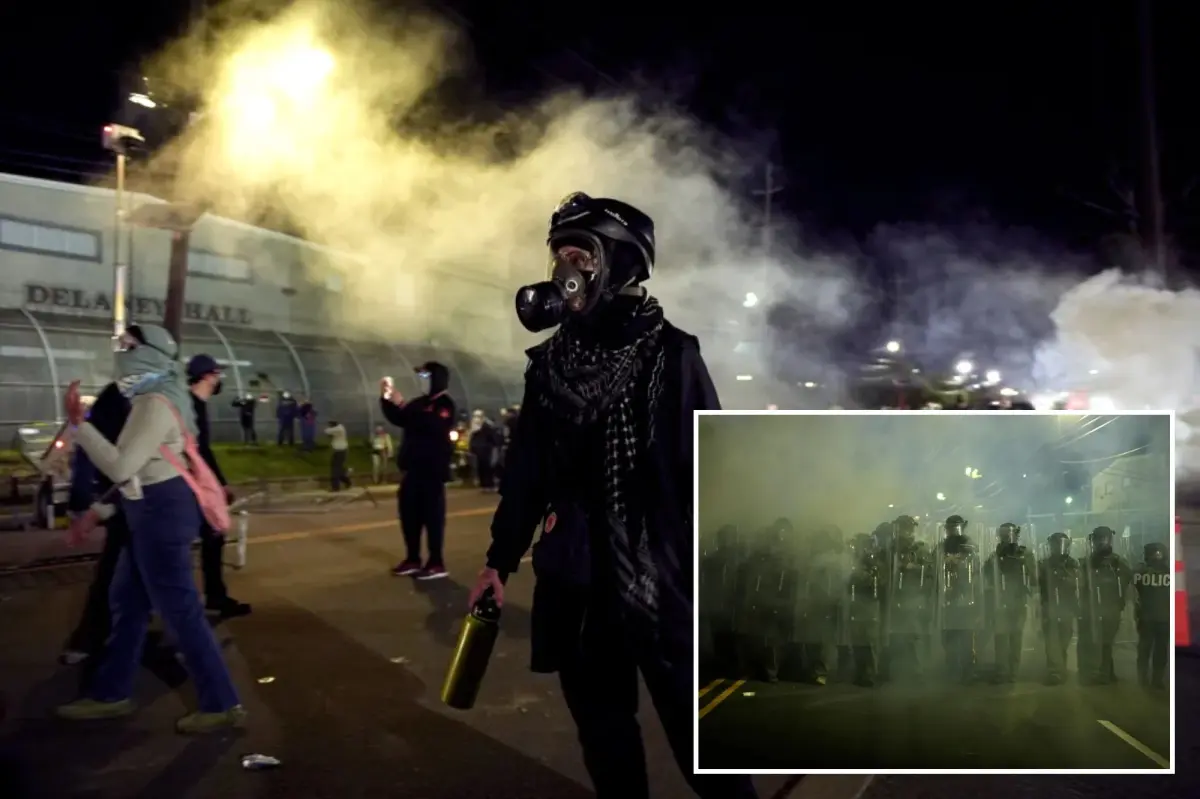
On a chilly, tension-filled Saturday night in Newark, New Jersey, the space outside Delaney Hall transformed from a site of peaceful advocacy into an absolute crucible of chaos. The detention facility, long a lightning rod for controversy due to its holding of immigrant detainees under contract with Immigration and Customs Enforcement (ICE), became the backdrop for a dramatic and physical escalation between passionate activists and heavily armed law enforcement officers. For hours, demonstrators had gathered along the perimeter, their voices raised in chants demanding dignity, freedom, and an immediate end to the dehumanizing practices of immigrant detention. However, the atmosphere shifted violently when a literal and symbolic “tug of war” erupted over a metal security fence separating the public from the heavily guarded institutional grounds. This fence, representing the stark boundary between state-sanctioned captivity and human empathy, became the focal point of intense friction as protesters attempted to dismantle or breach the barrier, prompting an immediate and heavy-handed tactical response from the police force stationed nearby. The physical struggle over the chain-link structure acted as a catalyst, instantly turning a demonstration of civil disobedience into a chaotic standoff where the raw, desperate desire to tear down systemic walls met the unyielding, rigid defense of state power.
The response from law enforcement was swift, overwhelming, and highly coordinated, resembling a military operation rather than standard civil policing. Backed by a massive fleet of at least twenty-five police vehicles that illuminated the dark Newark streets with a dizzying, anxious strobe of red and blue lights, officers clad in full riot gear and carrying protective shields advanced toward the crowd. Under the imminent threat of arrest, the authorities issued dispersal orders, but the tense standoff quickly deteriorated into sensory bedlam. Officers deployed chemical agents, smoke grenades, and flashbangs directly into the crowd to force their retreat. The explosive, concussive booms of the flashbangs shattered the night air, sending physical vibrations through the pavement and casting blinding flashes of light across the faces of fleeing demonstrators, while thick, acrid smoke from chemical canisters choked the atmosphere, stinging eyes and burning throats. Amidst the chaos, the ominous wail of sirens grew louder as an ambulance was seen rushing frantically toward the facility, a sobering and terrifying reminder to everyone present that the line between a political demonstration and a physical tragedy had been violently crossed on the asphalt outside Delaney Hall.
To truly understand the terror and gravity of that night, one must look through the eyes of those who stood on the pavement, such as Stephanie, a thirty-seven-year-old demonstrator who had traveled from New York to show solidarity with the detainees. Her experience encapsulates the sudden journey from hopeful activism to sheer survival instinct as the street erupted around her. “There was a tug of war over the fence. And then they brought the shields out on both sides of the street,” Stephanie recalled, describing the terrifying moments when the physical barriers between police and citizens dissolved into a kinetic clash. As the sky filled with the deafening cracks of flashbangs and the thick, suffocating plumes of smoke grenades, Stephanie felt the primal urge to run, leaving behind the organized line of defense to escape the enveloping fog of tear gas. Her vivid account of seeing protective shields advance from all directions and watching smoking projectiles arc through the night sky highlights the profound vulnerability felt by everyday individuals who choose to put their bodies on the line for social justice, transitioning instantly from vocal advocates to terrified fugitives running for their lives in the dark.
While the streets outside raged with physical confrontations, blinding lights, and exploding canister fire, an equally profound but silent drama was unfolding inside the walls of Delaney Hall itself. Inside the cold, sterile rooms of the facility, hundreds of immigrant detainees—fathers, mothers, brothers, and sisters caught in the labyrinthine and often indifferent machinery of the American immigration system—sat in agonizing suspense, listening to the muffled chaos outside. For those locked behind the concrete and steel, the distant booms of flashbangs, the screeching sirens, and the shouts of the crowd were a double-edged sword: a terrifying reminder of the volatile world just beyond their reach, but also a deeply comforting confirmation that they had not been forgotten by the outside world. The struggle on the streets was, at its core, a fight for their humanity, a loud and disruptive assertion that those held within Delaney Hall are not merely case numbers or political talking points, but real human beings with families, dreams, and an inherent right to dignity. The contrast between the loud, chaotic violence of the street protest and the quiet, desperate hope of the detainees inside serves as the emotional heart of this conflict, illustrating the human cost of a system that commodifies and confines human lives.
Saturday night’s explosive confrontation was not an isolated incident of unrest, but rather the climax of a grueling, multi-day cycle of escalating tension and resistance at the controversial Newark complex. The community’s anger had been building steadily throughout the week, fueled by a deep-seated frustration with the persistent use of local facilities to detain migrants, leading to successive nights of high-stakes demonstrations. Just days prior, the streets had witnessed similar clashes, resulting in nine arrests on Thursday and another six arrests on Friday as police consistently sought to suppress the growing crowds. This escalating tally of detentions reflects a determined, unyielding community resolve; despite watching their fellow activists get tackled, handcuffed, and carted away night after night, protesters continued to return to Delaney Hall, refusing to be intimidated by the looming threat of criminal charges or police physical force. While it remained unclear exactly how many individuals were ultimately swept into police custody during the chaotic melee on Saturday, the sustained pattern of arrests underscores a deep, systemic friction between a community demanding human rights reform and a municipality committed to maintaining administrative order at all costs.
Ultimately, the smoke that settled over Newark on Saturday night left behind a landscape charged with deep moral questions and an unresolved struggle that extends far beyond the perimeter of Delaney Hall. This violent clash stands as a stark microcosm of the immigration debate surrounding privatization, enforcement, and the militarization of local police forces acting in response to public dissent. When the state deploys tear gas, riot shields, and armored fleets against its own citizens to protect a facility that locks up foreign nationals seeking a better life, it forces a critical evaluation of society’s collective values. The fences at Delaney Hall may remain standing, reinforced by the physical might of law enforcement, but the passionate cries of the protesters and the lived trauma of the detainees inside ensure that the demand for systemic reform will not be easily hushed or swept away. As the community heals from the physical and emotional wounds of this chaotic weekend, the enduring spirit of solidarity demonstrated on those Newark streets serves as a powerful reminder that as long as human beings are kept in cages, there will always be those willing to stand in the dark, face the smoke, and fight for their liberation.