





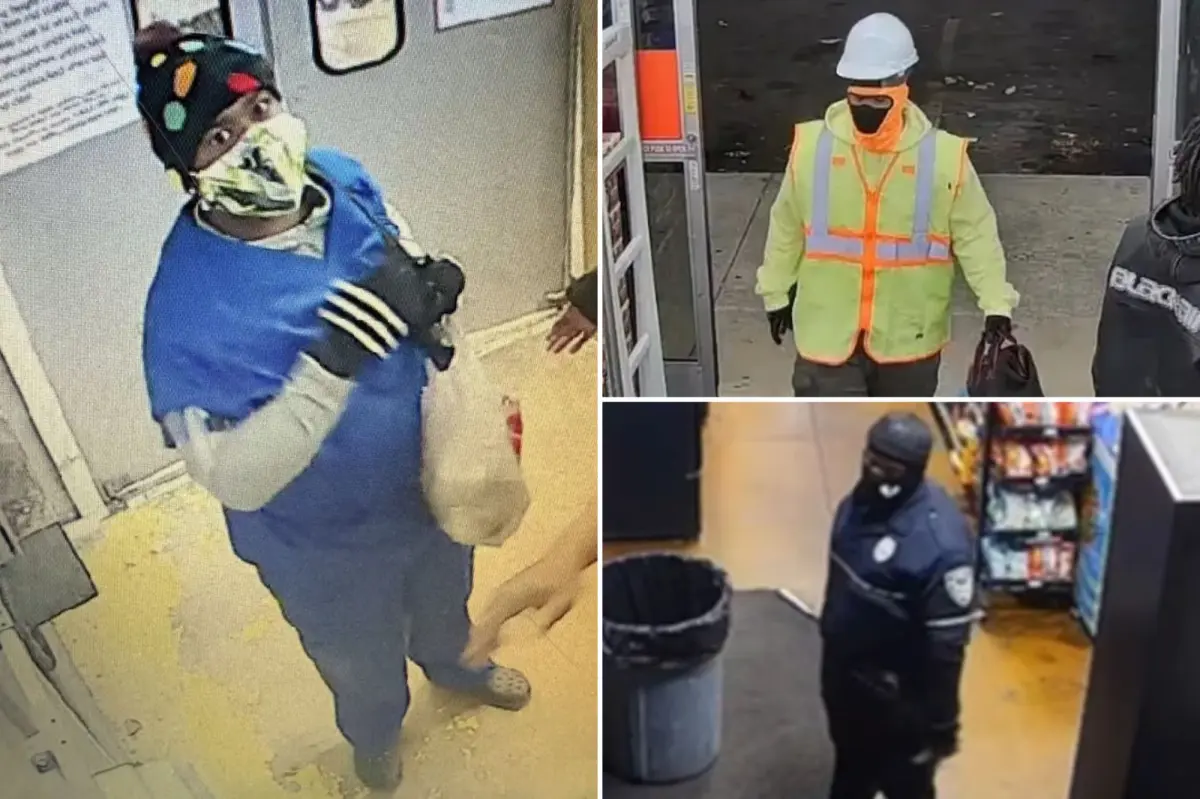
For the ordinary retail workers who keep our communities running late into the night, the workplace is supposed to be a space of routine transactions, a predictable environment of bright fluorescent lights, the quiet hum of refrigeration, and brief, friendly interactions with late-night commuters. However, across the metropolitan Atlanta area, that mundane reality was shattered over a harrowing several months by a threat that seemed to morph with every appearance, leaving employees in a state of constant, paralyzing dread. Tracy Daryl Mingo, a 33-year-old resident of College Park, Georgia, is now facing the full weight of the federal justice system after allegedly orchestrating what prosecutors have described as a ruthless, months-long “reign of terror.” Dubbed the “Master of Disguise” by investigators, Mingo is accused of transforming ordinary shopping runs into scenes of sheer terror, targeting ten different commercial establishments at gunpoint between October 2025 and January 2026. The geographic scope of his alleged crime spree reflects a calculated, predatory pattern that stretched across multiple jurisdictions, leaving a trail of deeply traumatized workers in College Park, Decatur, East Point, Fairburn, Marietta, and Union City. For the clerks, cashiers, and sandwich artists working the late shift, the fear was not merely about the loss of daily revenue, but the sudden, terrifying confrontation with a lethal weapon held by an unpredictable stranger. These late-night establishments, including Circle K convenience stores, Subway restaurants, and Family Dollar retail locations, became the hunting grounds for a man who seemed to view the hardworking individuals behind the counters not as human beings with families and lives, but as mere obstacles standing between him and a cash drawer. The psychological toll on these communities was immense, as each subsequent robbery amplified the collective anxiety of retail workers who wondered if they would be the next target of an elusive gunman whose true identity remained cloaked in shadows, turning the simple act of showing up for a night shift into a high-stakes gamble with survival.
What made these armed robberies particularly insidious and deeply unsettling to both the victims and the public was Mingo’s deliberate manipulation of societal trust through his choice of disguises. In a modern society, we are conditioned to look at certain uniforms as symbols of safety, utility, and care—we trust the construction worker directing traffic, we find comfort in the presence of a healthcare professional, and we feel secure when we see a security guard patrolling a property. Mingo allegedly weaponized this subconscious trust, systematically altering his physical appearance from one heist to the next to blend seamlessly into his surroundings before revealing his violent intent. During some of his alleged raids, he would walk into a store dressed in high-visibility gear mimicking a construction laborer; in others, he wore scrubs resembling a dedicated medical worker, or donned the authoritarian apparel of a professional security guard. This elaborate masquerade allowed him to approach his targets without raising immediate alarm, effectively disarming the natural vigilance of employees who might otherwise have been suspicious of a late-night visitor. Once he bypassed their initial defenses, the illusion would instantly shatter as Mingo allegedly produced a handgun, transforming a seemingly harmless encounter into a life-or-death crisis. By exploiting these daily archetypes of labor and service, he did not just steal money; he violated the shared social contract that allows individuals to interact safely in public spaces, leaving his victims with a lingering, deeply ingrained paranoia that makes it difficult to trust even the most familiar faces in their everyday environments.
The task of stopping this elusive predator fell upon a dedicated coalition of local police departments and federal investigators who refused to let administrative boundaries hinder their pursuit of justice. Tracking a suspect who constantly alters his physical appearance presents a monumental challenge for law enforcement, as standard security camera footage can often mislead investigators into looking for entirely different suspects. Recognizing the sophisticated nature of the threat, the Federal Bureau of Investigation’s Atlanta Field Office stepped in to coordinate a massive, multi-jurisdictional intelligence-sharing effort, bridging the gap between the various local police forces in College Park, Decatur, East Point, Fairburn, Marietta, and Union City. Detectives worked tirelessly behind the scenes, meticulously cross-referencing surveillance videos, analyzing ballistics data, comparing witness testimonies, and mapping out the temporal and geographic patterns of the robberies to build a comprehensive profile of the offender. This collaborative synergy was highlighted by U.S. Attorney Theodore S. Hertzberg, who expressed immense pride in the combined efforts of the FBI and local police partners to neutralize the threat before any innocent lives were tragically lost. Marlo Graham, the special agent in charge of FBI Atlanta, emphasized that Mingo’s reliance on disguises ultimately underestimated the relentless determination of the law enforcement community, pointing out that while the suspect believed he could evade detection by changing his clothes, he could not outrun the unified strength and analytical precision of a coordinated police network dedicated to protecting vulnerable workers.
The dramatic culmination of this high-stakes manhunt occurred on the chilly evening of January 2, 2026, bringing a sudden end to the suspect’s months of evasion and restoring a sense of safety to the traumatized region. Law enforcement officers, who had been maintaining tight surveillance and analyzing the suspect’s behavior patterns, finally closed in on Mingo as he prepared to strike yet again. In a striking twist of fate, investigators apprehended Mingo at the very moment he was allegedly preparing to don the exact same security guard disguise he had utilized just twenty-four hours earlier during a brazen robbery at a Circle K convenience store. This critical mistake—reverting to a previously used persona—proved to be his undoing, highlighting the reality that even the most meticulous criminal strategies eventually succumb to human error and the pressure of a closing dragnet. The arrest was a powerful, redemptive moment for the dozens of investigators who had spent sleepless nights worrying about the safety of local retail employees, and it sent a wave of relief through the late-night retail community of metropolitan Atlanta. By catching Mingo in the physical transition between his civilian identity and his criminal persona, police not only secured crucial physical evidence connecting him directly to the crimes, but they also prevented what would have almost certainly been another terrifying armed confrontation, proving that the meticulous, invisible web woven by law enforcement was far stronger than any costume Mingo could construct.
With the physical threat neutralized, the battleground shifted to the federal legal system, where the full gravity of Mingo’s alleged actions was formally laid bare in a sweeping twenty-count indictment. On July 28, a federal grand jury returned a comprehensive true bill against Mingo, charging him with a litany of severe offenses, including multiple counts of Hobbs Act robbery, attempted Hobbs Act robbery, brandishing a firearm during a crime of violence, and being a convicted felon in possession of a firearm. The inclusion of the Hobbs Act is a particularly significant legal escalation, as this federal statute is reserved for robberies that obstruct, delay, or affect interstate commerce, thereby elevating what might otherwise be local crimes into the realm of federal prosecution with devastating sentencing guidelines. Each count of brandishing a firearm during a violent crime carries severe, consecutive mandatory minimum sentences, culminating in a staggering minimum of 63 years in federal prison if Mingo is convicted on all counts. This massive potential sentence reflects the justice system’s recognition of the profound psychological and physical trauma inflicted upon the victims, ensuring that if convicted, the 33-year-old Mingo will likely spend the remainder of his natural life behind bars. Currently held without bond in the strict custody of the United States Marshals Service, Mingo’s transition from a free-roaming, disguised predator to a prisoner in a federal holding facility underscores the absolute finality of federal law enforcement’s intervention, turning his calculated “reign of terror” into a stark cautionary tale of the severe consequences of armed violence.
Ultimately, the story of Tracy Daryl Mingo is not merely a chronicle of clever disguises and police tactics, but a deeply human narrative about the vulnerability of working-class citizens and the collective responsibility of society to protect them. The victims of these robberies were not corporate executives or wealthy individuals; they were everyday people working demanding, low-wage shifts to support their families, pay their rent, and build their lives in the suburbs of Atlanta. To be forced to look down the barrel of a loaded gun while simply trying to perform one’s job is an experience that inflicts invisible, long-lasting scars, shattering an individual’s sense of personal safety long after the physical threat has been removed. The resolution of this case serves as an important reminder of the vital role that collaborative law enforcement plays in defending the most vulnerable segments of our workforce from those who would exploit them for quick financial gain. As Mingo awaits his trial in federal court, the communities he terrorized can finally breathe a collective sigh of relief, knowing that the streets are safer and that the voices of the retail workers who stood terrified behind those counters have been heard and vindicated. The empty promise of a criminal disguise has faded, leaving behind only the stark reality of accountability, the resilience of the survivors, and the enduring truth that justice, though sometimes slow, possesses an unyielding gaze that no mask can ever truly hide.