






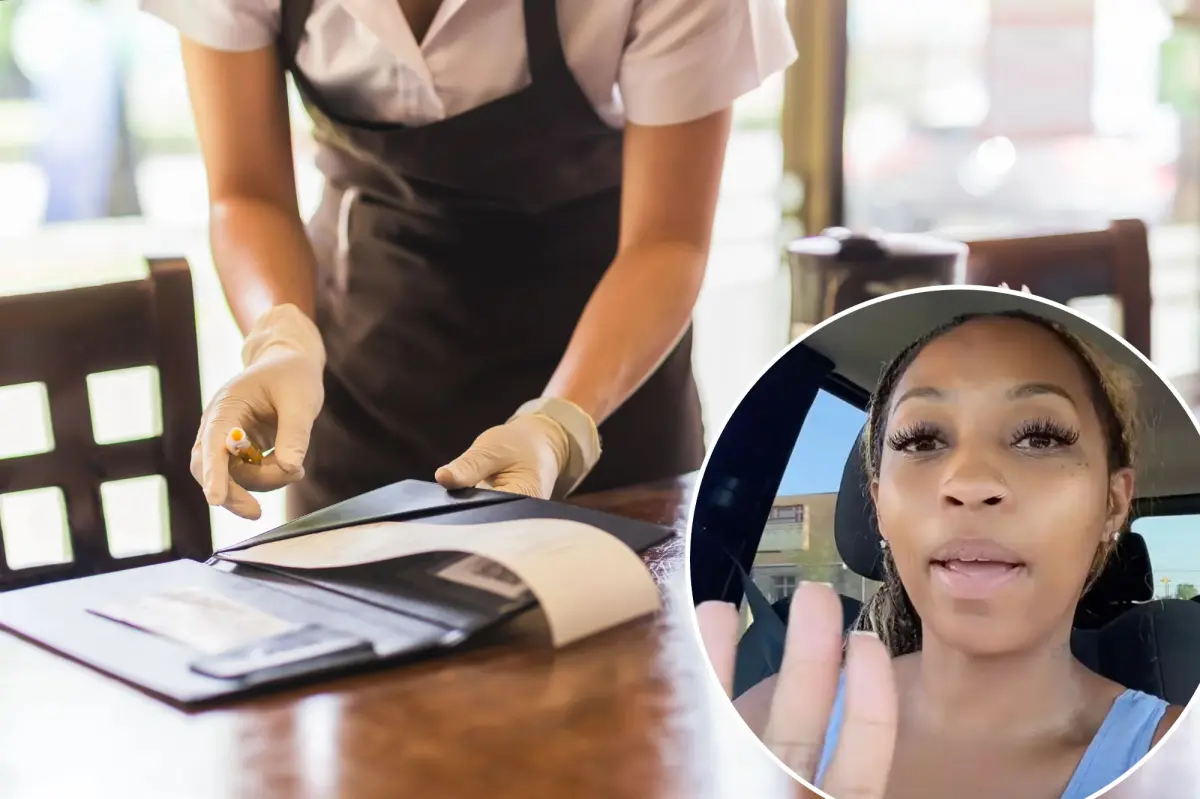
A server walks up to a table with a check, a smile, and a quiet hope. The meal went well, the drinks were refilled, the bread basket never sat empty. But what happens next can change an entire shift. A self-identified waitress recently took to social media with a simple, no-nonsense message for diners everywhere: gratuity is not a tip. “Gratuity is gratuity, and a tip is a tip,” she said in a TikTok video that has since made its way around the internet, reigniting an old, heated, and deeply American conversation about who owes what, to whom, and why. She did not expect to become the face of a tipping debate. She was just tired. Tired of watching customers stare at the bold line on their receipt that said “gratuity included” and then decide they had done enough, unaware of what happens to that money after the hostess collects the check. The video struck a nerve, drawing thousands of comments from people who either felt seen, misunderstood, or simply angry. On TikTok, her original post collected more than three thousand comments; an Instagram repost drew over eight thousand. In that flood of reactions, a larger truth emerged: Americans are exhausted by tipping, but few can agree on what the rules actually are.
When the waitress explained her point, she described the mechanics of a system that many customers never think about. That automatic gratuity charge, often added to large parties or certain checks, is not a bonus delivered neatly into the server’s pocket. It is a pool, a service charge, a shared pot that gets divided among a team of people who made the meal possible. Out of that gratuity, the waitress said, she has to pay the bartender who mixed the drinks. She has to pay the barback who restocked the liquor and carried the kegs. She has to pay the bussers and the support staff who cleared tables and kept the floor clean. So when a guest points to the receipt and says, “Gratuity is included,” the server hears something different: “You’ve already been covered.” But the person who actually waited on them, refilled their water glass, checked on their food, and asked about allergies might receive only a fraction of that fixed charge. In her view, a true tip is something extra, a direct acknowledgment of service, a way of saying, “You took care of me, and I see you.” A gratuity is the baseline infrastructure that keeps the restaurant running. She put it bluntly: if your server is treating you right, keeping your space clean, being responsive, and simply being great, then you should tip. And then she added the line that boiled so many people’s blood: “If you can’t afford to tip, then you shouldn’t be out, plain and simple.” It was harsh, unvarnished, and honest in the way that only someone who has spent years working on their feet can be.
The backlash came quickly, and it was loud. One TikTok user wrote that “this is what people are talking about when they say tip culture is out of control. Gratuity is definitely a tip.” Another commenter, clearly annoyed, said that servers need to take their grievances up with their employers, not with the people who are already paying for a meal and then being asked to pay more. “I’m not tipping on gratuity. So you shouldn’t work at an establishment that strictly requires gratuity. Telling people they shouldn’t be out is rude! Because really and truly tipping is optional!” A third commenter, who claimed to have served for years, added, “Gratuity is the formal word for ‘tip.’ Please stop.” That particular phrase, “gratuity is the formal word for a tip,” is hard to argue with in a dictionary sense. The word gratuity, after all, has always meant a gift of money, a thank you, a voluntary gesture of appreciation. In fine print on menus everywhere, the word appears alongside percentages and service charges. But the waitress was not trying to rewrite the dictionary. She was trying to describe how the money actually moves. And in that effort, she exposed a gap between language and labor. Some commenters did see that nuance, but they still held to their position: if a restaurant decides to split gratuities among the team, that is a business decision, not the customer’s burden. One commenter said, “The breakdown of how it is divided is beyond the customers’ responsibility. To expect an additional 20% on top of 18% gratuity seems to be something you need to take up with your employer.” Another was quicker and sharper: “Still a tip if you get a cut.” The implication was clear. If the money is being distributed among staff, it is still part of the tipping system. Calling it something else, from the customer’s perspective, felt like a disguise.
But behind the arguments and the angry comment sections, there is a bigger story about how American tipping culture has mutated into something that nearly everyone hates but nobody can escape. A recent survey from Popmenu found that 78 percent of customers believe tipping practices “have become ridiculous.” Two-thirds of customers said they felt pressured to leave a tip even when they received poor service. That number alone speaks to the social anxiety that surrounds the payment screen. The rise of digital payment systems has changed everything. There was a time when tipping happened in cash, discreetly, or by writing a number on a paper slip. Now, after every coffee, every sandwich, every slice of pizza, a glowing screen turns toward the customer with percentage buttons: 15, 20, 25, 30, even higher. The transaction becomes a public performance of generosity. A 2025 survey from Talker Research found that the amount Americans spend on guilt-induced tipping fell 38 percent, from $453 to $283, between 2024 and 2025. That suggests a growing number of customers are deliberately choosing not to be swayed by the pressure. They are clicking “no tip” and walking away with a strange mix of relief and shame. It is a strange dynamic. The customer feels nickel-and-dimed; the worker feels invisible. The restaurant owner feels squeezed by rising costs. And the one thing that remains constant is that the service worker is the one who has to look the customer in the eye and hope that the math works out in their favor. This is not just a conversation about etiquette. It is a conversation about the economy, about a system that effectively outsources wages to customers, about a country that has never really decided how to fairly pay people who serve us food and drinks.
In some ways, the waitress in the video was offering a defense of the customer, not an attack on them. She was saying, “You are not responsible for the bartender, the barback, the bussers, and the host.” She was saying, “That automatic gratuity is going to the team, not just to the person who served you.” But that distinction collapsed in the replies because no one can agree on what the customer is actually paying for. If a service charge is mandatory, then it is not a tip; it is a price. If a restaurant labels it “gratuity” and automatically adds it, most customers reasonably assume that the server has already been taken care of. If the restaurant then divides that amount among a larger team, that is an internal decision. The customer has no way to verify it, no way to control it, and no reason to trust it. The waitress’s advice, to add a tip on top of the gratuity, feels like an ask for double compensation. But her life, and the lives of millions like her, depends on this fragile arrangement. In many states, tipped workers still earn a base wage far below the standard minimum wage, relying on gratuities to close the gap. When a table refuses to leave anything beyond an automatic gratuity, the server might finish a busy night with less than the cost of a tank of gas. That is why her words carried such emotional weight. She was not being greedy. She was being desperate, tired, and honest. And the real problem is not between customers and servers at all. It is between all of them and a system that refuses to change.
The debate over gratuity versus tip is not merely a matter of vocabulary. It is a symptom of something deeper: a growing unease about who is responsible for paying the people who make our lives more pleasant. Words matter because they shape expectations. When a receipt says “gratuity included,” it feels final. It feels like the debt has been paid. But the waitress’s message, however controversial, asks us to pause and consider the human being standing on the other side of that receipt. She does not want pity. She does not want a lecture about business models. She wants to be seen. A tip is not just a transaction; it is a recognition that someone did something for you. Whether the word gratuity is a synonym for tip or a separate thing altogether, the deeper point is that our reluctance to talk honestly about money and service has created a culture of confusion, frustration, and resentment. Customers want fair prices and no surprises. Servers want a livable wage and the freedom to work hard without begging. Restaurant owners want to stay in business without being cast as villains. None of those wants are unreasonable. But until the conversation moves beyond the receipt, beyond the comment threads, beyond the guilt and the gratuity, nothing will truly change. Perhaps the best we can do is be more thoughtful. More generous when we can. More understanding when we cannot. And when we look at that line on the bill, maybe we can remember that someone typed it, someone printed it, someone handed it to us with a smile. Gratuity or tip, it is more than a word. It is a paycheck, a future, a story. And the next time a server says, “Gratuity is included, but a tip is not,” we might not agree with the semantics, but we can understand the need. We can choose to be kind. We can choose to be human.