





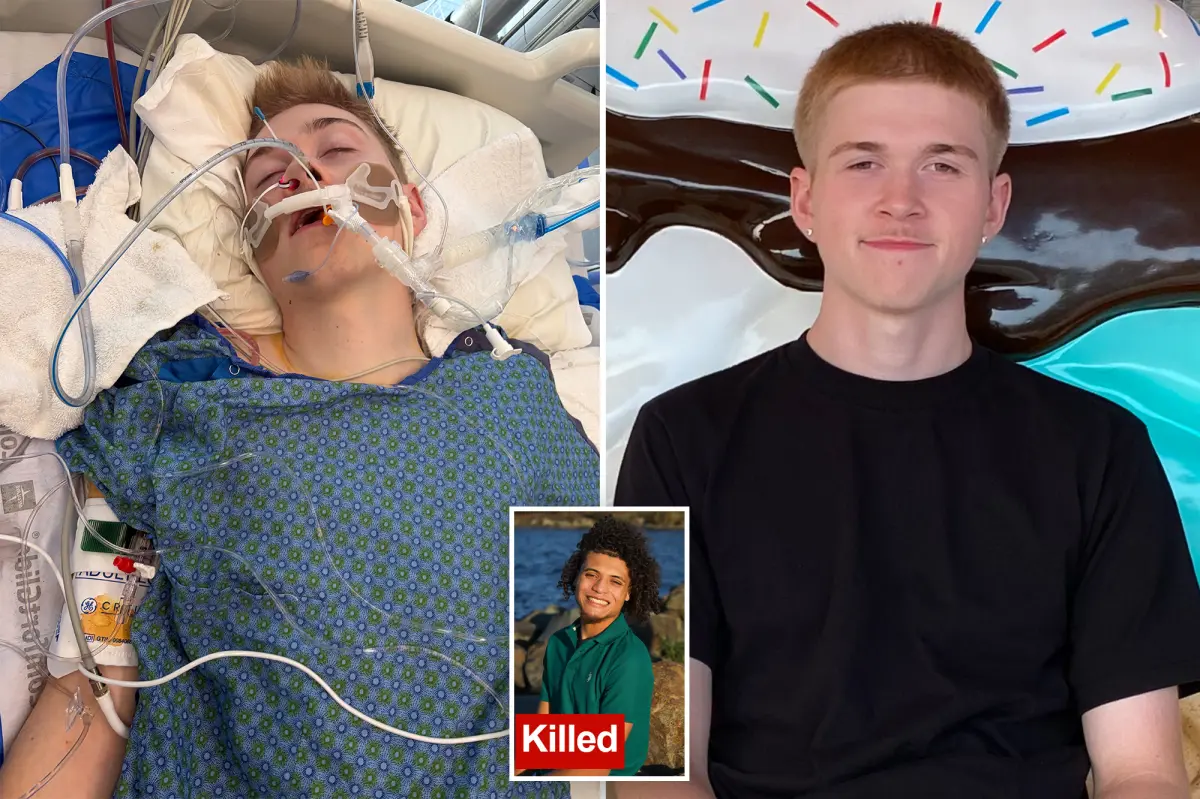
In the hazy, adrenaline-fueled hours of a Sept. 6 morning in Seattle’s Belltown neighborhood, the city’s usual drone of traffic and distant sirens was replaced by something more sinister—an illegal street takeover. Cars spun in dizzying circles, engines roaring, tires shrieking against the asphalt, painting an ephemeral canvas of smoke and danger. Among the crowd of onlookers and participants were two young friends, 21-year-old Matthew Lanske and 20-year-old Isaac Elijah Rios, two ordinary men swept up in the magnetic chaos of a late-night scene that promised nothing but momentary excitement. They had no idea that this night would transform into a waking nightmare, a crucible of impossible choices and harrowing loss. As the spectacle unfolded, a man and a woman emerged from the shadows of the streetlights, their intentions as dark as the abandoned industrial corners surrounding them. They weren’t there to watch the cars; they were there to exploit the confusion. With sudden, terrifying speed, a gun was drawn, not as a deterrent but as a tool of violent robbery aimed directly at Isaac. In that heartbeat, the sound of squealing tires faded into the background, replaced by the raw, blood-pounding silence of imminent danger. Matthew, standing just steps away, felt the world narrow to a single imperative: his friend’s life was in peril, and he could not—would not—stand idly by.
With the reckless, instinctive bravery of a man who acts before fear can paralyze him, Matthew Lanske plunged into the line of fire. The gunshot was a brutal, concussive crack that echoed off the concrete and steel of the surrounding buildings, shattering the night’s fragile peace. Isaac Rios, a former high school football player with a life full of untold promise, took the fatal bullet, collapsing onto the gritty pavement as if the strings of his existence had been abruptly severed. Matthew, however, did not retreat. He surged forward, attempting to shield his friend, to somehow undo the irreversible damage that had just been done. But the gunman turned, and the weapon barked again—and then again. Hot lead tore through Matthew’s stomach, ripping through soft tissue with savage ease. Another bullet struck his pelvis, shattering the bone into fragments and severing a major artery, unleashing a catastrophic flood of internal and external bleeding. The pain was apocalyptic, a blinding white-out that threatened to swallow his consciousness. Yet, astonishingly, his will refused to break. He did not simply fall and wait for death. His body, broken and leaking, was driven by a primal motor of survival. He forced his legs to move, chasing the gunman in a desperate, staggering pursuit, leaving a grotesque crimson trail that marked his path across the sidewalk. He knew, with awful clarity, that he was dying. He could feel the warmth of his life ebbing away with every heartbeat, and he knew that his only hope lay in reaching the glowing beacon of a convenience store just ahead—a place of fluorescent lights, potential witnesses, and a phone to call for an ambulance.
Matthew Lanske reached the glass doors of that convenience store, his vision swimming in and out of focus, his hands slick with his own blood as he pressed them against the cold surface. He found the handle, yanked it, but it was locked. He pounded on the glass, each thud sending shockwaves of agony through his shattered pelvis. He begged. The words that escaped his lips were not coherent pleas but primal, desperate screams for liberation from death: “Please! Call 911! I’m bleeding out! Let me in!” He looked through the glass and saw the employees inside. They saw him too. They saw his blood-soaked clothes, the horrifying pallor of his face, the way he clutched his stomach trying to hold his intestines inside his body. And then, instead of rushing to unlock the door, they took a step back. They raised their phones. They began to film him. The glass transformed from a barrier of safety into a screen, separating a dying man from his own salvation. They were not first responders; they were content creators. They watched him slide down the glass, leaving a thick, dark smear as his strength failed, prioritizing a viral video over a human life. Later, when Matthew would be reunited with his mother, Shanda Barney, in the sterile quiet of his hospital room, the memory of that moment would break him apart again. He would tell her, his eyes filled with tears that mirrored the blood he had shed, “Mom, they wouldn’t let me in. They locked the doors. I begged them to let me, and there was so much blood coming out of my stomach, I thought I was going to die.” It was a formal declaration of humanity’s failure, and it wounded his mother more deeply than the bullet wounds themselves.
Out on the street, the scene was an even more grotesque tableau of modern apathy. The initial chaos of the street takeover had been replaced by a macabre, silent circus. People who had been filming donuts and burnouts now turned their lenses on the two dying young men. Isaac Rios lay on the unforgiving concrete, a vibrant life extinguished, his body becoming a mere object of observation. His aunt, Beneta Lal, would later capture the horror in a heartbreaking GoFundMe post, writing, “In those terrifying moments, Isaac and his friend were shot and left to die, all while being filmed. Isaac was found on the sidewalk, bleeding and fighting for his life … despite every effort to save him, he did not survive.” The words sting with the bitter truth of the situation—no effort was actually made by the crowd. Those around him didn’t phone for help, didn’t apply pressure to his wounds, didn’t scream for anyone to stop the bleeding. They simply watched. They zoomed in on the tragedy, capturing the final moments of a twenty-year-old boy’s struggle for existence, perhaps to post on social media with a hashtag or a sad emoji. This is the chilling legacy of a digitally saturated society: the atomization of empathy. The bystander effect has evolved into a predatory form of passive consumption, where a human tragedy is reduced to a piece of consumable media. While Matthew fought against the odds inside the store’s threshold, Isaac was left to die alone under the cold, indifferent gaze of a crowd that could have been his salvation. The cameras were not recording evidence for justice; they were capturing trophies of morbidity. This callousness became a second wound for the families, a violation of dignity that cut as deeply as the bullets themselves.
Matthew Lanske did survive, though the word “survive” carries a cruel weight of new burdens. Rushed to the hospital, he underwent multiple grueling surgeries to repair the devastating damage inflicted by the bullets. Surgeons worked for hours to reconstruct his shattered pelvis, to repair the torn artery that nearly bled him dry, and to remove the lead that had embedded itself in his torso. When he finally woke up in the sterile confines of the intensive care unit, the weight of the world descended upon him. His body was a patchwork of incisions and tubes, a physical monument to the violence he endured. But the physical pain was eclipsed by the psychological devastation. He asked about Isaac. He had to know if his friend was okay, if his sacrifice had meant something. The news, delivered with gentle but devastating clarity, informed him that Isaac Rios had died on the sidewalk. The guilt that followed was immediate and overwhelming. His sister, Brooklynne Lanske, would articulate this profound torment to reporters, saying, “He has, I feel like, survivor’s guilt, you know. He wanted to save his friend so bad, and he woke up to so many changes.” In the quiet hours of his recovery, Matthew is haunted by a relentless loop of “what ifs.” What if he had been faster? What if he could have pulled Isaac out of the way? What if he had died instead? He faces a long and arduous road of physical rehabilitation, learning to walk again on a pelvis that was shattered, but the true battle lies within his mind. He cannot escape the image of his friend falling, the sensation of his own blood pooling, or the memory of those heartless faces behind the glass, filming his agony. He is now a survivor burdened with a guilt that is impossible to rationalize away, a young man forever changed by a night of extraordinary, if futile, heroism.
As the families grapple with their devastating new reality, they are united in a desperate demand for justice. They are appealing to the witnesses—the same ones who filmed instead of helped—to do the right thing now and contact the police. They know that those videos hold the key to identifying the gunman, even if they lack the key to basic human decency. Crime Stoppers of Puget Sound has offered a meager $1,000 reward for information leading to an arrest, a sum that feels insultingly trivial against the backdrop of a lost life and a shattered soul. But this tragedy is more than a single criminal case; it is a stark, unflinching mirror held up to the soul of our culture. It forces us to confront the uncomfortable question: What have we become when our instinct to record eclipses our instinct to rescue? Matthew Lanske chose to throw himself into the breach for his friend, demonstrating a primal, selfless courage that should define humanity. The store workers and the spectators chose to watch through a screen, choosing spectacle over salvation. In a city of millions, a man was left to bleed to death while his audience curated his demise for the digital world. As Matthew lies in his hospital bed, grappling with survivor’s guilt, and as Isaac’s family mourns a future that will never be, there is a deep, aching hope for justice. But there is an even more profound hope that the revelation of this unconscionable apathy will spark a reckoning. The streets of Seattle will undoubtedly see more takeovers, and tragically, more violence. The question that lingers in the air, thick as the smoke from those spinning tires, is whether we will choose to reach out with our hands to help, or simply raise our phones to film. The blood of Isaac Rios and the lingering trauma of Matthew Lanske demand an answer—a reclamation of our collective humanity before it is lost forever.