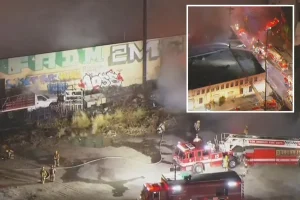






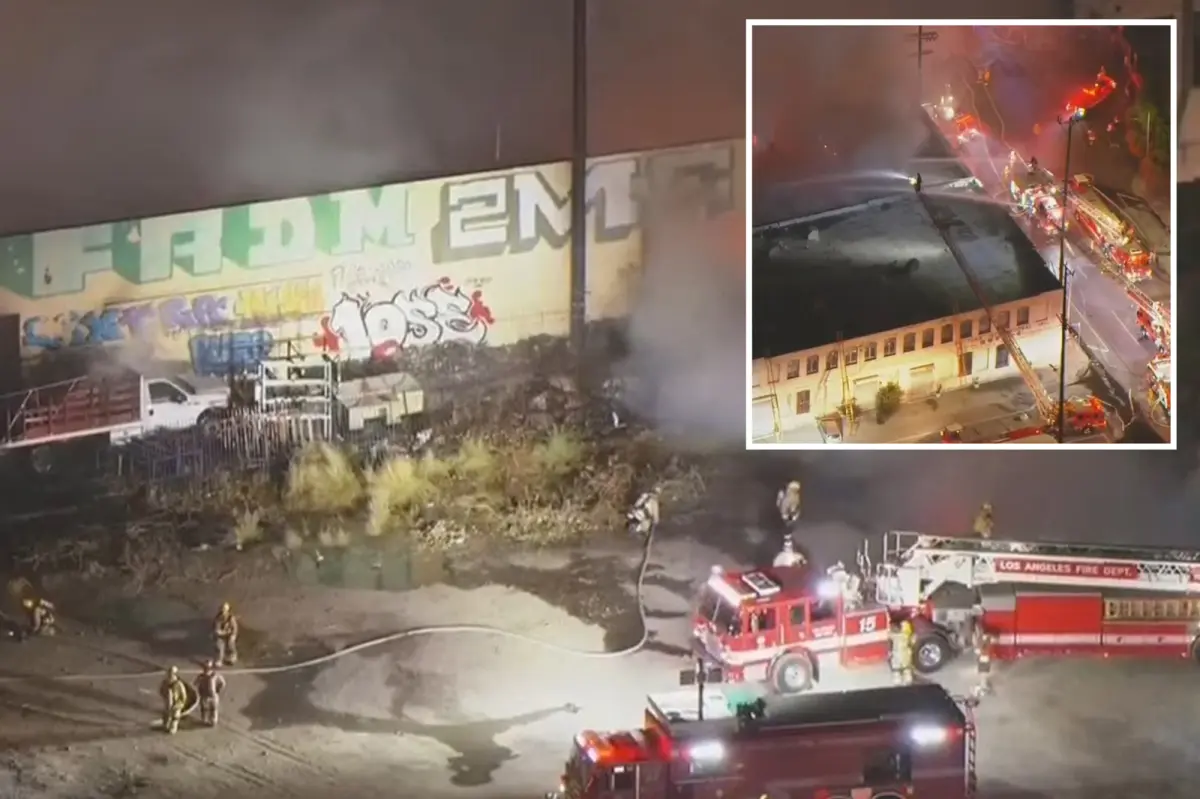
Thursday night in Los Angeles’ Chinatown began like so many evenings in that storied neighborhood: streetlights casting a soft glow over sidewalks, the savory scents of late-night kitchens drifting through the air, and the steady hum of traffic along North Main Street. But just after 7 p.m., that familiar rhythm was broken by the unmistakable sound of emergency sirens. A fire had broken out along North Main, initially burning in an outdoor space before spreading into a one-story commercial building just north of downtown. The Los Angeles Fire Department rushed multiple crews to the scene, and within minutes, what had been a typical city block was transformed into a bright, loud, and tense staging ground. Red and blue lights pulsed off nearby storefronts, and residents, workers, and passersby stopped in their tracks, phones raised, trying to make sense of the smoke curling upward. For a neighborhood like Chinatown—one of the most historically and culturally significant communities in the city—the arrival of a structure fire is not just a logistical emergency. It is a disruption of the daily rituals that define the area: the exchange of greetings between shopkeepers, the delivery of fresh produce to restaurant kitchens, the quiet routines of families living above businesses. That Thursday night, all of those rhythms were put on hold as the city’s first responders moved in to confront the flames.
Fire crews quickly went to work, positioning trucks and laying hose lines to attack the blaze from as many angles as possible. According to the Los Angeles Fire Department, the fire had started outside before finding its way inside the one-story commercial building, and it was that transition from outdoor burning to structure fire that made the situation more dangerous. Crews worked to knock down the flames, aware that in a dense urban neighborhood, the risk of a fire jumping from one building to the next is always present. The building itself, likely home to one or more businesses, became a stubborn target as firefighters worked through smoke and heat to bring the situation under control. Meanwhile, the Los Angeles Police Department issued a clear and practical warning: the blaze could cause severe traffic disruptions in the area. Drivers were urged to use caution and expect delays near the scene. This was not a minor aside; in a city where people rely on cars and buses to get to work, to pick up children, or to make dinner reservations, a fire that shuts down streets has immediate ripple effects. The LAPD’s message was meant to keep people away for their own safety and to preserve space for the fire department’s operations. As the night wore on, emergency personnel continued to manage the scene, and officials reported no injuries. The cause of the fire, however, was not immediately known, and the story remained very much in its early stages.
To truly understand the weight of the moment, one has to consider what Chinatown represents to the people who live and work there. This is not merely a cluster of streets and buildings; it is a living expression of Chinese-American heritage, a community that has weathered displacement, discrimination, and economic hardship across generations. Along North Main Street, behind unassuming façades, there are stories of immigrants who built businesses from nothing, of families who spent decades perfecting recipes, and of workers who arrive each morning to open iron gates and sweep sidewalks. A fire in such a place is not just a physical event; it is an emotional rupture. For a business owner who has spent years stocking shelves and building relationships with customers, the sight of smoke coming from a nearby commercial building is a visceral reminder of how quickly all of that effort can be threatened. For an employee heading to work, the sudden barrier of police tape and fire trucks can mean a missed shift, lost wages, and uncertainty about what comes next. For elderly residents who have lived in the neighborhood for decades, the sirens might stir memories of other fires, other moments of crisis, other times when the community had to come together. Even as firefighters worked methodically, neighbors likely gathered at the edges of the scene, talking in hushed tones, sharing whatever information they had. The smell of smoke, the hiss of water hitting hot surfaces, the crackle of radio communication—those sensory details will linger in the memories of everyone who was there. By the time the immediate danger passed, the emotional impact would still be unfolding.
In the vacuum of official information, questions multiplied. The cause of the fire had not been determined, and officials offered no early explanation. Was it an accident, an electrical malfunction, or something else entirely? The lack of answers is a familiar anxiety in any developing story, but it hits especially hard when a community’s livelihood is tied to the buildings around them. Fire investigators would eventually take over from the firefighters, moving through the debris with cameras and careful attention, tracing the fire’s path back to its origin. They would interview witnesses, examine the exterior area where the flames first appeared, and look into the building’s utilities and structural history. But all of that would take time. In the meantime, the community was left with fragments: the LAFD’s brief statement about the fire starting outside and spreading inward, the LAPD’s caution about traffic disruptions, and a growing awareness that this was still a developing situation. The word “developing” is often used in news reports, but for those directly affected, it means something more personal. It means living suspended between concern and hope, unsure if a business survived, if a building can be repaired, if life will return to normal. It means refreshing news updates and checking local reports, waiting for a fuller picture to emerge. For the people of Chinatown, the wait was both practical and emotional, a test of patience in a moment when certainty was still out of reach.
This fire also fits into a larger truth about Los Angeles: it is a city forever in conversation with fire. Wildfires in the hills, structure fires in the dense streets, and industrial blazes in warehouses have shaped the way Angelenos understand risk and resilience. The firefighters who respond to these emergencies are among the most seasoned in the nation, and they are used to confronting fires in unexpected places. But a fire in a historic commercial neighborhood carries its own special urgency. Chinatown’s buildings are not separated by vast distances or open space; they stand close together, sharing walls and alleyways. The potential for a small fire to become a large one is ever-present, and the stakes go far beyond property damage. There is the loss of heritage, the displacement of workers, the hollowing out of a community’s commercial core. The LAPD’s traffic warning, while utilitarian, reflected a deeper reality: the fire was already affecting the city’s flow, forcing people to change their routes, cancel plans, or wait and watch. In a city that is already marked by congestion, even a single blocked intersection can create a cascade of delays. But the response also demonstrated the strength of the city’s emergency infrastructure. Firefighters, police officers, and other first responders moved together with practiced coordination, their presence a reassurance to a worried community. The news media, too, played an important role, carrying updates to a wider audience and reminding people that, even in a city of millions, a fire in one neighborhood matters to everyone.
As the night wore on, the flames would eventually be brought under control, and the work would shift from firefighting to investigation and recovery. By morning, the building would likely be marked by char and soot, surrounded by barriers and the quiet evidence of what had happened. Insurance adjusters, building inspectors, and city officials would arrive, adding a new layer of bureaucracy to the grief and uncertainty of the previous night. But the deeper story would not end with the last hose line being rolled up. For the people of Chinatown, the aftermath would be measured in questions: Which businesses were affected? Would jobs be lost? Could the building be restored? How long would the sidewalk remain closed, the block shrouded in scaffolding and the smell of smoke? These are the quiet, human costs of an urban fire—costs that never appear in a one-line news report. Yet the night also showed something else: the power of community solidarity. When a fire strikes, neighbors look out for one another. They share information, offer places to stay, support local businesses, and remind each other that a neighborhood is more than its buildings. The phrase “this is a developing story” is often used to invite patience, but it also captures something truer: that the story of a fire is not finished when the smoke clears. It continues in the lives of everyone whose routines were interrupted, whose memories were triggered, or whose place of work was put at risk. For now, the most important response is simply to remain present—to follow the updates, to support the community, and to hold space for the resilience that always emerges from moments of crisis. In the end, Chinatown’s strength, like that of all great neighborhoods, lies not in its buildings alone, but in the people who refuse to let a fire define them.