





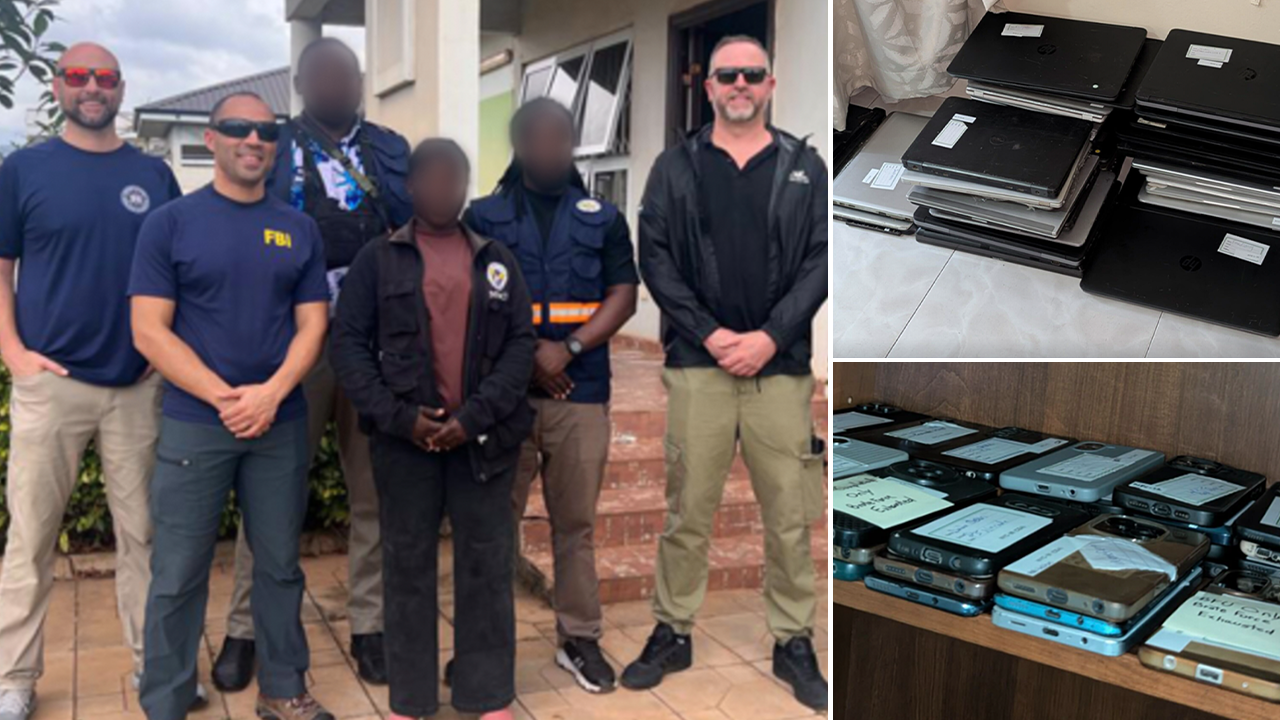
Imagine a Wednesday morning in a quiet Ohio neighborhood. A retired teacher is folding laundry when the phone rings. The caller identifies himself as a federal agent. He says her Social Security number has been linked to a drug cartel, and that a warrant has been issued for her arrest. Her voice shakes as she asks what to do. He transfers her to a “bank investigator,” who instructs her to withdraw cash and place it in a Bitcoin machine. She follows every instruction. By lunchtime, her retirement savings are gone, converted into cryptocurrency and sent to an account overseas. This is not an isolated nightmare. It is the blueprint of a global fraud industry. The FBI’s Operation Blackout exists to attack that industry at its source, and the recent coordinated strike in Ghana is one of the largest efforts yet. According to information provided to Fox News Digital, the operation has led to more than 130 arrests or detentions in Ghana, identified nearly $10 million in confirmed financial losses, and uncovered 89 victims. Agents also seized more than 300 devices—laptops, phones, and hard drives—filled with scripts, contact lists, and payment trails used to run these schemes. The victims are often senior citizens: polite, trusting, and vulnerable to authority. They are not foolish. They are human. The compound raid in Ghana is more than a law enforcement statistic. It is a warning to criminals that no matter how carefully they hide behind foreign borders, anonymous apps, and encrypted messages, someone is watching. It is also a reminder that every dark room filled with computers and Wi-Fi routers represents a carefully engineered attack on ordinary American families. The scale is difficult to process, but the pattern is clear: a phone rings, a false emergency unfolds, and a life changes forever. In that context, the arrest of more than 130 people is not just cause for applause; it is the beginning of a long recovery for hundreds of wounded households.
The details of the Ghana investigation show how complicated these operations really are. The 130-plus individuals arrested or detained include suspected traffickers and low-level workers, but also, importantly, people who may themselves be victims of human trafficking. According to the FBI, those individuals are expected to be repatriated to their home countries, primarily Nigeria. That is a crucial point. In the world of scam compounds, the line between criminal and victim can blur. Many workers are recruited with promises of legitimate call-center jobs or hospitality work. Once they arrive, their passports are taken, their movements are restricted, and they are forced to participate in fraud under threats of violence. The people running the compounds see them as disposable assets, just as they see American seniors as easy marks. In Ghana, the FBI and its international partners had to sort through this tangled web: who was an organizer, who was a willing participant, who was trafficked, and who had been coerced into a criminal scheme. The fact that more than 300 devices were seized suggests the scale of the evidence. Every phone may contain chats with victims, scripts for emergency calls, or payment instructions. Every laptop may hold decades of stolen identities. The confirmed financial losses so far are nearly $10 million, but investigators know that number will grow. Sometimes victims do not come forward because they are ashamed. Sometimes they do not yet know they are victims. The operation is still ongoing, and the FBI expects the list of 89 known victims to lengthen as more people are contacted. This human sorting process is perhaps the most important part of the work. It is also the most delicate. Treating a trafficked worker as a criminal would be a second injustice; treating a scammer as a victim would undermine justice. The FBI is trying to do both with care, using intelligence, interviews, and forensic analysis to separate the exploited from the exploiters. It is slow, unglamorous work, but without it, the cycle of abuse simply repeats with new faces.
FBI Director Kash Patel has been blunt about the mission. He called Operation Blackout a “historic, global scam center fraud demolition operation” that takes apart scam compounds all over the world, especially those targeting American seniors. In his words, “We are attacking this problem right at the source and blowing these compounds up, seizing billions of dollars, freeing thousands of trafficked workers, and protecting tens of thousands of Americans at risk of losing their hard-earned savings through these scams.” He then added a promise with an almost biblical echo: “Those who steal from Americans no longer have sanctuary—this FBI will find them and bring them to justice.” The language is intentionally tough, but the strategy behind it is more than rhetoric. Patel had earlier warned that international scam networks were expanding beyond Southeast Asia and the Middle East and migrating deeper into Africa. That is exactly what the Ghana operation is confronting. The migration is not random. When countries like Cambodia and Myanmar begin to crack down on scam centers, sometimes brutally, the criminal networks pack up and move. They look for countries with weak enforcement, corruption, or difficult terrain. Africa, with its young workforce and increasingly connected digital infrastructure, has become the next host. But the FBI says it is already positioned, working with local law enforcement, to meet them. The term “pre-positioned” is significant. It means the bureau has built relationships, trained partners, and placed resources in places where scams are likely to emerge. It means waiting is not an option. For Patel, this is a matter of national security and human dignity. Scam centers are not just economic crimes; they are modern slavery camps with call centers. They exploit the desperation of African workers and the trust of American seniors. Dismantling them requires a combination of aggressive arrests and quiet diplomacy. The Ghana raids, according to the FBI, are an example of that combination in action. They are a warning that the world has become smaller, and that the American government will follow the money and the victims all the way to the source.
The Ghana strike did not happen in isolation. It is part of a much larger global movement. In September, U.S. investigators helped authorities in Madagascar dismantle 13 scam compounds linked to Chinese organized crime syndicates. In that operation, more than 3,200 electronic devices were processed. Around the same time, the FBI announced the seizure of a record-setting $8 billion in cryptocurrency tied to fraud schemes. Taken together, these actions reveal the staggering scale of the scam economy. Operation Blackout, according to the FBI, has seized roughly $17 billion globally, led to hundreds of arrests, and freed thousands of trafficked workers. The numbers can feel abstract. Seventeen billion dollars is more than the GDP of some small nations. But try to imagine what that money means in human terms. It is a widow’s pension that was about to be transferred to a foreign bank account. It is a couple’s home equity line that was one click away from vanishing. It is a child’s education fund that a hacker was about to drain. It is also the money that would have paid for more compounding fraud, more kidnapping, more suffering. When investigators seize a scam center, they do more than disrupt a criminal enterprise. They interrupt a pipeline that feeds human misery. The hundreds of arrests across multiple countries show how organized these networks are. The syndicates have layers: top financiers who may never see a victim, midlevel managers who run daily operations, and floor workers who make the calls. They operate with branding, marketing, and customer service. They even have human resources departments. The fact that law enforcement has managed to pierce this corporate facade is remarkable. Each seizure of a device, each arrest, each repatriated trafficking victim is a step toward breaking the infrastructure. But it is also a reminder that the infrastructure is enormous. The global scam economy is not a collection of small-time crooks. It is a parallel world that runs on stolen hope. The FBI’s operations are now challenging that world in a way that no single national police force could. By sharing intelligence, coordinating raids, and pressuring foreign governments, Operation Blackout has become a global counterattack. It is not finished. But it has proven that when nations work together, the sanctuary that fraudsters once enjoyed begins to shrink.
Arrests and seizures are only one side of the fight. The other side is prevention, and this is where the FBI’s work becomes deeply personal. The bureau says it has warned more than 10,000 Americans who were suspected of being targeted by scams, preventing an estimated $670 million in financial losses. That is not a statistic; it is thousands of phone calls and home visits. It is an agent explaining to a confused grandmother that the man she loves online is a fictional persona built by a criminal in another country. It is a fraud analyst patiently convincing a veteran that the “government official” demanding gift cards is not from the government. The FBI’s Operation Level Up program takes this further. The bureau has contacted more than 10,400 potential victims, and the most striking finding is that 77 percent of them did not realize they were being scammed. That fact should give everyone pause. It means that most people who are being targeted do not see the trap. And that is not because they are gullible. It is because the traps are built to mirror real life. Scammers use real agency names, real phone numbers that appear on caller ID, and credible-looking websites. They exploit current events, tax season, medical bills, romance, loneliness, and fear. They know exactly how to create urgency and isolate their victims. The 77 percent figure also reveals something else: many people are one conversation away from disaster. A single warning from the FBI can be the difference between losing a life’s savings and keeping it. The beauty of prevention is that it costs little and saves everything. It also gives victims their dignity back. People who are stopped before they send money do not have to experience the shame of having been deceived. They may be embarrassed for a moment, but they wake up the next morning with their accounts intact. The FBI cannot always be there, which is why public education matters. The agency’s warnings, news conferences, and community outreach are not merely for show. They are designed to give Americans the same scripts and red flags that agents use in interviews. When a grandchild learns to say, “Grandma, that’s a scam,” that is prevention. When a retired man hesitates before wiring money, that is prevention. The goal of Operation Blackout is to make the scam industry unprofitable, and prevention is the most powerful weapon for doing so.
The Ghana investigation remains open. The FBI expects the number of identified victims and the total financial losses to grow. This is not a sign of failure; it is simply the nature of complex international fraud. New victims will be discovered as agents examine the seized devices. More trafficked workers will be repatriated. More arrests may follow. The operation is a process, not a single event. But the message is already clear: the United States will not allow overseas fraudsters to treat American citizens as an ATM. With Operation Blackout, the FBI has created a permanent campaign against scam compounds. The old model of chasing individual cybercriminals is being replaced by a more ambitious strategy—one that treats the entire illicit industry as a target. It is a strategy rooted in justice and compassion. The 130 arrests in Ghana put more than a hundred people before the legal system, but the real victory may be the 89 victims who were found, the 300 devices that were taken out of circulation, and the thousands of Americans who were warned before they lost everything. There is also a humanitarian victory for the workers who were trapped in the compounds. They will not all be repatriated at once, but they will have a chance to go home, which is more than they had before the raid. For the rest of us, this story is a reminder that fraud is not a faceless crime. It is committed by real people with real techniques, and it is suffered by real people with real hopes. The FBI’s global crackdown is a powerful answer to a dehumanizing problem. It tells victims that their losses matter. It tells criminals that distance does not equal safety. And it tells the American public that the fight is not over. The next phone call may be a scam. But with awareness, with prevention, and with agencies willing to travel to the ends of the earth, the odds are getting better. The scammers still work every day. Now, so does the FBI. And in this fight, there is no sanctuary for those who prey on the vulnerable.