





Secretary of War Pete Hegseth announced Thursday that Nidal Hasan, the former Army major who murdered 13 people at Fort Hood in 2009, will be executed by firing squad on the same Texas base where the massacre occurred—and that the execution will be open to the public. Speaking to Real America’s Voice, Hegseth made clear that the decision was deliberate. “We’re gonna make sure that people are able to watch it, that it’s public, because people need to understand that there’s serious consequences for these types of things,” he said. Hasan, a former Army psychiatrist, has been on military death row since 2013, after a military jury convicted him of 13 counts of premeditated murder and 32 counts of attempted premeditated murder. The announcement ends, at least in principle, a long and painful wait for the families of the fallen. It also raises profound questions about justice, vengeance, and the meaning of public punishment in modern America. Hegseth’s language was blunt and unapologetic. “Army major betrays his country, radical Islamist kills a bunch of Americans at Fort Hood. Of course we’re doing it at Fort Hood,” he said. The execution, he added, will take place on a Thursday at one o’clock in the afternoon—the same day and hour Hasan launched his attack. Soldiers with rifles will form the firing squad. For Hegseth, the symmetry is the point. The nation, he believes, needs to see the consequence of such betrayal. The base itself has changed over the years, but the memory of November 5, 2009, remains etched into its soil and its people.
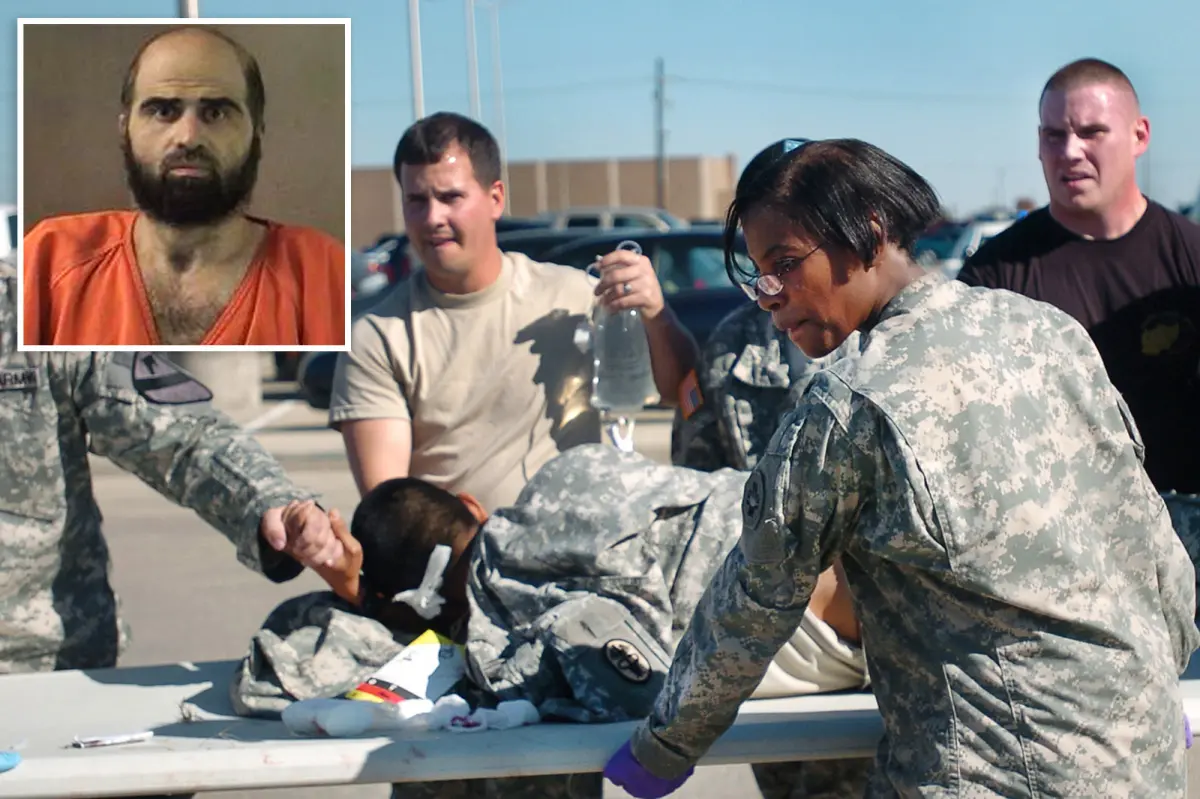
The attack Hasan carried out that autumn day was not a random act of violence. It was a planned, ideological slaughter. Hasan, a U.S.-born Army psychiatrist, had spent years treating soldiers struggling with the psychological wounds of war. But in the years before the shooting, he had become radicalized, communicating with Anwar al-Awlaki, the American-born cleric who had become a leading figure in al-Qaeda. On the morning of November 5, 2009, Hasan walked into the Soldier Readiness Processing Center at Fort Hood, a facility where troops were undergoing medical and administrative checks before deploying to Iraq and Afghanistan. He was wearing his military uniform and carried a semi-automatic pistol. At around one o’clock, he shouted “Allahu Akbar” and opened fire on the unarmed soldiers and civilians inside. When it was over, 13 people lay dead and 32 were wounded. It was the deadliest shooting ever to take place on a U.S. military installation. The dead included soldiers preparing for deployment, a pregnant private first class, a 62-year-old physician assistant, and a lieutenant colonel who had served her country for decades. The wounded were left with shattered bones, traumatic brain injuries, and invisible scars that would never fully heal. Hasan was shot by police and taken into custody, paralyzed from the waist down. He survived, stood trial, and was convicted. For more than a decade, he has remained on military death row at Fort Leavenworth, Kansas, while his case moved slowly through the appeals process.
Hegseth’s announcement is striking not only for its content but for its tone. He did not speak in the careful, measured language that often surrounds military justice. Instead, he described Hasan as a traitor and a radical Islamist, and he insisted that the execution be carried out at Fort Hood, at the exact time of the attack, with soldiers as the executioners. “We’re going to do it on a Thursday. We’re going to do it at one o’clock, which is when he did it. And it’s going to be soldiers with rifles executing the firing squad,” he said. The choice of a firing squad is itself deeply symbolic. It is a military method of execution, one that requires a group of soldiers to act together, sharing the weight of the act. It is also visceral and old-fashioned, a reminder that the state’s power over life and death has not become softer or more abstract. Public executions are even more unusual. The last public execution in the United States took place in 1936, when a crowd gathered in Kentucky to watch a hanging. Since then, executions have been moved behind prison walls, away from public view. If Hegseth follows through, this would be the first public execution in America in nearly a century, and the first military execution since 1961. For Hegseth, that is precisely the point. He wants the country to look. He wants the consequences to be visible. He wants people to understand that betraying one’s oath, murdering one’s fellow soldiers, and committing an act of terrorism on American soil carries a price that cannot be hidden or sanitized.
But behind the politics and the symbolism, there are human beings whose lives were changed forever. The thirteen people killed at Fort Hood were not statistics. They were sons and daughters, husbands and wives, fathers and mothers. Michael Cahill was a 62-year-old physician assistant who had spent his career caring for soldiers. Francheska Velez was a 21-year-old private first class, pregnant and preparing for a deployment that would never happen. Amy Krueger was a sergeant who had already survived a tour in Iraq and was preparing to go again. Juanita Warman was a lieutenant colonel and a nurse, a woman of deep faith and dedication. Libardo Caraveo was a major and a psychologist, a Mexican immigrant who had worked his way up through the Army. Justin DeCrow, John Gaffaney, Frederick Greene, Jason Hunt, Aaron Nemelka, Michael Pearson, Russell Seager, Kham See Xiong—each name carries a story, a family, a set of dreams that were cut short in a matter of minutes. Their families have spent sixteen years waiting for justice. Some have attended every hearing, carried photographs, and spoken their loved ones’ names aloud in courtrooms. Others have chosen to grieve in private. For them, the announcement of a public execution is complicated. It may bring a sense of closure, but it cannot bring back the dead. It may feel like justice, but it also reopens wounds. The survivors, too, carry the weight of that day. Thirty-two people were wounded, and many of them still live with shrapnel in their bodies, chronic pain, and memories that surface without warning.
There are also legal and moral questions that cannot be ignored. Hasan’s death sentence has not yet been carried out, and military death sentences require presidential approval before an execution can be ordered. His appeals have not been fully exhausted, and his lawyers may continue to fight. The death penalty itself remains deeply controversial in the United States, and public executions even more so. Some will argue that Hegseth’s plan is a form of retribution that demeans the state by turning justice into a spectacle. Others will say that the public has a right to see that justice is done, and that the victims deserve no less than a visible accounting for the horror they endured. There is also the uncomfortable reality that Hasan is paralyzed and confined to a wheelchair. A firing squad execution would require soldiers to shoot a man who cannot stand, a man who has spent years in a cell while the world moved on. The image is stark and difficult. Yet for many of the victims’ families, the difficulty of the image is not a reason to avoid it. They have lived with difficult images for sixteen years. They have imagined the moment their loved ones were shot down in a place where they should have been safe. They have carried the weight of that day in their chests, in their sleepless nights, in the empty chairs at holiday dinners. The execution, if it happens, will not erase any of that. But it will mark the end of a long legal process, and it will send a message that the nation does not forgive those who murder its soldiers in cold blood.
In the end, the execution at Fort Hood will be more than a punishment. It will be a moment of reckoning for the country, a chance to remember what happened on that Texas afternoon and to reflect on the costs of war and radicalization. Hegseth’s words were harsh, but they were also a reminder that actions have consequences. The soldiers who will form the firing squad will carry the memory of that day with them for the rest of their lives. The families who watch will carry their grief forever. And the rest of us, whether we support the death penalty or oppose it, will be forced to confront a difficult truth: that the men and women killed at Fort Hood died not on a distant battlefield, but on American soil, at the hands of a man who had sworn to protect them. Their names deserve to be spoken. Their stories deserve to be told. And their sacrifice deserves to be remembered, not only in the abstract language of policy and law, but in the quiet, human details of the lives they lived. As the hour approaches, the nation will look at Fort Hood and remember. The sun will be high over the Texas prairie, the rifles will be raised, and the long wait for justice will finally come to an end. But the memory of November 5, 2009, will never fade. It will remain in the hearts of the families, in the scars of the survivors, and in the conscience of a country that must never look away from what happened there.