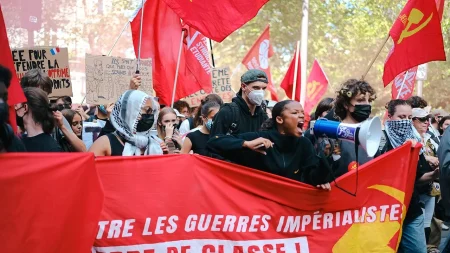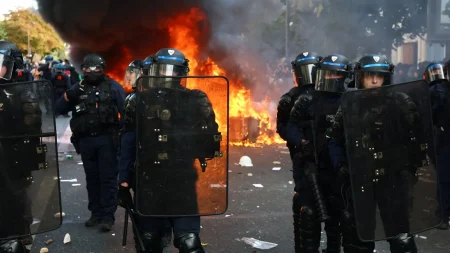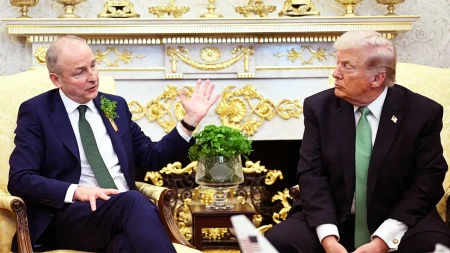







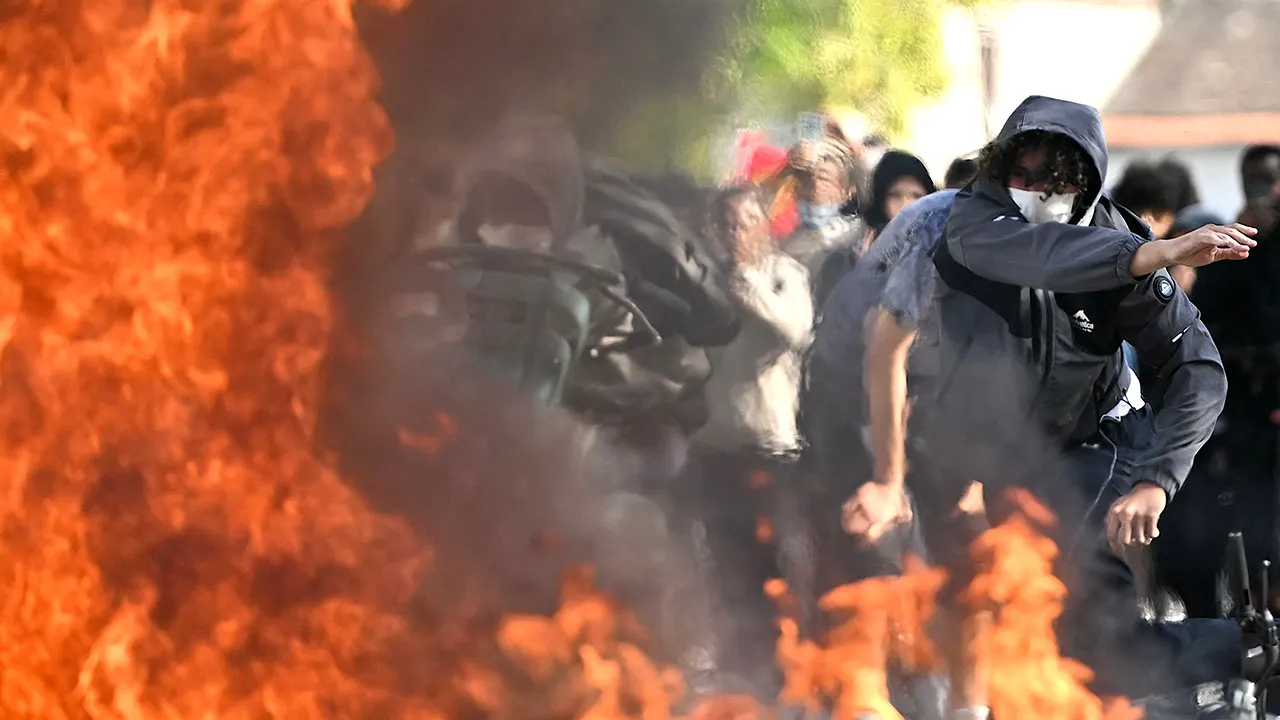
It begins, as so many modern crises do, with a blur of images: tear gas curling through the streets of Paris, teenagers in hoodies scattering between burning barricades, and the unmistakable crack of projectiles against riot shields. France, a nation that has long worn its revolutionary spirit as a badge of honor, is once again convulsing in protest. But this time, the unrest is not merely about pensions or labor laws. It has exploded through the country’s high schools, driven by students who say their classrooms are crumbling, overcrowded, and underfunded. And it has drawn a sharp, controversial response from President Donald Trump, who looked at the chaos and saw something far larger than education policy. In a Truth Social post on Tuesday, Trump declared that what is happening in France is “nothing less than out of control mass migration,” adding, “This isn’t about schools, this is about Islam wanting to take over a once great Country!” The comment immediately reignited a familiar debate, one that pits the raw, often inflammatory language of cultural and demographic anxiety against the more grounded, messy realities of institutional decay and youth frustration.
Trump’s words landed at a moment when France was experiencing its most intense day of school-related violence since the protests first began in September. The scenes were visceral: police firing tear gas in Paris, Lyon, Strasbourg, and Rennes; protesters lighting fires and hurling objects at security forces; and the Interior Ministry reporting that more than 6,100 people had been arrested, the overwhelming majority of them minors. Prime Minister Sébastien Lecornu described the clashes as producing the school system’s “heaviest toll in decades,” with at least 215 teenagers and 85 school staff members injured, alongside more than 700 police officers. More than half of France’s roughly 3,700 high schools were blockaded or expected to close on Tuesday, according to the High School Students Union. In Paris alone, police said about 300 people attempted to confront security forces, though they maintained that the broader protest was unfolding peacefully elsewhere. It is a scene of national turmoil that feels both deeply French and disturbingly new, and it has opened a fresh chapter in the ongoing argument about what, exactly, is tearing the country apart.
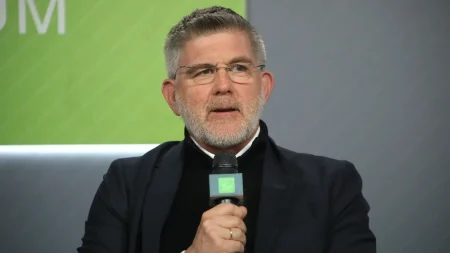
Into that argument stepped Mike Waltz, the U.S. Ambassador to the United Nations, who echoed Trump’s concerns while attempting to add a layer of policy analysis. Asked by Fox News Digital about the president’s comments and the images emerging from France, Waltz condemned the violence outright but insisted that it could not be separated from Europe’s broader choices around immigration and governance. “I think we would always condemn lawlessness, condemn the violence that we’re seeing in Paris,” Waltz said. “But I think we also have to recognize that when you have open borders, when you [have] this pro-migration, unchecked immigration kind of policy, coupled with policies over the years that deny people basic energy, that overspend on all kinds of other government programs, that you see a level of frustration boiling to the surface.” For Waltz, the riots were not an isolated incident but a symptom of accumulated failures—immigration policies that overwhelmed social cohesion, energy policies that pinched ordinary families, and government spending that promised much but delivered little. He added that Trump had “brought that to light,” suggesting that the president’s blunt framing, however uncomfortable, was pointing at a truth that European leaders preferred to ignore.
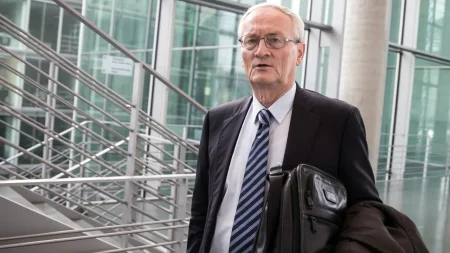
That interpretation was reinforced by Theo Wold, a former assistant attorney general and former White House deputy assistant for domestic policy under Trump. Wold acknowledged that France has a long and proud tradition of street demonstrations, strikes, and labor stoppages—indeed, it is woven into the very fabric of the Fifth Republic’s civic culture. But he argued that what is happening now is qualitatively different. “What’s new is the violence, lawlessness and rioting,” Wold told Fox News Digital. “This is a consequence of mass immigration.” For Wold and others on the right, the student protests are not really about school conditions at all, or at least not only about them. They are about a country struggling to absorb demographic change, a struggle that manifests in schools as overcrowding, in neighborhoods as alienation, and ultimately in the streets as rage. The argument is powerful and provocative, and it resonates with a segment of the American public that sees Europe’s turmoil as a cautionary tale about what happens when borders become porous and national identity becomes negotiable. But it is not the only story being told, and it is not the story that many students, teachers, and parents say they are living.
Indeed, the more immediate and concrete grievances driving the protests are rooted in the daily realities of French public education. Reuters and the Associated Press have reported that the movement began over school conditions: teacher shortages, overcrowded classrooms, deteriorating buildings, water leaks, and even rat infestations. Students describe schools that feel abandoned by the state, places where learning is secondary to survival, where the promise of equal opportunity has given way to a grim arithmetic of underfunding and neglect. For them, the riots are not an abstract commentary on immigration or Islam; they are a desperate cry for basic dignity in the institutions where they spend their formative years. The unrest has also become entangled in the country’s political battles ahead of the presidential election in April and May 2027. French authorities and political opponents have accused lawmakers and mayors from the hard-left France Unbowed party, or LFI, of stoking the demonstrations, a charge the party denies. This political dimension adds another layer of complexity, as the protests become a proxy for larger struggles over the country’s future direction, its social contract, and who gets to define its identity.
When all of these threads are woven together, the picture that emerges is not simple. Trump sees a civilizational clash, a story of migration and religious ambition threatening to overwhelm a once-great nation. Waltz sees a policy failure, a stew of open borders, energy mismanagement, and fiscal irresponsibility finally coming to a boil. Wold sees a departure from France’s historical protest culture, a new and dangerous violence born of mass immigration. But the students in the streets see leaking ceilings and overcrowded classrooms. They see teachers who are exhausted, buildings that are crumbling, and a future that feels foreclosed. The truth, as always, is probably somewhere in the middle, but that middle is hard to see through the smoke of tear gas and the heat of political rhetoric. What is undeniable is that France is facing a moment of profound strain, one that raises questions not just for Europe but for the United States as well. If a wealthy, established democracy can be brought to the edge of chaos by a combination of demographic change, institutional decay, and political polarization, then no country is immune. The images from Paris are a warning, a mirror, and a mystery all at once—and how they are interpreted will shape not only the coming election in France, but the way the West understands its own fragility. For now, the fires are still burning, the arrests are still mounting, and the arguments are only growing louder. What happens next depends on whether France can find a way to listen to its young people without losing itself in the process.