





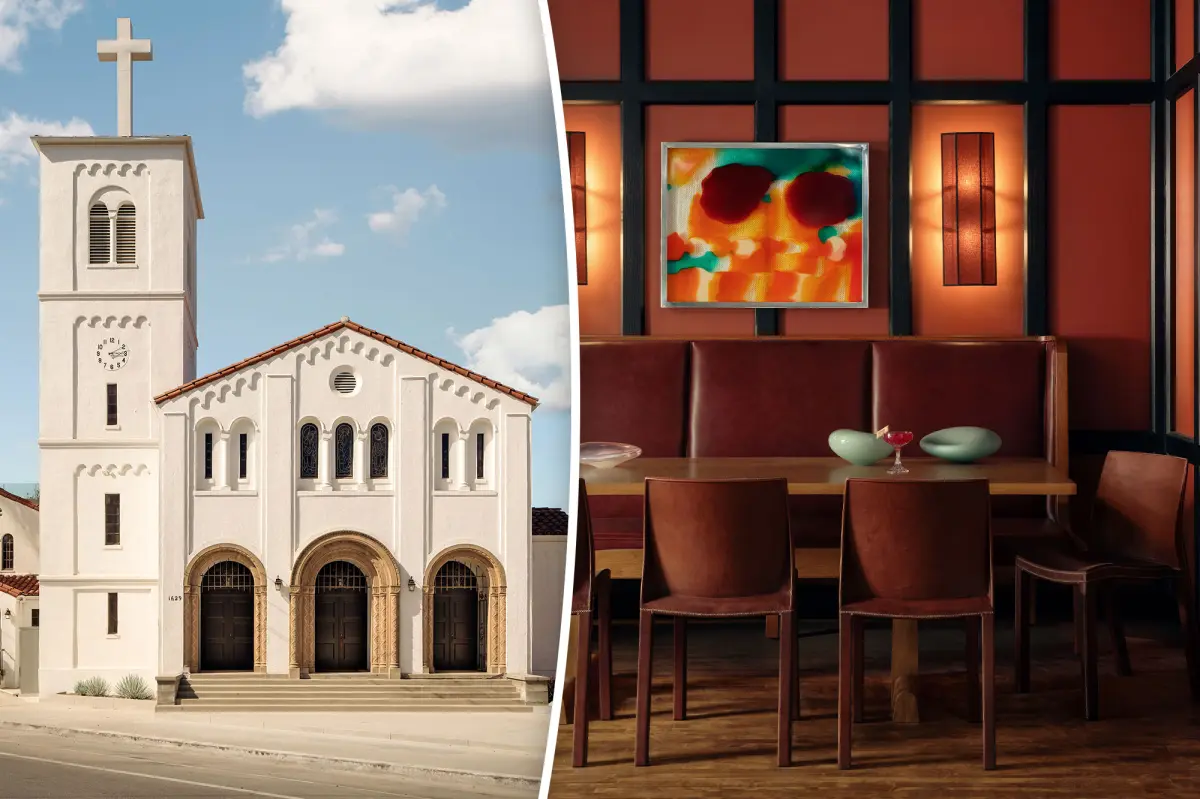
For nearly a century, the stately Gothic Revival building at 1629 Griffith Park Boulevard in Los Angeles was a place where people came to whisper, to reflect, to seek something bigger than themselves. It was Bethany Presbyterian Church, a 95-year-old sanctuary in the heart of Silver Lake, the city’s famously creative and sophisticated east side enclave. For years, though, the church sat dormant, its heavy timber doors closed, its stained-glass windows quietly gathering dust while the neighborhood around it grew trendier and more alive with every passing season. Now, salvation has arrived in an unexpected form: Hotel Lucile, a 25-room boutique hideaway that opens this week inside the deconsecrated church. The transformation is nothing short of divine — a playful, reverent reimagining of sacred space into a place of rest, indulgence, and communal gathering. The rooftop cross remains in place, a quiet nod to the building’s past. The stained-glass windows still throw jewel-toned light across the floors. But the pews are gone, replaced by velvet armchairs, carefully curated bookshelves, and minibars stocked with Erewhon’s finest provisions. There is even a roving martini cart, ready to appear at a moment’s notice, as if the building itself has traded incense for aperitifs. It is a renovation that honors the old while embracing the new, and it gives Silver Lake something it didn’t know it needed: a sanctuary for slow mornings, late nights, and everything in between.
The heart of this resurrection is Sous Sous, a roughly 120-seat New American French restaurant and bar that now occupies what was once the cavernous main sanctuary. Where parishioners once bowed their heads in prayer, guests now cradle Sazeracs and dig into steaming bowls of bouillabaisse beneath soaring chapel arches. The menu comes from executive chef Patrick Costa, the culinary mind behind downtown hotspot De La Nonna, and it carries the same confident, ingredient-driven energy that made his name downtown. But Sous Sous feels entirely of this place — the high ceilings amplify the clink of glasses, the murmur of conversation, and the occasional burst of laughter in a way that feels almost musical. The former choir loft has been transformed into a moody mezzanine lounge, a perch where you can sip a cocktail and watch the room below come alive as the evening deepens. There is something quietly magical about drinking in a space that once reverberated with organ music and hymns. The light still pours through those kaleidoscopic windows, but it now falls on marble counters, leather banquettes, and hands holding wine glasses instead of hymnals. It is not a parody of a church, nor is it a stuffy museum piece; it is a living, breathing neighborhood gathering place that happens to have once been a house of God.
Upstairs, the 25 guest rooms are designed to cradle guests in a kind of modern comfort that feels both luxurious and personal. The rooms frame a sunlit interior courtyard, offering a sense of calm and privacy that is rare in a city so sprawling and busy. There is no austerity here, no monastic minimalism intended to evoke the building’s religious past. Instead, the rooms are warm, tactile, and thoughtfully composed, with Aesop bath products in the showers, crisp Parachute linens on the beds, and handcrafted ceramics scattered throughout. Each room comes with custom stained-glass coasters made by local artists, a small, beautiful touch that connects the guest experience directly to the neighborhood’s vibrant creative community. An on-site library, assembled in partnership with Skylight Books in neighboring Los Feliz, offers a carefully chosen collection that invites guests to curl up with a novel or a book of poetry. The overall effect is intimate rather than cathedral-scale; these are rooms that feel like a friend’s impeccably tasteful guesthouse, not a chain hotel. You can still feel the old bones of the building — the thick walls, the tall windows, the sense of history embedded in every beam — but the experience is firmly rooted in the present, with all the amenities and ease that modern travelers expect.
The building’s history is as rich and layered as the neighborhood it now calls home. Before it became Hotel Lucile, the structure had already lived several different lives. After serving a succession of congregations, it found new purpose as the original home of East West Players, the nation’s first Asian American theater company, which launched ambitious productions within these walls. Later, it was used as an antiques shop, where treasures and oddities were displayed beneath the same stained glass. General manager Anthony Gutierrez sees this layered past as the soul of the project. “Throughout this restoration, our focus was on honoring the many lives this building has already held while creating something that feels distinctly of Silver Lake today,” he said. “We hope Hotel Lucile continues to evolve alongside the neighborhood through the artists, neighbors, guests, and collaborators who become part of it.” Those words are more than hospitality-speak; they reflect a genuine attempt to make the hotel a genuine community hub rather than a sterile property. The walls have heard sermons, monologues, and the clatter of antique dealers. Now they will hear toastmasters, first dates, birthday celebrations, and quiet mornings with coffee and a good book.
The journey from church to hotel, however, was anything but heavenly. The redevelopment dragged on for more than a decade, a long and often painful process that included neighborhood debate, city hearings, and even a bankruptcy filing. There were moments when it seemed the old church might never find its next chapter. But in 2020, the hospitality group Casetta took over the project, and slowly, painstakingly, the building began its redemption arc. Today, the reimagined property also includes a cocktail pool, meeting spaces, and a rooftop deck with sweeping views of Los Angeles — a perch that feels particularly magical at sunset, when the city lights begin to flicker on. Contemporary art pieces are expected to rotate throughout the property, with many available for purchase, turning the hotel and its public spaces into a living art gallery. Guests might encounter a striking painting in the hallway one month and a sculpture in the courtyard the next. This commitment to art and local collaboration is what makes Hotel Lucile feel less like a corporate venture and more like a passion project, a space that is constantly evolving and welcoming new voices into its collection.
Of course, no Silver Lake story would be complete without a few caveats, and Hotel Lucile has one very traditional local amenity notably missing: parking. There is no on-site lot, so guests and restaurant diners will depend on valet service or the notoriously scarce street spots in the area. It is a small price to pay for a slice of this divine renovation, but one worth knowing before you go. Nightly rates start at around $441, a reflection of the boutique experience and the prime location, though locals can snag a 15% discount to celebrate the opening, according to the hotel. For Angelenos lucky enough to slip into that opening window, it is an invitation to rediscover a familiar corner of the city through new eyes. Hotel Lucile is not just a place to stay; it is a love letter to Silver Lake, a neighborhood that has always thrived on reinvention. It is where old holy moments mingle with new ones, where a rooftop cross watches over a cocktail pool, where the stained-glass light falls on fresh flowers and clever martinis. Heavenly? Maybe. But it is also deeply, wonderfully human — a reminder that even the most sacred spaces can be reborn, not despite their history, but because of it.