





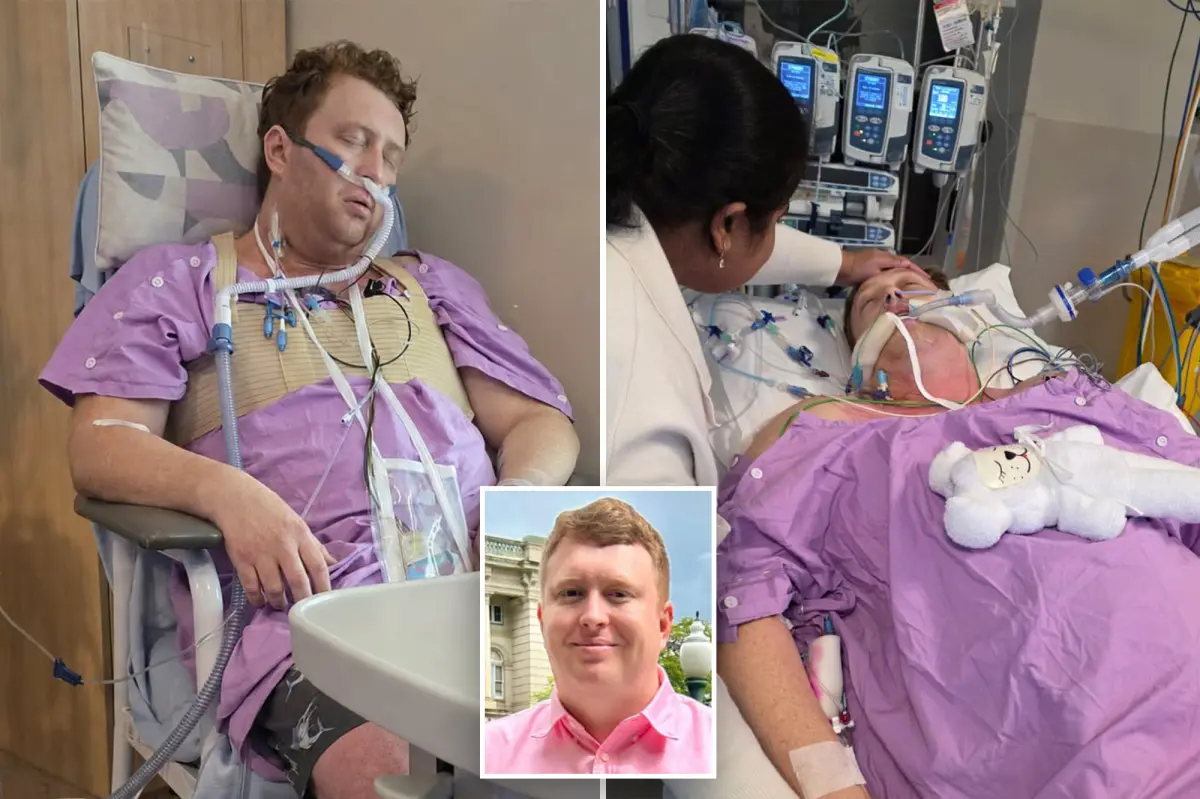
It began like any other ordinary evening, the kind you don’t think twice about afterward. Luke, a 35-year-old Queenslander with no prior medical issues, was dealing with a toothache. It was annoying, certainly, but not alarming. He felt a bit feverish, a little run down, and his head was starting to throb. Like most people, he chalked it up to a seasonal bug. “I didn’t think much of it,” he later recalled in a deeply personal Facebook post shared by Queensland Health. “I assumed I was coming down with some sort of bug, some viral illness.” It was the kind of everyday discomfort that millions of people shrug off, expecting a few days of rest and fluids to fix. But the horror was just beginning. Over the next few days, Luke’s symptoms didn’t ease; they escalated with terrifying speed. A tightness gripped his chest, and his head burned with an unbearable, feverish intensity. That was the moment he knew something was seriously wrong. What had started as a minor dental complaint was quietly transforming into a life-or-death crisis, one that would ultimately leave him in an intensive care unit, facing emergency open-heart surgery and fighting for every breath.
When Luke and his wife Jennifer rushed to Redcliffe Hospital, they were hoping for antibiotics, a reassuring doctor, and a prescription that would send them home to recover. Instead, they received a diagnosis that stopped them cold: Luke’s blood was infected, and he had developed sepsis. For many people, sepsis remains a vague and misunderstood medical term, but it is one of the deadliest conditions in modern medicine. It occurs when the body’s immune system, instead of simply fighting an infection, goes into overdrive and begins attacking its own tissues and organs. The result is a cascading, systemic inflammation that can rapidly destroy the body from within. Its early symptoms often mimic far less serious illnesses—fever, fatigue, malaise, confusion—which makes it incredibly dangerous. A person can believe they have a cold while their internal organs are quietly shutting down. In Luke’s case, the untreated dental infection had triggered a particularly vicious form of the disease called infective endocarditis. This meant the bacteria from his tooth had entered his bloodstream and attached itself to the inner lining of his heart, completely destroying one of his heart valves. In the space of just a few days, he had gone from feeling slightly under the weather to having a potentially fatal cardiac emergency.
The medical team at Redcliffe Hospital moved quickly, but the damage was already catastrophic. Luke was told point-blank that without surgery, he would not live much longer. His heart, the very engine of his life, had been compromised beyond repair by an infection that started in his mouth. There was no gentle road to recovery, no simple procedure to patch things up. He needed emergency open-heart surgery, one of the most invasive and high-stakes operations that exist. He was wheeled into the operating room with the terrifying knowledge that his survival was not guaranteed. “I was told that without surgery I wouldn’t live for much longer,” he remembered, describing the ordeal in the intensive care unit, surrounded by beeping machines, tubes, and the quiet urgency of nurses who had seen too many patients in his condition. He later said, “I’ve never felt so vulnerable or so broken as a human being.” In a matter of days, Luke’s identity as a healthy, active man in his mid-thirties was stripped away, replaced by the fragile reality of a patient fighting for a future he had never imagined he would need to fight for. The surgery itself was successful, a testament to the skill and dedication of the surgical team, but the physical and emotional cost was immense. He woke up to a body that no longer felt like his own, a chest that had been cut open, and a heart that would never be the same.
The aftermath of such a catastrophic health event is never simple, and for Luke, it has meant a permanent reshaping of his life. He now faces a future defined by daily medication, regular blood tests, and an extreme level of caution around even the smallest cuts and bruises. For most people, a papercut is a joke; for Luke, it could become a gateway to another life-threatening infection. He cannot afford to be careless about dental hygiene, skin wounds, or any sign of infection, because his body has already proven how quickly things can spiral out of control. The recovery has been grueling, both physically and mentally. He lives with the memory of that terrifying hospital room, the feeling of helplessness, and the weight of knowing how close he came to leaving his wife and family behind. Yet despite all of this, Luke’s voice is not one of bitterness but of profound gratitude. He speaks at length about the massive team of healthcare workers who kept him alive—the doctors, nurses, surgeons, and support staff who moved with precision and compassion through his darkest hours. His core message to the public is remarkably simple and universally accessible: trust your instincts, don’t ignore the signs, and always ask the medical professionals, “Could this be sepsis?” It is a question that could save a life, and he is living proof of the difference it can make.
Luke’s story did not stay confined to his own community, however. When Queensland Health shared his account on Facebook, it struck a major nerve across the country. Hundreds of Australians flooded the comments section, not just with sympathy but with their own terrifying close calls and near-fatal experiences with sepsis. As these stories unfolded in the public thread, a larger conversation began to emerge, one that went far beyond individual health awareness and touched on a glaring gap in the Australian healthcare system. Many commenters argued that Luke’s ordeal was a textbook example of why dental care should be included under Medicare. The logic was stark and compelling: Luke might never have delayed seeking treatment for his tooth if it hadn’t been so expensive to see a dentist in the first place. Out-of-pocket dental costs in Australia are notoriously high, and for many people, they are prohibitively so. A routine check-up for a family can easily run into hundreds of dollars, and more serious dental work can cost thousands. When people are forced to choose between paying rent, feeding their family, and addressing a dental issue that doesn’t yet feel urgent, they often choose to wait. That delay, as Luke’s story demonstrates, can be catastrophic. “This story is a prime example that dental should be included under Medicare,” one user wrote, while dozens of others echoed the sentiment. “He might not have put off a trip to a dentist if it wasn’t so expensive. It should be covered by Medicare,” another added, capturing the frustration and fear that so many felt in reading his story.
The public reaction to Luke’s experience reveals a deep and growing unease about the way healthcare systems treat dental health as separate from physical health. The mouth is not an isolated domain; it is a gateway to the rest of the body, and infections there can travel quickly to the heart, brain, and bloodstream. Yet in many countries, dental care remains a luxury, an afterthought, or a financial burden that people are expected to shoulder alone. Luke’s life was nearly lost to an infection that likely could have been treated early, simply, and inexpensively if he had been able to access dental care sooner. His ordeal is a powerful reminder that the social determinants of health are not abstract academic concepts; they are the reasons some people visit a dentist at the first twinge and others wait until it is too late. In the comments of the Facebook post, there was a palpable sense of anger and fear, a recognition that this could happen to anyone who has ever winced at a dental bill and decided to wait another month. The demand for systemic change was loud and clear, born out of empathy for one man’s unimaginable suffering. But it was also born out of self-interest, because everyone understands, on some level, that the next person to die from a preventable dental infection could be them, or their parent, their spouse, or their child.
In the end, Luke’s story is not just one of survival, but of the fragile line between everyday life and sudden catastrophe. It is a story that humanizes sepsis, transforms a clinical term into a face, a name, a frightened young man in the ICU, and reminds us that health is never guaranteed, no matter how young or strong we feel. It also shines an unforgiving light on the gaps in a healthcare system that forces people to gamble with their own wellbeing. The solutions are not complicated in theory: make dental care accessible, educate the public about sepsis, ensure that patients and practitioners listen to the subtle signs that something is wrong, and build a system that treats the body as a whole rather than a collection of separate problems. But such changes require political will, public pressure, and a collective refusal to accept that a toothache should ever become a death sentence. Luke’s message is a simple one, and yet it carries the weight of his entire ordeal: when something feels wrong, ask the question, push for an answer, and don’t let cost or inconvenience silence you. His recovery may be lifelong, but his willingness to share his trauma has already sparked a conversation that could save countless others. In sharing his pain, he has given a gift—the knowledge that sepsis is a silent killer, not because it cannot be detected, but because too often, no one asks if it might be there. And in asking, we might just be able to turn an ordinary evening into a story with a different ending.