

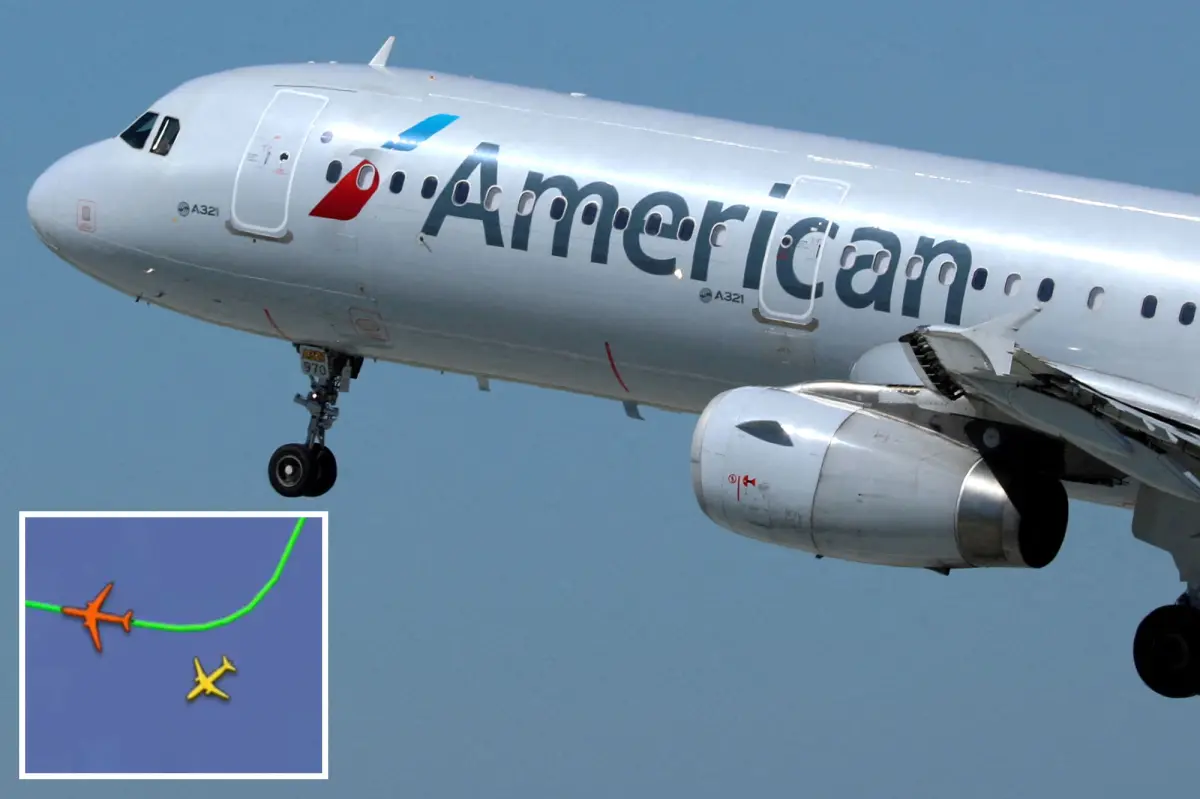
It was a Saturday morning like any other at Los Angeles International Airport—the sprawling, sun-drenched hive of jet engines and suitcase wheels that greets thousands of travelers daily. The sky was clear, the runways were active, and the rhythmic hum of takeoffs and landings filled the air. But in the span of a few terrifying seconds, that ordinary morning morphed into a high-stakes thriller where the margin between a routine flight and an unthinkable catastrophe was measured in mere feet. Two massive passenger jets, as they clawed their way into the sky, found themselves on a collision course after a critical navigational error. The aircraft—an Air France Airbus bound for the tropical paradise of Papeete, Tahiti, and an American Airlines Airbus heading toward the bustling hub of Dallas-Fort Worth—climbed out of adjacent runways, their combined metal frames carrying around five hundred souls. As the Air France jet began to veer left from its assigned departure route, the pilots of both planes, along with the vigilant air traffic controllers on the ground, were thrust into a nightmare scenario where every second counted, and where the difference between a near miss and a catastrophic crash was a razor-thin gap of just 400 feet in vertical separation.
In the cramped, dimly lit confines of the air traffic control tower, the controllers’ eyes were fixed on their radar scopes, the green blips of the two aircraft tracking perfectly along their designated pathways. But then, a subtle blur, a deviation. The Air France jet, which had been cleared to climb via a specific Standard Instrument Departure (SID)—a published route designed to keep traffic safely separated—suddenly turned off the path. It was a left turn that placed the jet squarely in the path of the American Airlines flight. The controller’s training kicked in with lightning speed, overriding the usual calm monotony of routine instructions. “Air France 028 heavy, fly heading of 270 immediately,” the controller commanded, the urgency unmistakable in the clipped transmission. It was a direct order to turn the aircraft onto a specific compass heading, a maneuver designed to break the deadly geometry that was forming. Simultaneously, the controller alerted the American crew. “Traffic alert, traffic 12 o’clock, less than a mile, maintain 2,000,” the transmission crackled, warning them that another jet was directly ahead and just under a mile away, and to hold their altitude at 2,000 feet to avoid a vertical encounter. In that moment, the radar scope was no longer just a screen of data; it was a window into a potential tragedy, and the president of the sky was pulling every lever at his disposal to thread the needle between two giant birds of prey.
The American Airlines cockpit, usually a serene environment of cross-checks and heading changes, snapped to full attention. The alarm in the controller’s voice was unmistakable, and the crew’s response was immediate and flawless. They stared ahead, scanning the sky for the approaching threat, their hands steady on the controls as they acknowledged the altitude restriction and held their course. There was no room for hesitation, no time for debate; the professional discipline drilled into them over years of training took over. They complied with the instructions, holding the aircraft level and steady, trusting the voice in their headsets to guide them out of the danger zone. As the two jets passed, the vertical separation of 400 feet felt like a whisper—a mere five or six stories of air separating their wingtips and fuselages. The tension in the American cockpit was palpable, but it quickly transformed into a grim understanding of how close they had come. On the ground, the controller let out a breath he hadn’t realized he was holding. Knowing the other pilot had been the cause of the error, he switched frequencies to offer a personal, almost human apology to the American crew. “Sorry about that. That aircraft just turned in front of you,” he said, his voice laced with residual adrenaline. Then, with genuine gratitude, he added, “Great job, thank you.” The American pilot, calm and composed, simply responded, “No problem.” It was a momentary exchange of professionalism—a stark contrast to the chaos that had just unfolded—but it captured the essence of aviation’s core: trust, communication, and a shared determination to keep the skies safe.
On the other side of the radio, inside the Air France cockpit, the mood was shifting from active flight management to a severe post-mortem. The pilots had successfully flown their jet away from the conflict, but the repercussions of that unauthorized turn were only beginning. The controller, now that the immediate danger had passed, turned his focus to the root cause of the incident. “You were instructed to climb via SID, not turn to a heading,” he stated, the rhetorical question hanging in the air like a heavy fog. “Why did you turn to a heading?” The question was direct, almost confrontational, demanding an explanation for a breach of protocol that had nearly cost hundreds of lives. The Air France crew, likely stunned by the gravity of the situation and the accusatory tone, initially requested time to respond. They were fumbling for an answer, perhaps re-checking their flight management computers, trying to reconcile their actions with the instructions they believed they had received. When the controller pressed them again, asking “What departure were you instructed to fly?” they finally admitted, “We were instructed to fly SUMMR TWO departure,” referring to the specific waypoint navigation that guides traffic out of LAX. The controller then delivered the final, bureaucratic hammer: “Possible pilot deviation. I have a number for you to call when you’re ready.” That phrase—a starkly neutral administrative notification—carried the weight of a legal summons. It indicated that the FAA would be reviewing their actions, and while it didn’t inherently mean punishment, it meant the pilots would be answering for their mistake. In that cockpit, the silence must have been deafening, the realization that a momentary lapse in navigation could have brought down a plane and changed the lives of thousands.
This incident underscores the fragile, invisible architecture that governs the world’s airspace—a network of routes, altitudes, and instructions that functions flawlessly thousands of times a day, but which relies entirely on absolute compliance and split-second vigilance. The Standard Instrument Departure, or SID, is the unsung hero of aviation safety. It is a pre-planned set of turns, headings, and altitude changes designed to get aircraft safely away from the busy terminal airspace and onto their en-route corridors. Deviating from a SID is not a minor infraction; it is akin to a driver suddenly swerving into oncoming traffic on a congested highway. The 400-foot vertical separation is a terrifying figure, especially when you consider that the wingspans of modern wide-body jets can exceed 200 feet, and the wake turbulence they leave behind can violently buffet another aircraft from a considerable distance. In the aftermath, the Federal Aviation Administration (FAA) is expected to launch a thorough investigation into the pilot deviation. They will pull radar data, listen to cockpit voice recorders, and interview the crew to determine what caused the error—was it a misinterpretation of instructions, a technical glitch, or simple human distraction? The purpose of this meticulous process is not purely punitive; it is to extract lessons from the near-miss to further tighten the safety net that prevents these events from becoming disasters. Every near-miss provides crucial data, allowing engineers and regulators to refine procedures, improve cockpit technology, and reinforce training so that the margin for error shrinks even further.
Ultimately, this close call is a profound reminder of the human element at the heart of the incredibly complex machine we call commercial aviation. For the passengers on those two flights, the drama unfolded unnoticed. They sat in their seats, sipping coffee, watching in-flight movies, oblivious to the fact that their lives had just been spared by a single terse command from a controller and the steady hands of a pilot. They landed in Tahiti and Dallas a few hours later, merely tired and eager for their vacations, never aware of the glorious, terrifying dance that happened just above the Pacific coast. But for the people involved—the air traffic controller who went home and couldn’t sleep, replaying the radar replay, the American pilots who debriefed the incident and felt that chill once it was over, and especially the Air France crew who now had to navigate the bureaucratic storm of an FAA inquiry—this Saturday morning will be etched into their memories forever. It humanizes the statistics, reminding us that behind every flight number and departure time are real people wrestling with complex data, facing fears, and making decisions where the cost of failure is unthinkable. The blue sky that stretches above us, so serene and empty to the naked eye, is actually a crowded, dynamic ballet of heavy metal and careful coordination. And while technology and procedures have made flying the safest form of travel in history, it is the vigilance, the focus, and the sheer professionalism of those in the tower and in the cockpit that ultimately carry us home. The 400 feet they maintained that day was not just a number; it was a testament to the quiet, continuous miracle that keeps the world connected, and a stark reminder that we are all, ultimately, at the mercy of the humans who fly the planes.