

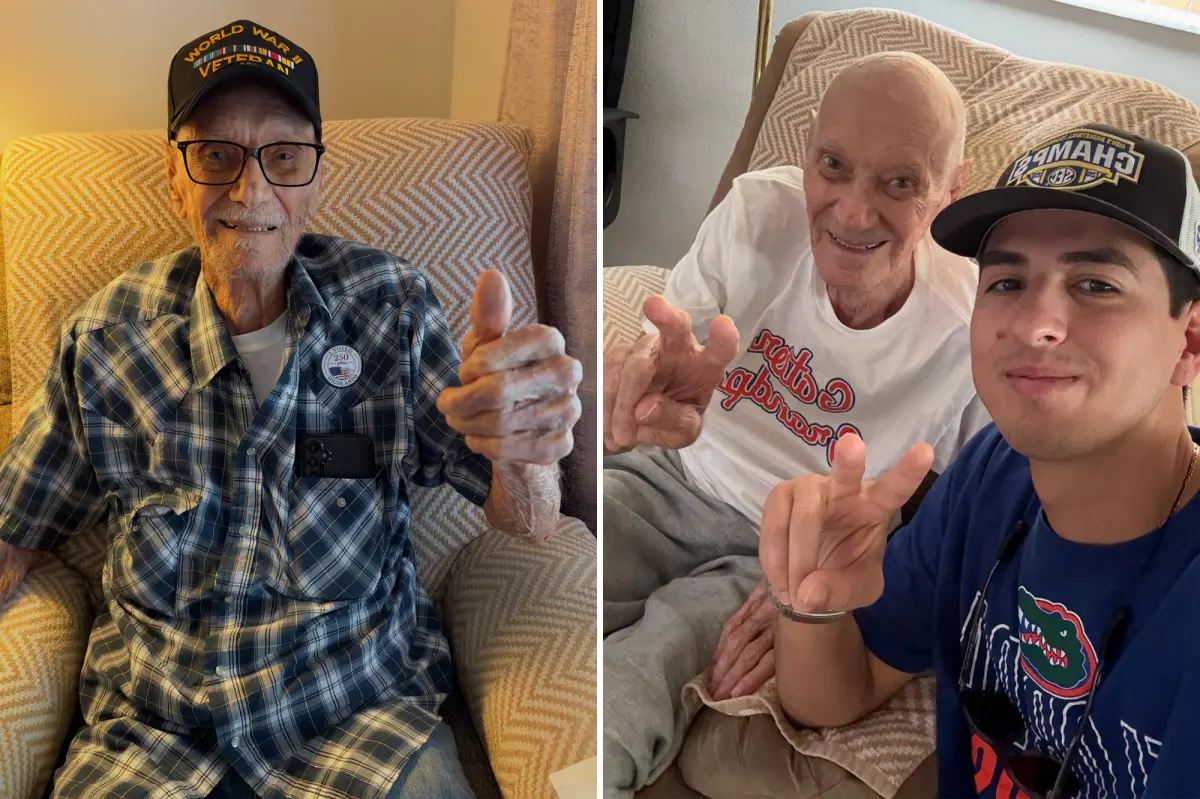
In a quiet corner of Lake Placid, Florida, an unlikely friendship has captured hearts around the world. Ross Longo, a 98-year-old Navy veteran who served in World War II and the Korean War, never expected to become a social media sensation. But when his 26-year-old neighbor Sevastian Munguia-Barajas began filming their everyday lives, the simple rituals of breakfast runs and grocery trips turned into a global celebration of service, family, and small-town kindness. Longo has lived next door to Munguia-Barajas and his parents for more than twenty years. With no relatives nearby, he was gradually welcomed into their family. “They adopted me, and I adopted them,” Longo says. “I consider him my grandpa, honestly,” adds Munguia-Barajas. Last month, the family took the final step by moving Longo into their home, making their bond official. For Longo, who has outlived most of his friends and loved ones, the daily company changed everything. The sentence sounds simple, but it carries the weight of a man who spent years alone and is no longer alone. What began as neighborly concern has become a profound friendship, one that has reminded millions of viewers that heroes do not need to be famous—they just need to be remembered. The account name says it all: @your98yearoldvet.
The viral success began almost by accident. Munguia-Barajas recorded an ordinary afternoon—walking over to Longo’s house, going out for breakfast, stopping at the grocery store. By morning, the clip had around a million views. It was a wake-up call: people were hungry for something tender and real. The page, now known simply as “Ross the Vet,” became a daily diary of an unlikely grandfather-grandson duo. There are videos of Longo giving practical advice to young people, with the blunt wisdom of a man who has seen everything and wasted little time on worry. There are trips to Taco Bell, Wendy’s, and Chick-fil-A, where Longo orders with the enthusiasm of a teenager and complains happily when the fries are cold. There are holiday dinners, birthday cakes, and quiet moments on the couch. None of it is staged. Munguia-Barajas does not plan content or chase trends; he simply brings his phone and records what matters to him. The world responded. Comments pour in from viewers who call Longo “Grandpa” and write messages of gratitude. The mail has become an event: letters from Australia, Hawaii, and all over the United States. Longo opens them with shaking hands, surprised every time that someone across an ocean knows his name. “They thank me for my service and that I’m up in age and how blessed I am, whatever,” he says. The “whatever” is pure Ross—humble, unsentimental, unwilling to make a fuss. But the fuss keeps growing.
What began as a personal friendship has become a mission. Munguia-Barajas and Longo do not just film their own outings; they use their platform to extend kindness to other veterans. In Highlands County, where roughly 15,000 veterans live, many of them older and alone, the pair have carried a birthday cake to a Vietnam veteran battling cancer, just so he would feel remembered. They have loaded Longo’s old recliners and scooter into a vehicle and delivered them to veterans who could not afford the basics. They pay for veterans’ meals at restaurants whenever they spot them. “Today, I paid for someone’s breakfast who was a veteran. I do that often, just to show appreciation to them because a lot of these guys get walked past,” Munguia-Barajas says. His compassion has not gone unnoticed. Fosters Outriders, a nonprofit that supports community caretakers, awarded him a Good Neighbor Grant for his work. The recognition is nice, but for Munguia-Barajas, the real reward is seeing Longo’s face light up when they help someone else. He has learned that gratitude is not a feeling; it is a practice. Every video, every act of service, says the same thing: no veteran should be forgotten. Longo, who spent decades without family nearby, knows what that loneliness feels like. Together, the two are building a safety net for the people who served a country that sometimes forgets to serve them.
Longo’s own service began when he was a teenager with a lie. Born in Connecticut and raised in St. Louis, Missouri, he was the son of Italian immigrants. In 1943, at the height of World War II, he enlisted in the Navy. He was only 15, two years below the minimum age, but he said he was older. “And they never asked no questions; they took me,” he remembers. “I went and took the physical, passed it.” His motivation was simple: his older brother, whom he idolized, had joined the Navy at 17. Longo told his mother he would go with him. That plan never worked out, but the brothers did meet at boot camp, a memory that still glows. Longo went on to serve six and a half years, deployed to Europe during World War II and later to Korea. The most harrowing moment of his military life came in Korea. He ran off a landing craft into what he did not realize was a bomb crater on the beach. He fell back onto the sand, and the soldiers behind him, moving under fire, trampled over his body. He was knocked out. When he came to, he was in a helicopter headed for a hospital boat. The diagnosis was eight broken ribs. It was a devastating injury, but he recovered and kept serving. More than 80 years later, he speaks of his time in uniform with quiet pride. “It’s an honor that I served. It means something to me deep down in my heart,” he says. That sentence has become a touchstone for the millions who follow his story.
After the Navy, Longo came home and began a curious, hardworking American life. He moved in with his parents in St. Louis, drove a dump truck, learned carpentry, and eventually became a country singer. The singing happened by accident: someone was looking for a performer, and his brother pushed him to audition. Longo knew only one song, Hank Williams’ “Your Cheatin’ Heart.” He started to sing, and before he could finish, a woman stopped him and told him he had the job. The pay was $340 a week—more than three times what he earned as a truck driver. It was the kind of luck that punctuates a long life. Longo married twice and was divorced both times. He has no nearby family of his own, but he gets by with a pension and Social Security. According to Munguia-Barajas, who helps manage his finances, the money is not enough to cover all his needs. So the younger man started a GoFundMe campaign, and strangers stepped up. More than $31,000 has been raised, enough to pay for in-home caregivers, groceries, and a little extra dignity. The generosity has been staggering. Longo has received gifts from brands he loves—Omaha Steaks, Crocs, Stouffer’s, and Gatorade—and fan mail from every corner of the globe. He and Munguia-Barajas make a weekly trip to the mailbox, partly out of habit, partly because the mail has become a ritual of joy. “He loves seeing what people sent him,” Munguia-Barajas says. “It shocks him.” The shock is understandable. A man who spent most of his life unnoticed has suddenly been embraced by the world.
What is the secret to living to 98 with no medicine? Longo answers with a shrug: “I have no idea what’s keeping me alive.” His younger friend has a theory: “Spinach. He eats a lot of spinach.” Or maybe it was the beer. Longo drank a beer every single day until the last six months, usually a Miller Lite or a Modelo. On Veterans Day, the two plan to share a meal and one of those beers in his honor. The holiday carries deep meaning for Longo, a reminder of a duty he has carried in his heart for more than eight decades. “I love my country very much,” he says. There is no irony, no cynicism, only the plain honesty of a man who fought for his flag at fifteen and never stopped loving it. Some viewers joke that spinach and beer are the secret; others say it is love. His story has touched people because it is not really about war or politics. It is about family—the family you are born into and the family you choose. A 26-year-old neighbor saw an old man alone and decided to do something. The old man, in turn, gave the young man a sense of purpose and an enormous amount of love. Together, they built a community out of a front porch, a cellphone camera, and a shared breakfast. Ross Longo may claim he does not know what keeps him alive. But watching him laugh, eat spinach, open his mail, and raise a glass to the country he loves, millions of people might know better. It is the recognition, the connection, the being needed. That can keep a person going for a very long time.