





Paragraph 1: The Dream of a Quiet Escape and the Unexpected Turn
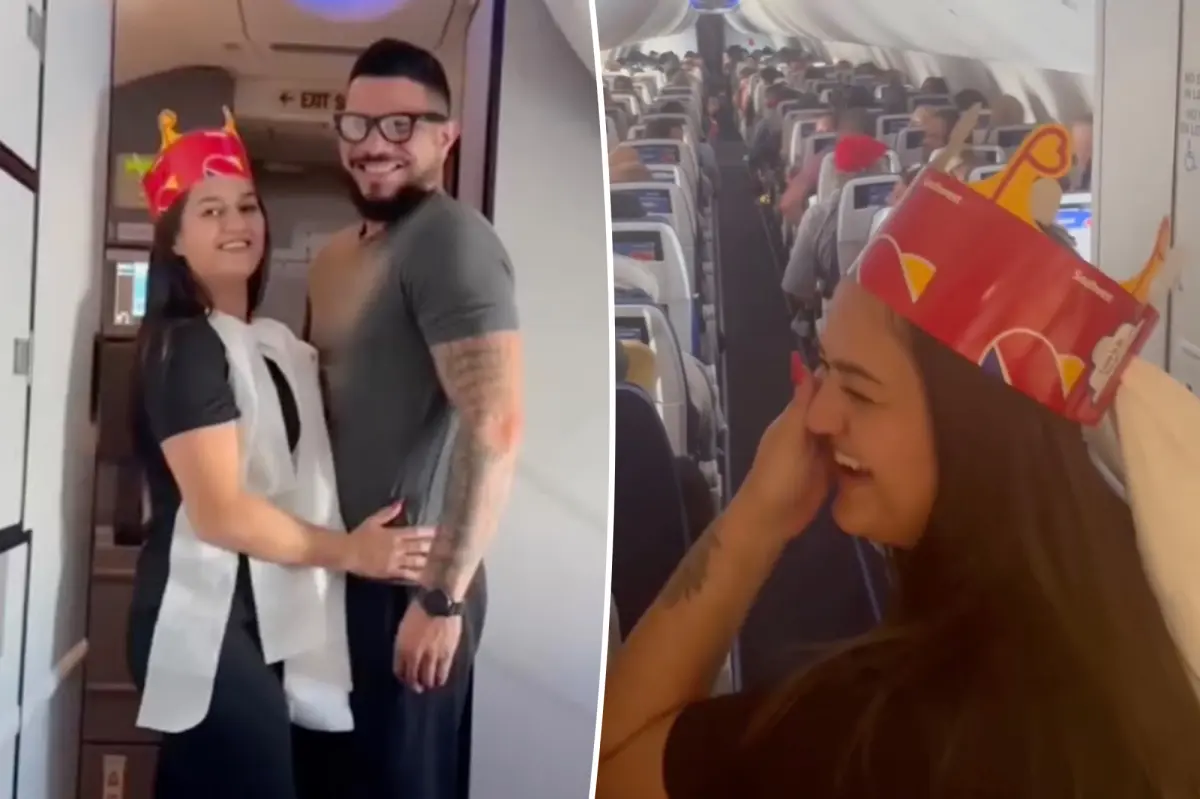
In the quiet, predictable hum of a commercial airliner cruising toward the neon glow of Las Vegas, a young couple, Sara Arroyo Montalvo and her partner, clutched their hands together, dreaming of a private, intimate elopement in a desert chapel. Like countless couples before them, they had envisioned a moment of nearly monastic seclusion—two souls standing before a hired officiant, surrounded not by the chatter of friends and family, but by the silent, glittering sprawl of the Mojave Desert, with nothing but the dry desert wind to witness their sacred promise. The flight itself was merely a means to an end, a monotonous prelude of stale cabin air, the drone of jet engines, and the occasional clatter of a beverage cart. But fate, as it often does, had other plans entirely. As the aircraft soared to a cruising altitude of 35,000 feet above the cloud-dusted earth, the ordinary mechanics of air travel were about to be completely upended by a burst of pure, chaotic, and overwhelmingly joyful humanity. They were flying with Southwest Airlines, their first time doing so, and unbeknownst to them, this particular flight crew was composed not just of safety professionals, but of spontaneous, creative wedding planners who were about to turn the entire cabin into a sanctuary of love. What began as a quiet ambition for solitude would morph into a breathtaking, once-in-a-lifetime spectacle performed before 178 rapt witnesses, proving that the most profound human connections can ignite in the most improbable of places—even a pressurized aluminum tube hurtling through the sky.
Paragraph 2: The Whispered Secret and the Captain’s Blessing
The transformation began organically, born from a simple moment of shared vulnerability. It is easy to imagine the scene: a flight attendant, leaning down to take a drink order, noticing the nervous, giddy energy radiating from Sara and her partner. Perhaps they mentioned the wedding—the tiny chapel they’d booked, the rings tucked safely in a carry-on bag—and their desire to keep things quiet and deeply personal. That simple disclosure acted as a spark. The flight attendants, those tireless, unsung heroes of the sky, looked at each other with a glimmer of mischief and profound empathy. They understood that an elopement is a declaration of individuality, but they also understood that love, in its purest form, yearns for celebration. So they devised a plan. They approached the captain, a figure of authority and gravitas in the cockpit, and revealed the couple’s secret. Yet, this was no ordinary captain. In a twist of almost poetic synchronicity, the pilot happened to hold a second, equally meaningful title: he was an ordained minister. It seemed as if the universe had conspired to eliminate every obstacle. The captain didn’t hesitate; he offered his services, ready to shift his role from navigating the aircraft to guiding two hearts into union. The couple, initially stunned, were swept up in the sheer audacity and charm of the proposal. The notion of being married by the person flying the plane—a man whose very job embodied precision and gravity—in front of a cabin full of complete strangers who were about to become their unwitting wedding guests, was overwhelming. Yet, as they looked into each other’s eyes, suspended between earth and sky, a profound sense of “yes” fell over them. It was the perfect marriage of the pragmatic and the poetic, a testament to the crew’s remarkable ability to humanize the sterile environment of a flight.
Paragraph 3: Crafting a Bride with Toilet Paper and Coffee Stir Sticks
With the officiant secured and the “guests” filling the seats, the greatest challenge remained: the details. A bride needs a dress, a veil, and a bouquet, but these are not typically found in the inventory of a passenger airliner. Yet, the crew’s creativity knew no bounds. They engaged in a frantic, joyful hunt through galleys and storage compartments, unearthing the most humble of supplies. The result was a sartorial masterpiece born of necessity and pure, unadulterated whimsy. For the veil and the wedding gown, they turned to the most readily available fabric in the sky: toilet paper. Sara was wrapped in a delicate, one-ply creation that crinkled softly with every movement—a dress that was undoubtedly transparent, structurally fragile, but shimmering with profound meaning. It wasn’t couture, but it was couture of the heart, fashioned with love and laughter. Her bouquet, a delightful nod to the caffeine-fueled journey they were on, was crafted from an armful of Southwest Airlines’ iconic coffee stir sticks, a green and gold tribute to the very vessel that carried their love. The absurdity of the scene—a bride in a toilet paper dress clutching a bundle of stir sticks—was not lost on anyone; rather, it served to dissolve all pretense and create an atmosphere of unbreakable joy. The passengers, who had boarded expecting a mundane flight, watched in awe as the cabin transformed into a studio of frantic, collaborative artistry. The flight attendants played the roles of stylists and handmaidens, carefully arranging the delicate paper, ensuring the “bride” looked as breathtaking as possible. In a world that often demands expensive, pristine weddings, this act of improvised styling served as a profound reminder that love’s purest expression is often found in the messiness of spontaneity.
Paragraph 4: Vows at Forty Thousand Feet, Witnessed by the Sky
The ceremony itself was a spectacle of pure, unfiltered emotion. The captain’s voice, usually reserved for weather updates and flight path announcements, softened into a melodic cadence, echoing over the public address system. He addressed the passengers, explaining the joyous occasion about to unfold, and the cabin erupted in applause and cheers. The narrow aisle of the Boeing jet became the sacred walkway. Sara, wrapped in her paper gown and veil, walked toward the front of the plane, her partner’s eyes welling with tears, the entire plane a silent, reverent congregation. 178 strangers became an impromptu family, holding their breaths, some dabbing at their eyes, capturing the moment on their phones—a digital testimony to a miracle witnessed at altitude. Vows were exchanged, the captain declared them married, and the plane shook not with turbulence, but with the collective roar of celebration from the passengers. It was a moment that transcended the mundane flight experience; here, at 35,000 feet, the air was thick with connection, love, and the remarkable power of human kindness. Later, reflecting on the whirlwind, Sara posted her gratitude on social media, writing, “Fate couldn’t have been more aligned.” She thanked the crew from the bottom of her heart, describing the trip as “unforgettable.” In her mind, the private elopement they had planned had been replaced by something far greater—a tapestry woven from the goodwill of strangers. The crew had not only married them; they had wrapped them in a blanket of human warmth, turning a private promise into a communal festival of joy that they would retell for the rest of their lives.
Paragraph 5: A Viral Sensation and the Logistics of Love
As the story took flight on social media, the world’s reaction was immediate and overwhelmingly positive. Comment sections flooded with emojis, congratulations, and heartfelt admiration for the crew’s thoughtfulness. Facebook users wrote phrases like, “This is the best thing ever!!! Would’ve loved to have been on that flight!” and “about the coolest wedding story I have ever heard of.” The narrative of the toilet paper dress and the coffee stirrer bouquet charmed millions, reminding a weary world of the power of innocent, spontaneous joy. However, in the midst of the romance, human curiosity inevitably shifted to the dry legalities of such an unconventional union. Commenters posed a flurry of practical questions: “I wonder what state their marriage license is in?” Others wondered how a captain, while flying over potentially multiple states, could legally sign a marriage certificate. At what latitude does the union become legally binding? While the romantic in everyone celebrated the moment, the pragmatist wondered about the bureaucratic hurdles awaiting the couple upon landing. Yet, this very confusion only amplified the charm of the event. The ambiguity of the legal jurisdiction only served to underscore the beautiful anarchy of the moment—a moment where love, not statute, ruled the day. It highlighted a delightful truth about modern love: that it refuses to be bound by conventional borders, just as the airplane itself was not. The story made headline news, picked up by Fox News Digital and others, who flocked to embrace the delightful oddity. It stood as a stark contrast to the traditional, stuffy weddings of yesteryear, proving that the heart of marriage lies not in the perfect venue, but in the perfect moment.
Paragraph 6: Golden Arches and the Universal Spirit of Celebration
Interestingly, this airborne union was not the only unconventional wedding making rounds in the news cycle recently. Fox News Digital had earlier reported on another couple who managed to turn the quintessential fast-food joint into a venue of matrimonial bliss. Jamie and George Callicoat, both employees at a McDonald’s in Akron, Ohio, recently tied the knot inside the very restaurant where they worked. Initially considering a getaway wedding, they were prompted by a district manager’s jokingly tossed suggestion to hold the ceremony right there under the golden arches. And they did. The restaurant was transformed, decorated for the occasion, with friends, family, and coworkers gathering to celebrate. The drive-thru, remarkably, remained open throughout the ceremony, a delightful surrealism that perfectly captured the couple’s working-class spirit. The wedding featured dinner, a cake, and a charmingly unconventional flower girl who carried petals in a Happy Meal box. When placed side-by-side, these two stories—one 35,000 feet in the sky wrapped in toilet paper, the other on the linoleum floors of a fast-food franchise—reveal a profound, humanizing truth. They dismantle the pervasive myth that a wedding must be perfect, expensive, or planned down to the last detail. Instead, they champion authenticity over aesthetics and connection over convention. They tell us that love doesn’t need a cathedral; it can be whispered over the roar of jet engines or between the sizzle of a griddle. It is the boundless creativity of the human heart, and the willingness of strangers and colleagues to join in that creativity, that truly makes a marriage—or rather, that makes a moment worth remembering for a lifetime. Sara Arroyo Montalvo’s wedding was fleeting, a brief interval between takeoff and landing, but its impact resonated far beyond the terminal, proving that sometimes, the best journeys are the ones we never planned.