




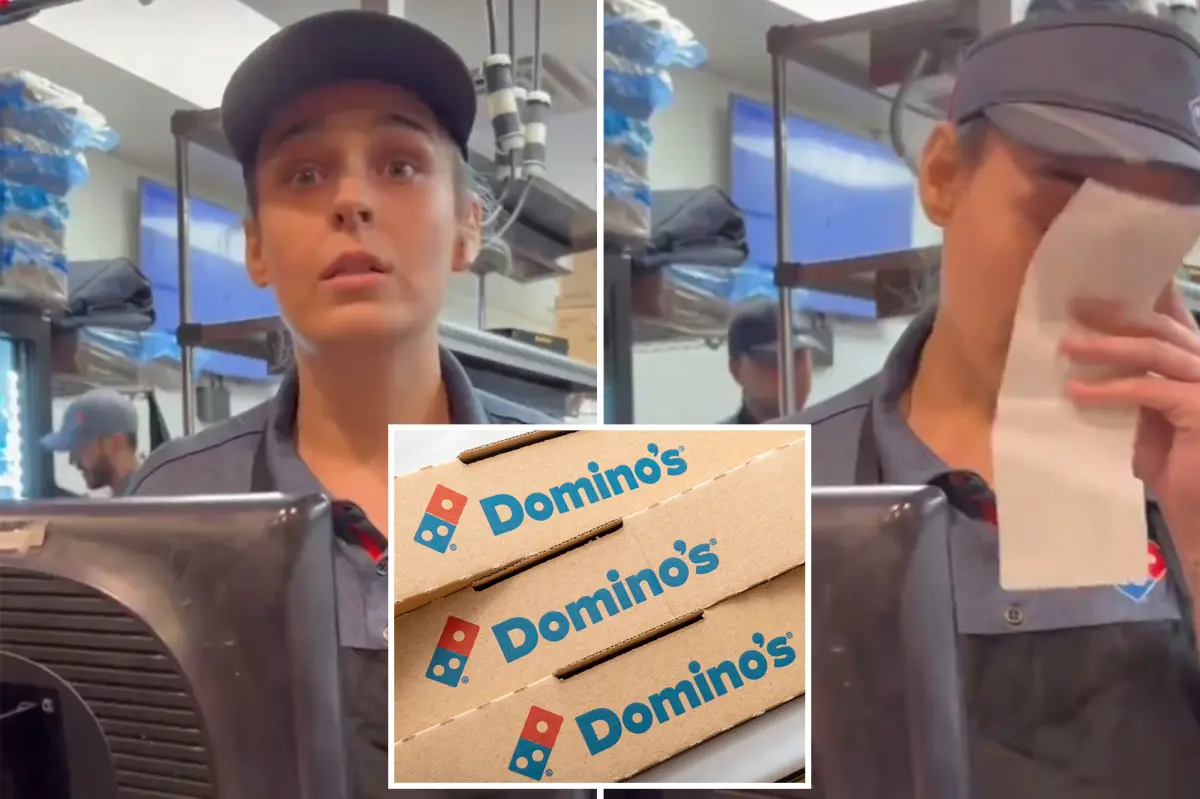
In a contemporary social landscape where almost every minor public grievance, awkward misunderstanding, or retail dispute is instantly captured on high-definition smartphones and broadcast to the digital coliseum, a recent viral video showcasing a tense, emotionally charged standoff inside a local Domino’s Pizza lobby has struck a deep, incredibly empathetic chord with millions of internet onlookers across the globe. At the absolute epicenter of this sudden digital whirlwind is a young front-line employee who managed to exhibit an almost superhuman level of composure, patience, and professional poise while being aggressively cornered by a group of highly frustrated, vocal customers who were demanding an immediate financial refund. The entire confrontation, which was recorded and subsequently uploaded to social media by one of the disgruntled guests in what appeared to be a misguided attempt to publicly shame the worker and rally online outrage to their cause, backfired in a spectacular and highly public fashion across multiple online platforms. Instead of generating the intended public sympathy for the unsatisfied customers who claimed their evening was ruined, the brief, raw clip rapidly transformed the poised young employee into an overnight folk hero for service industry workers everywhere, who instantly recognized her quiet, high-stakes struggle as a vivid reflection of their own daily professional battles. This brief but incredibly intense incident serves as a stark, microscopic window into the grueling, exhausting everyday reality of the modern fast-food and retail sectors, where front-facing staff members are routinely expected to absorb intense consumer hostility over low-stakes transactions while keeping their composure entirely intact under pressure. By examining the anatomy of this localized dispute, we gain valuable insight into a growing, highly palpable societal exhaustion with customer entitlement, ultimately elevating what could have easily been a forgotten, mundane workplace argument into a much broader, highly relevant cultural conversation about basic human decency, the exhausting nature of emotional labor, and the incredibly thin, stressful boundary that exists between professional tolerance and personal self-respect under the constant, looming threat of digital surveillance and public condemnation.
The physical anatomy of the dispute, as captured in the raw, shaky footage recorded from across the counter, centers on a fundamental disagreement regarding standard retail policies and basic common sense, beautifully illustrating the massive disconnect that often exists between consumer expectations and corporate realities on the ground. The group of customers had entered the establishment visibly upset, claiming with immense frustration and disappointment that the pizza they had previously purchased from the store was entirely “dry and nasty” and therefore, in their opinion, completely inedible and unworthy of payment. However, the critical point of contention arose when the employee calmly informed the group that she could not issue a direct cash or credit card refund because they had failed to bring the actual product—the physical pizza and its corresponding box—back to the store as tangible proof of their dissatisfaction. In an honest effort to resolve the issue amicably while strictly adhering to standard corporate operational procedures, the employee offered the group a compromise in the form of a store credit, which would allow them to redeem a free meal at a later date, but this standard peace offering was met with immediate, highly vocal rejection. “You could really just refund me,” one of the female customers pleaded in a tone mixed with desperation, disbelief, and irritation, insisting that the poor quality of the food alone should justify a return of their hard-earned money without any further bureaucratic hoops. The employee, maintaining a remarkably steady, soft-spoken, and polite tone, repeatedly offered the store credit, only to be met with the defensive excuse that the group lived an hour-and-a-half away from that particular location and would have absolutely no use for future store credits tied to a neighborhood they rarely visited. This geographical inconvenience, in the customers’ eyes, somehow invalidated the store’s standard operating procedures, creating a frustratingly circular argument where personal circumstances were expected to override standard corporate accountability and established protocol.
This difficult logistical standoff highlights a fascinating, deeply ingrained psychological disconnect between the general public and the operational structures of modern service businesses, where policies are often put in place to prevent systemic abuse but are perceived by customers as personal slights. The employee’s patient, repetitive explanation that “you gotta give back the product for me to give you a refund” is a foundational pillar of the retail and food service world, designed to ensure that businesses do not simply hand out free meals to anyone who claims to be unhappy after already consuming the food in its entirety in the privacy of their homes. Yet, to the frustrated group standing on the other side of the counter, this common-sense rule felt like an arbitrary, unnecessary obstacle erected solely to make their lives difficult, prompting them to snap back with complaints that such a requirement should have been explicitly detailed over the telephone before they made the long drive back to the shop. The retail worker, executing her duties with an admirable level of patience, gently characterized the entire situation as a mutual misunderstanding rather than an act of malice or deliberate poor service, reassuring the customers that while the situation was unfortunate, the rule remained absolute and non-negotiable. This portion of the interaction underscores the immense pressure placed on modern workers, who find themselves caught in the middle of corporate mandates they did not create and consumers who view corporate policies as flexible negotiations that can be bypassed through sheer persistence and volume. In these highly charged moments, the low-wage worker becomes an easy, accessible scapegoat for systemic frustrations, forced to defend complex or inconvenient regulations to angry patrons who often view the employee not as a human being earning a living, but as an inanimate obstacle to their immediate gratification and consumer desires.
As the verbal dispute continued to spin in circles without any viable resolution in sight, the emotional temperature of the lobby continued to rise, culminating in the customers accusing the young worker of possessing a hostile attitude and being intentionally disrespectful toward them. Despite her remarkably soft tone and her clear, repeated attempts to de-escalate the situation through compromise, the group insisted that she was being “really rude,” a common linguistic tactic often utilized in customer service settings to shift the blame onto an employee when a customer feels powerless to get their way. It was at this precise moment of heightened tension that the interaction took an unexpected turn, shifting from a typical customer service disagreement into a masterpiece of passive resistance and quiet, triumphant rebellion. Realizing that further logical explanation was completely futile and that she was talking to a brick wall of unyielding anger, the employee took a deep, centering breath, looked directly at the recording camera lens, blew a peaceful, theatrical kiss toward the confrontational group, and calmly wished them a warm and final “have a good night.” This sudden, disarmingly polite, yet undeniably sassy gesture completely disrupted the hostile momentum of the customers, leaving them momentarily speechless and utterly incredulous at her audacity to end the conversation on her own terms. “Did she just blow a kiss?” one shocked voice muttered off-camera, captured on tape as they struggled to process the fact that their attempts to intimidate, film, and break the worker’s professional stride had completely failed, leaving them empty-handed, utterly stymied, and socially outmaneuvered by a simple, elegant gesture of calm defiance. By refusing to play the role of the submissive victim, she reclaimed her power in a hostile workspace. Her dramatic, cinematic kiss acted as a shield against their verbal aggression, illustrating that composure does not mean submission, and that workers have the right to disengage when interactions cross the line from constructive dialogue into emotional abuse. This moment of brilliant theatricality underscored the absurdity of the conflict itself, showing that sometimes, the only rational response to an irrational situation is a touch of grace wrapped in supreme confidence.
Once the video found its way onto X, the social media platform formerly known as Twitter, it spread like wildfire across the internet landscape, racking up millions of views, thousands of shares, and triggering a massive deluge of commentary that was overwhelmingly supportive of the poise, boundaries, and quick-witted composure demonstrated by the Domino’s employee. Rather than joining the disgruntled customers in their vocal outrage, the vast majority of commentators were absolutely flabbergasted by the sheer audacity of demanding a financial refund for food that had apparently been entirely consumed or left at home. “Isn’t it basic, everyday common sense to actually bring the item back if you expect a refund?” asked the user who originally posted the now-famous video, pointing out the absurdity of the entire situation with a rhetorical question that resonated deeply with the online community at large. Other users chimed in with their own personal principles regarding dining out and customer etiquette, with one widely shared comment stating, “Good Lord! I don’t even like sending food back at a sit-down restaurant if they got my order wrong, so I can’t even begin to imagine asking for a full cash refund for what I already ate!” A third commentator stepped in to analyze the business logistics of the encounter, pointing out that while refund policies can certainly vary slightly from one establishment to another, some tangible form of physical proof or product return is universally expected in any legitimate business transaction. This collective internet reaction highlighted a deep, shared understanding that service workers are human beings who deserve to be treated with dignity, rather than as emotional punching bags for disgruntled consumers. The public jury had reached a swift, unanimous decision: the customers’ demands were completely unreasonable, and the employee’s defense of both her store’s policy and her personal boundaries was absolutely flawless.
Beyond the immediate internet humor and lighthearted memes generated by the employee’s now-iconic blown kiss, the viral incident has sparked a much deeper, highly necessary conversation about the state of labor, mental health, and customer relations in a post-pandemic society that has grown increasingly impatient, aggressive, and hostile. Many social media users went so far as to call directly on Domino’s corporate headquarters to notice the footage, with one enthusiastic commenter writing, “Wow! Give that woman a raise and promote her immediately! Well done, young lady,” praising her ability to protect both the company’s financial interests and her own personal mental peace simultaneously under immense pressure. When major media outlets, including Fox News Digital, reached out to the pizza chain’s corporate offices for an official statement regarding the incident and their employee’s handling of the situation, the corporate silence highlighted the delicate, often awkward position that large multinational corporations occupy when their front-facing, minimum-wage workers suddenly become the face of internet-famous disputes. Ultimately, this brief encounter at a local pizza counter serves as a powerful, enduring reminder of the essential humanity of service industry workers, who, despite earning modest wages, are expected to perform high-stakes emotional labor on a daily basis for the comfort of others. The anonymous young woman behind the register did not just defend a mundane, bureaucratic corporate refund policy; she defended her own peace of mind, showing the world that with a little grace, a steady heart, and a well-timed, peaceful gesture, it is entirely possible to stand tall, maintain one’s dignity, and successfully disarm hostility in a world that all too often demands retail workers give up their humanity for the price of a cheap pizza. Her actions invite us to reflect on our own behaviors as customers and to recognize that behind every plastic counter, steering wheel, or telephone line is a living, breathing person who deserves the exact same respect, patience, and kindness that we ourselves expect in return.