




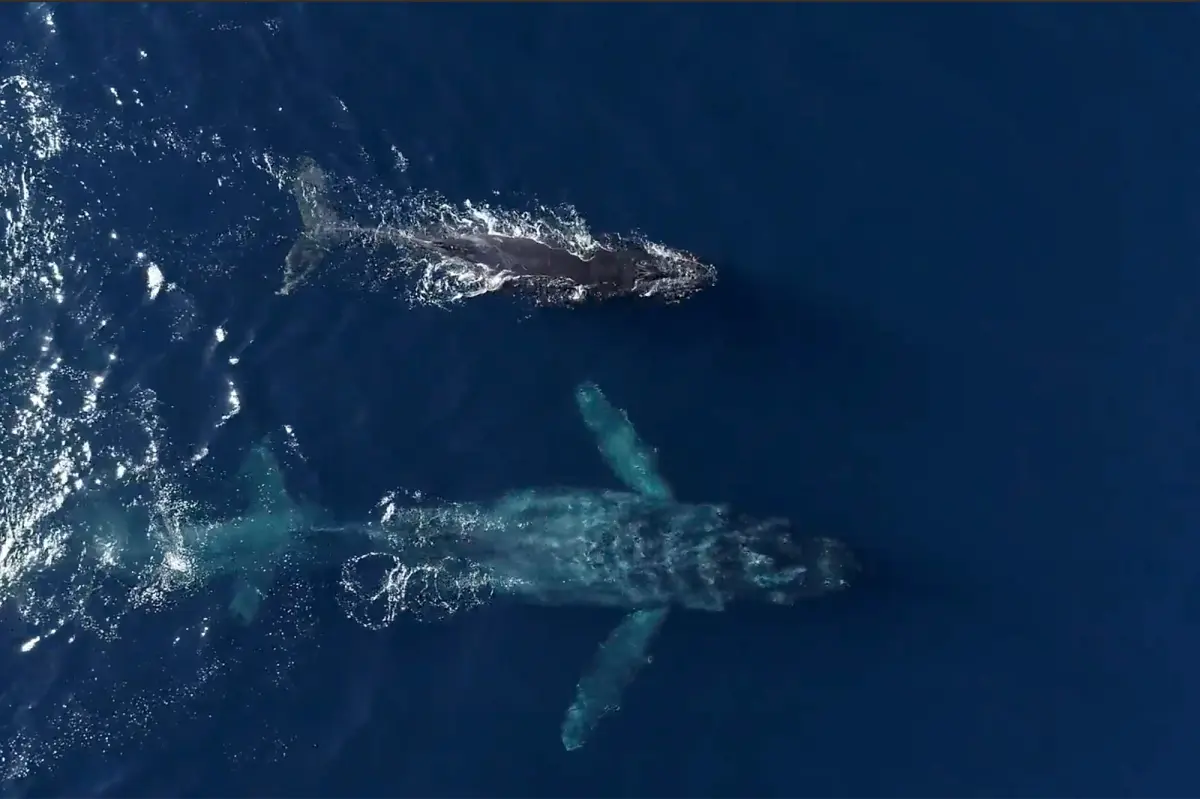
The Pacific Ocean off Southern California has transformed into a magnificent nursery, drawing whale watchers and marine enthusiasts to its shores for an unprecedented spectacle. The waters have become a stage for one of nature’s most awe-inspiring performances, starring a beloved and recognizable humpback whale affectionately nicknamed “Chompers.” This famous giant has made a triumphant return to the Newport Beach coastline, and this time, she hasn’t come alone. Swimming gracefully alongside the massive matriarch is her newest calf, a tiny miracle of nature that has sent waves of excitement through the local community and the scientific world alike. The pair have been spotted meandering through the waters, their journey a leisurely cruise from Laguna Beach to Newport, pausing to feed amidst a backdrop of hundreds of playful dolphins that seem to be celebrating the momentous occasion as much as the humans observing from boats. The sight of the enormous mother, known for her unique behavior, alongside her delicate, much smaller offspring gliding through the Pacific swells, has created a series of truly unforgettable moments for those fortunate enough to witness it.
Chompers, whose name is derived from her distinctive and peculiar feeding method, is no stranger to the Southern California coast. Unlike other humpbacks that typically lunge feed or create bubble nets to trap their prey, Chompers has developed a particularly unique style. She is famous for lifting her massive head completely out of the water, opening her enormous jaws, and snapping them shut in a behavior that resembles the chomping of a terrestrial predator. This unusual, almost curious action makes her incredibly easy to identify for researchers and whale watchers alike, even from a great distance. Her story is one of long-term observation and awe. First catalogued by the Cascadia Research Collective in 1991 as she fed in the Santa Barbara Channel, Chompers has been a living document of the health of the Pacific Ocean, with researchers meticulously documenting her whereabouts and behaviors for over three decades. She eagerly returned to the spotlight in 2014 when the local whale watching group, Newport Landing & Davey’s Locker, first spotted her off the Newport Beach coast, and since 2017, she has made an almost annual pilgrimage to the Golden State’s shores, bringing with her new life on three separate occasions.
The spectacle featuring Chompers is not an isolated event, as the arrival of another famous female humpback, affectionately known as “Chris,” has created a dual celebration along the Orange County coastline. Chris, a whale as equally beloved as Chompers, has also been spotted recently, and remarkably, she too is accompanied by a brand-new calf, which the whale watching team has christened “Snow Christal.” Chris holds a particularly special place in the hearts of local whale watchers, as she is the mother of “Snowflake,” a previous calf born during the 2016-2017 season. The return of Chris with a new baby is a poignant moment, marking the first time since Snowflake’s sighting in 2017 that the marine mammal has been seen with a new addition to her family. Through a series of adorable photographs and gripping video clips, the giant whales have been captured playing with their offspring, breaching the ocean surface, and gliding gracefully through the water, their massive tails slapping the surface and sending sprays of ocean spray into the air, much to the delight of onlookers.
The recent activity has brought profound meaning and excitement to the waters, representing a generational return that feels almost like a homecoming. The sight of these familiar mothers returning to their known feeding grounds with their new calves is a testament to the health and productivity of the marine ecosystem in the region. “It has made for a remarkable couple of weeks in Newport Beach, with familiar whales returning to our coastline, this time with the next generation swimming beside them,” a representative from the whale watching group shared, perfectly capturing the sentiment felt by all who have witnessed the event. The pair of famed humpbacks and their young have been taking full advantage of the productive Southern California feeding grounds, foraging for food in an area teeming with life. This rich bounty is the primary reason for the consistent and breathtaking activity that has occurred over the last two weeks, as the local food web provides the necessary sustenance for nursing mothers to support their newly born offspring and replenish their own energy reserves.
Observing these magnificent creatures, each weighing up to an astonishing 40 tons and stretching as long as 50 feet, is a humbling experience, but identifying them requires a more delicate glance. While Chompers’ unique chomping behavior makes her identification a simple task, most humpback whales are identified by a single, unique characteristic: the underside of their tail fin, or fluke. Much like human thumbprints, the black and white pigmentation pattern, along with the unique scarring and serrations on the trailing edge of the fluke, are entirely unique to each individual whale. Researchers and citizen scientists alike meticulously photograph these flukes to build catalogs of known individuals, allowing them to track migration patterns, longevity, and reproductive histories. This method is how a whale like Chris is instantly recognized upon her return, seamlessly connecting her past sightings in 2017 with her new status as a mother in the present day.
For those who follow these gentle giants, the sight of a mother with her calf is a powerful reminder of the often hidden intimacies of the ocean and the lives of its largest inhabitants. The journey of a humpback whale is one of vast migrations, covering thousands of miles between warm, tropical breeding grounds and the cold, nutrient-rich feeding grounds like those off California. The fact that these whales choose to return year after year to the same general areas speaks volumes about the health of the local environment and provides a beacon of hope for the recovery and persistence of the species. The reunion of Chompers and Chris with their calves off the shores of Newport Beach is not just a spectacle for eager onlookers; it is a profound success story, a symbol of resilience and the enduring cycle of life in the world’s oceans. This rare, two-in-one event allows scientists a unique opportunity to study the behavior of known mothers with their newborn calves, providing crucial data for ongoing conservation efforts and a heartwarming narrative that connects people across the globe to the wild, mysterious, and beautiful world that exists just beyond the breaking waves.