





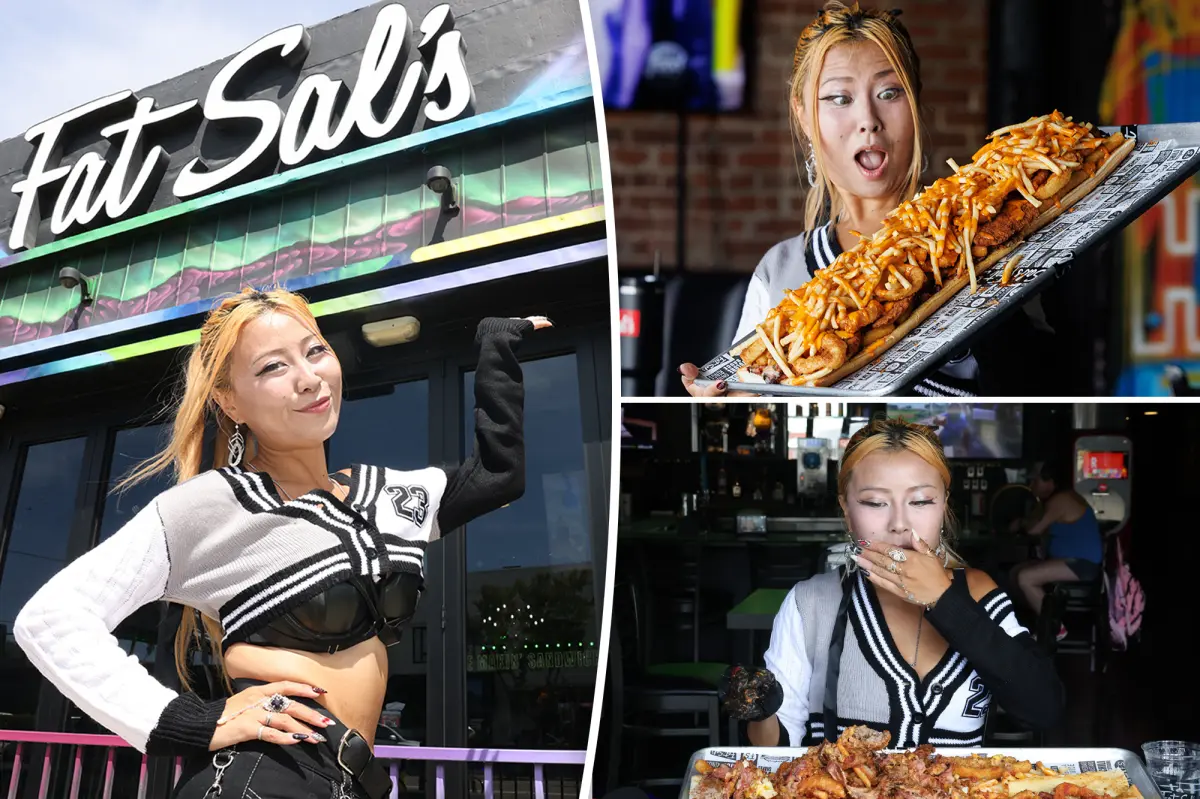
In the glittering, often delusional world of Los Angeles food culture, where kale smoothies and gluten-free avo-toasts typically reign supreme, there exists a monument to pure, unadulterated excess. Fat Sal’s, a beloved institution known for its gloriously messy, decadent creations, has never been one for subtlety. But even by its own notoriously over-the-top standards, one particular offering stands as a towering, trembling testament to culinary ambition and sheer human stubbornness: The Big Fat Fatty. This is not merely a sandwich; it is an event, a dare, a logistical nightmare that defies the very laws of physics and appetite. Stretching an unbelievable 30 inches in length and capable of weighing up to a hernia-inducing 14 pounds, it is a beast that demands respect, strategy, and a serious commitment to cardiac risk.
The sheer scope of the challenge is designed to intimidate from the moment it slides across the counter. The rules are brutally simple: one person, a strict 40-minute time limit, and absolutely no leftovers are permitted. For the uninitiated, attempting to conquer this behemoth alone is a fool’s errand. In the years since its inception, more than a thousand brave souls have stepped up to the plate, armed with napkins and bravado, only to be humbled by the sheer volume of food. According to Josh Cook, the VP of Operations, this monumental creation is not a recent marketing gimmick but rather a foundational piece of the deli’s lore, dating all the way back to its grand opening in 2010. The founders, Josh Stone and Sal Capek, were avid fans of television shows like “Man v. Food” and “Diners, Drive-Ins and Dives,” programs that celebrate the kind of gut-busting, over-engineered meals that seem to exist only in the American imagination. Inspired by these heroes of excess, they set out to create a challenge of their own that would etch their names into the hall of fame of competitive eating.
To fully grasp the magnitude of the Big Fat Fatty, one must first deconstruct its monstrous architecture. Imagine, if you will, a 30-inch sub roll, its integrity already questionable, being forced to accommodate a staggering array of ingredients that have no business being on the same plate, let alone the same bun. Inside this carb-loaded fortress lie two formidable cheeseburgers, their greasy patties glistening. These are joined by a pile of crispy fried eggs, their yolks ready to burst, and a generous helping of salty, smoky bacon. As if that weren’t enough, the sandwich is then loaded with a full Philly cheesesteak, complete with melted cheese and sautéed peppers and onions, alongside substantial slices of savory pastrami. But the madness does not end there. The creators have also seen fit to include an entire portion of crispy chicken fingers, more commonly found in a kid’s meal than next to pastrami. Adding to the deep-fried chaos are mozzarella sticks and onion rings, each contributing their own layer of grease and crunch. The entire towering edifice is then drenched in a hearty chili, smothered in rich marinara sauce, and buried under a mountain of golden French fries. To top it all off, a signature drizzle of Fat Sal’s legendary “Fat Sauce”—a secret concoction that has garnered its own cult following—binds this Frankenstein’s monster of a meal together into a single, terrifying, and surprisingly cohesive unit.
The genius of the Big Fat Fatty lies not just in its size, but in the psychological warfare it wages on its challengers. Social media personality and competitive eater Raina Huang, currently in her offseason, recently visited the Hollywood location to see what all the fuss was about. Knowing better than to commit to the full 40-minute ordeal while not in prime competition shape, she cleverly gave herself a 10-minute window to assess the damage she could inflict. Her verdict was both astute and relatable. She noted that the sandwich is “very heavy and dense,” a profound understatement for a meal that could likely sustain a small village for a week. Crucially, she pointed out the absence of any fresh vegetables to cut through the overwhelming richness. There is no crisp lettuce, no juicy tomato, no tangy pickle to offer respite. It is an unrelenting, savory onslaught of meat, fried food, and sauce, leaving the eater with nothing but pure, unfiltered protein and carbs to battle against. It is a war of attrition with your own esophagus.
The historical context of the challenge adds another layer of legend to the experience. The success rate is astronomically low; of the over 1,000 people who have attempted this feat of consumption, a mere six individuals have managed to conquer the beast in its entirety. This elite group, a veritable Mount Rushmore of competitive eating, has earned their place in Fat Sal’s lore. The rewards for such a monumental achievement are not just the fleeting glory of victory but also tangible compensation: their money refunded in full, plus a coveted Fat Sal’s swag bag filled with merchandise and gift cards. This incentive structure cleverly plays on the human psyche—the idea of getting a free meal is appealing, but the bragging rights that come from being one of the few to ever finish the sandwich is priceless. For the other 994 or so hopefuls, the cost of the challenge is a self-inflicted wound, a culinary tuition fee paid in exchange for a lesson in humility and the realization that perhaps, just perhaps, human beings aren’t meant to consume 14 pounds of food in one sitting.
Watching a challenger attempt the Big Fat Fatty is a spectator sport in itself. The initial bravado is palpable as they roll up their sleeves and survey their mountainous foe. The first five minutes are usually filled with confident, aggressive bites, often accompanied by encouraging cheers from friends. By the ten-minute mark, the pace slows down perceptibly. The breathing becomes heavier. The napkin is used less for wiping and more for mopping the sweat from the brow. The sheer monotony of chewing through endless layers of meat and batter can induce a sort of hypnotic fatigue. As the 40-minute deadline looms, the challenger’s face often transitions from determination to a dazed, thousand-yard stare. It is a primal conflict between the willpower of the mind and the finite capacity of the human stomach. The sandwich, with its gravity well of grease, begins to feel like a monolith that only grows larger with each bite, a cosmic joke served on a metal tray.
In the end, the Big Fat Fatty is more than just a meal; it is a modern-day myth, a rite of passage for those who dare to test the limits of their own body. It speaks to a uniquely American fascination with spectacle and excess, a celebration of the “more is better” philosophy taken to its logical, terrifying conclusion. Fat Sal’s has successfully created an icon, a piece of pop culture that exists beyond the confines of its deli cases. The sandwich has become a destination in itself, drawing in curious tourists, seasoned eaters, and YouTube thrill-seekers who want to document their brush with culinary legend. While you might not want to attempt the full challenge yourself, simply witnessing the sheer audacity of its construction—the mountain of food that defies all reason—is an experience in itself. It’s a reminder that in the sprawling, diverse landscape of Los Angeles, there is always room for something new, something crazy, and something gloriously, gut-bustingly excessive. It is a shrine to the indomitable human spirit (and a tribute to the power of a truly great deli) where victory is measured not in points or trophies, but in the simple, profound act of clearing your plate.