






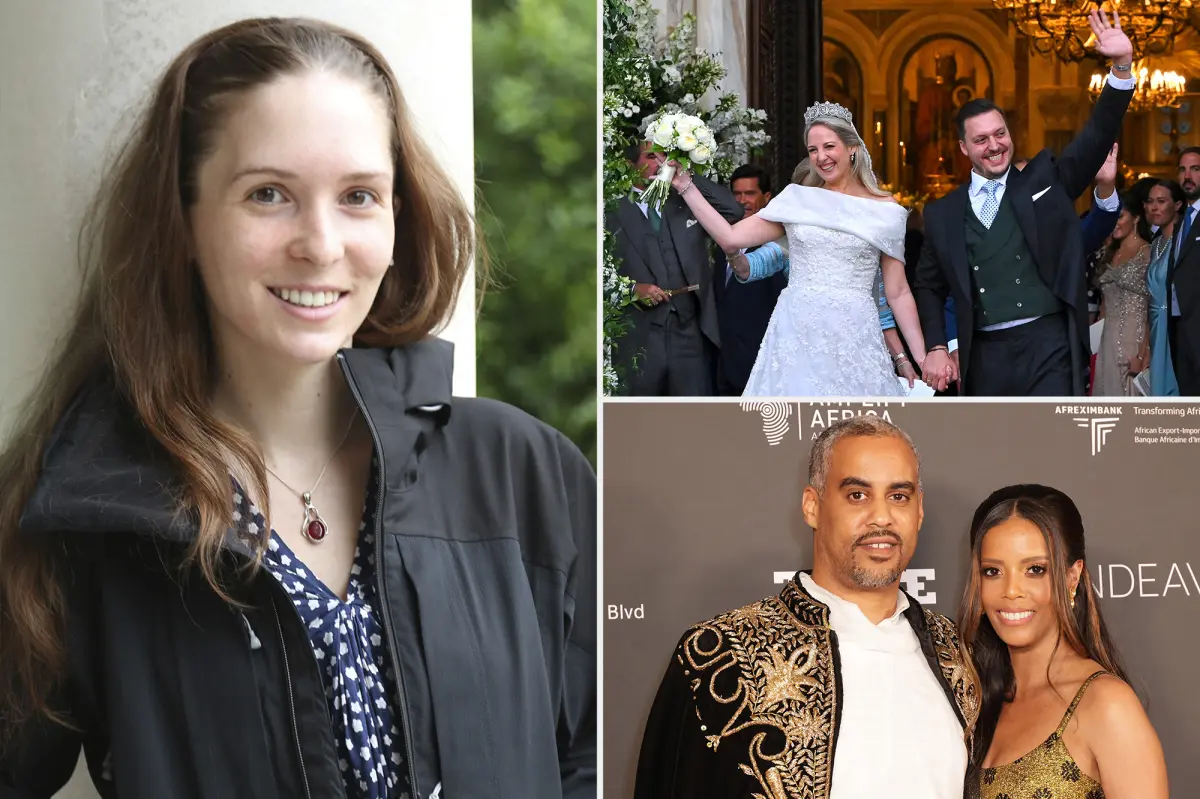
While Prince Harry and Meghan, Duchess of Sussex, are reportedly packing up their jam-packed Montecito mansion, their California neighbors are said to be absolutely thrilled at the prospect of seeing the high-profile couple vamoose. The Netflix crews, the security entourages, the traffic jams, the constant paparazzi helicopters—all of it has apparently worn thin in the wealthy seaside enclave. But here’s the thing: not every blue-blooded resident of the United States is a royal pain in the behind. In fact, just like that 26-year-old car salesman who suddenly became a Belgian prince this week, many of America’s aristocrats are living remarkably ordinary lives. They work in normal offices, live in modest suburban homes, send their kids to public school and soccer practice, and shop at chain stores. They are lawyers, doctoral students, healers, gemologists, media executives, soap opera actresses, and even hot dog vendors. They don’t all have Netflix crews trailing them. They don’t all have security details blocking rush-hour traffic. They’re not all trying to sell their own brand of royal drama. Instead, many of them are quietly building careers, raising families, and figuring out how to be both royal and human in a country that doesn’t really have a playbook for that kind of dual identity.
Take Raiyah Bint Al Hussain, for example. She is the 40-year-old daughter of the late King Hussein of Jordan and his beloved American-born wife, Queen Noor, originally Lisa Najeeb Halaby. Born into a world of Middle Eastern royalty, Raiyah could easily have spent her life in palaces and royal receptions. Instead, she charted her own academic course, graduating from the University of Edinburgh with a master’s degree in Japanese Studies before moving to New York City’s Upper West Side to study at Columbia University. Now based in Los Angeles, she is a doctoral student at UCLA, and she speaks Arabic, English, and Japanese fluently, with proficiency in Mandarin as an added bonus. There is something deeply grounding about a princess who spends her days buried in research, navigating the layered histories of languages and cultures rather than presiding over state banquets. And she is not alone in California’s quiet royal underground. Consider Dorian Neumann von Héthárs, the daughter of the late baronet John Neumann Ritter von Héthárs, a member of Austro-Hungarian nobility, and her mother Monica Ann Ford, a model and dancer who once toured with the legendary Nina Simone. Dorian could have leaned into her aristocratic European lineage and lived off the mystique. Instead, she runs Neu Breath, a healing center in Los Angeles that focuses on mind-body fusion, with a special focus on pregnancy, birth, and recovery for new mothers. She uses her time and energy to help women heal, not to cultivate a celebrity brand. That kind of work doesn’t make tabloid headlines, but it has a far more lasting impact than any red carpet appearance.
In Washington, D.C., there is another prince quietly making a name for himself. Prince Joel David Makonnen Haile Selassie is a descendant of Ethiopian emperor Haile Selassie I, one of the most significant figures in African history, and he carries that weight with grace. He is a graduate of both American University and Howard University’s School of Law, and he now runs Wax and Gold, a media and entertainment firm focused, in his words, on “powerful Black stories that inspire global audiences.” That’s not just a mission statement; it’s a commitment to storytelling that challenges stereotypes and amplifies voices that have too often been marginalized. And let’s not forget the deliciously unexpected detail that he is also a Knicks fan, which makes him a low-key king of New York in the hearts of anyone who has ever suffered through a Knicks season. Then there’s Princess Theodora of Greece and Denmark, who might look familiar for a very different reason. She is the 43-year-old daughter of the deposed Greek king Constantine II and his wife, Anne-Marie of Denmark, but she has spent the last 15 years playing the scheming secretary Alison Montgomery on the long-running soap opera, “The Bold and the Beautiful.” There’s something wonderfully surreal about a real-life princess pretending to be a dramatic soap character for a living. She married lawyer Matthew Kumar in 2024, just months before she finally obtained official Greek citizenship, a bureaucratic win that must have felt deeply personal for a woman whose family history has been tangled in politics and exile. In March, she pulled the ultimate “real girl” move by showing up to a red carpet wearing a polka dot dress from Zara that originally sold for $109. And it looked amazing. That’s the kind of princess many people can actually relate to: one who knows that style doesn’t require a royal couture budget.
Meanwhile, in New York, there is a life story that honestly sounds like a soap opera, except it’s completely true. Vacharaesorn Vivacharawongse, 45, is a lawyer living in Mount Vernon, but his path to the American Dream was anything but straight. Born to Thailand’s King Maha Vajiralongkorn and his then-queen Sujarinee, Vacharaesorn was exiled with his family in 1996 as a teenager after accusations of adultery swept the Thai kingdom. Imagine being born into one of the most elevated royal families in Southeast Asia, only to find yourself suddenly cast out. He moved to Florida with his family and, at one point, got a job selling hot dogs at NASCAR races. Hot dogs. At a stock car race. That’s not exactly what you picture when you imagine exiled royalty. But he didn’t let circumstance define him. He later graduated from George Washington University’s law school, built a legal career in New York, and in 2023 returned to Thailand to visit hospitals and help establish an advocacy fund for Thai students based in the States. He is also an ordained Buddhist monk. The breadth of his life experience is astonishing: from royal privilege to exile to hot dog stands to law school to monastic ordination to advocacy work. If anything, that trajectory has likely made him far more compassionate and grounded than most people who were born into privilege and never lost it. On the East Coast, another prince has carved out a different kind of cultural role. Prince Dimitri of Yugoslavia, 68, is a familiar face at local New York foodie haunts like Il Posto Accanto and Indochine, where he holds court with friends and fellow connoisseurs. A trained gemologist who worked as the senior vice president of jewelry at Sotheby’s, he now creates intricate pieces that fuse precious stones with polished wood. In 2020, he published “Once Upon a Diamond” with writer Lavinia Branca Snyder, a jewelry guide that explores the royal gem stashes of various European empires. There is something poetic about a prince who collects and creates beautiful objects, turning the scattered remnants of royal history into wearable art.
And then there is Victoria de Lesseps, who might just be America’s favorite royal psychic medium—although she would probably prefer that you not call her the Queen of the Dead, please. The 31-year-old is best known as the daughter of Luann de Lesseps, the “Countess” who married into a French diplomatic family, became a Real Housewife, and somehow became a chart-topper with the delightfully kooky 2010 club chant, “Money Can’t Buy You Class.” That title alone is practically a thesis on the relationship between wealth, status, and authenticity. Victoria grew up in that glittery, reality-television-adjacent world, but she has chosen a different path. Now a psychic medium and spirit healer living in Sag Harbor, she is currently at work on her first fantasy novel while offering her services as a life coach and intuitive online. She has turned her own life into a kind of spiritual practice, blending the theatrical drama of her family background with a quieter, more introspective calling. There is clearly a deep creativity running through her veins, and rather than leaning on her mother’s fame, she is building her own identity around healing, storytelling, and perhaps a bit of magic. That’s a wonderfully human way to navigate the complicated legacy of a family that lives in the strange intersection of European nobility, reality TV, and global pop culture. She isn’t chasing the crown; she’s chasing meaning, one session, one chapter, one spirit at a time.
Taken together, these lives complicate the easy stereotype of what it means to be a royal in America. Not every blue blood is causing traffic jams or fleeing with Netflix crews in tow. Not every aristocratic transplant is using their title to gain VIP access at clubs or asking for special treatment at restaurants. The United States is full of people with extraordinary bloodlines who are simply trying to live meaningful lives. They are doctoral students, lawyers, healers, entertainers, gemologists, monks, and novelists. They live in Los Angeles, Washington D.C., Mount Vernon, New York, and Sag Harbor. They wear Zara dresses and sell hot dogs at NASCAR races. They struggle with citizenship, navigate exile, and search for belonging just like so many immigrants and children of immigrants do. Being royal can mean many things, and one of the most beautiful things it can mean is simply showing up as a person, flawed and human, doing the quiet work of building a life. If Harry and Meghan are indeed leaving Montecito, their neighbors may be thrilled, but the rest of America’s aristocrats prove that there is no single way to wear an old title. Maybe the most royal thing of all is to find the ordinary—study, work, love, friendship, healing—and transform it into something that matters. That is the true inheritance these blue-blooded Americans carry: not crowns, but character; not palaces, but purpose.