



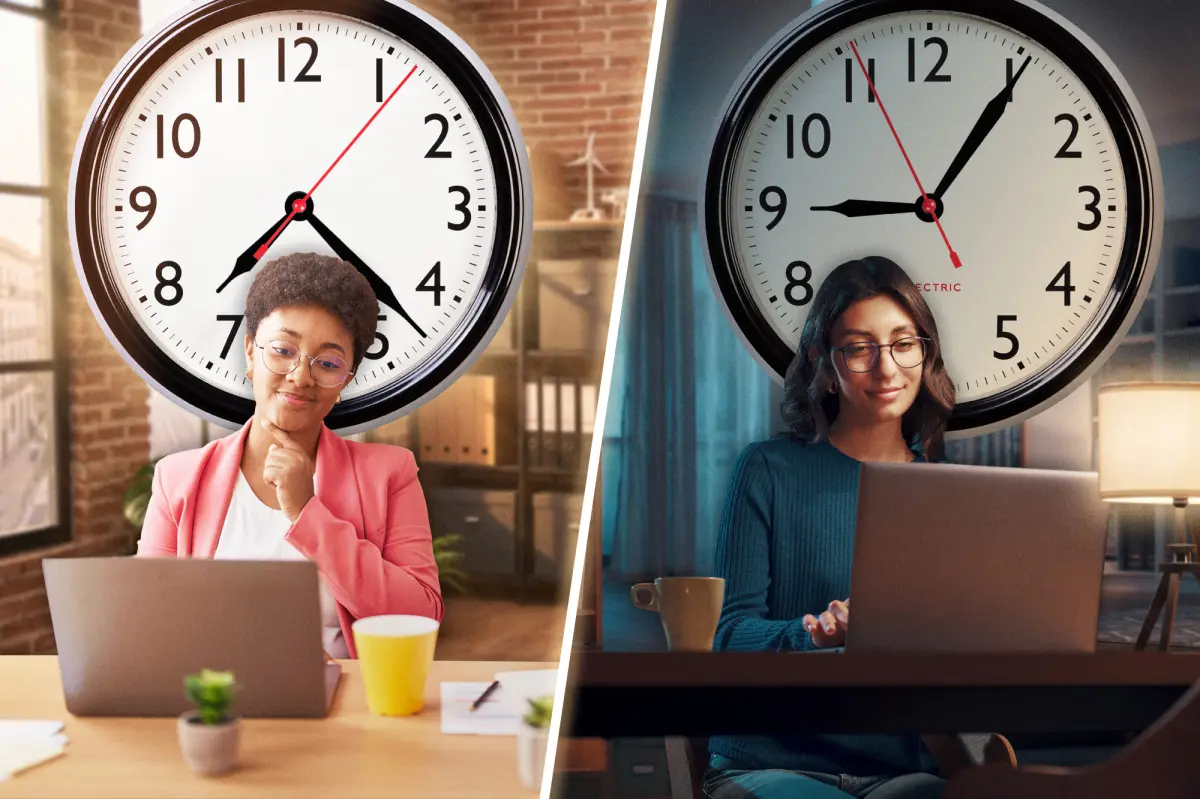
Let’s be honest: “I’m just not a morning person” has never been enough to get anyone out of a 9 a.m. status meeting. But lately that complaint has been upgraded into something with a name, a research base, and a growing fan club. It’s called chronoworking, and it’s the newest workplace buzzword to split offices into two camps: the people who think it’s the future of work, and the people who think it’s just a fancy excuse for dodging the schedule everyone else has to follow. The premise is simple. Human beings are not identical machines that boot up at the same time and run at the same speed until 5 p.m. Some of us are at our sharpest before sunrise and nearly useless after lunch; others are barely conscious at 9 a.m. and writing their best code or prose after midnight. Chronoworking—a term coined by British journalist Ellen C. Scott—says we should stop pretending that a one-size-fits-all workday makes sense. Instead, it argues, let people work when their internal clocks actually fire. In a return-to-office era where managers are already fighting over bums in seats, this idea has become a flashpoint. For workers, it feels like self-advocacy, a way to finally say, “I do better when I’m allowed to do things my way.” For bosses, it feels like a scheduling headache, a slippery slope toward everyone making up their own hours and no one ever being online at the same time. Both sides have a point, and that’s exactly why chronoworking has become such a messy, passionate, and very modern workplace fight.
The science behind the trend is real, and it’s not just about personal preference. Clinical psychologist and sleep expert Dr. Michael Breus, who developed one of the most widely cited chronotype systems, estimates that 55% of people hit their peak between 10 a.m. and 2 p.m. Fifteen percent are sharpest in the early morning, another 15% are at their best at night, and the remaining 10% have irregular, easily disrupted rhythms. That means a significant minority of the workforce is being asked to perform at a time when their brain is not fully online. A 2023 survey of 1,500 American workers by MyPerfectResume found that 94% said they are currently working outside their preferred hours, and 77% said that mismatch hurts their job performance. Researchers have found real consequences to ignoring chronotype. Organizational-behavior expert Christopher Barnes at the University of Washington has shown that “larks” behave less ethically late at night, while “owls” behave less ethically early in the morning—not because they’re bad people, but because their self-control and judgment are depleted when they’re fighting their own biology. Dr. Celine Vetter, a circadian rhythm researcher, has linked work-schedule misalignment to elevated Type 2 diabetes risk in a major nursing study. She estimates that roughly 80% of people work on a schedule that clashes with their internal clock. That’s a powerful argument for flexibility. But the science also comes with an important caveat that gets lost in the TikTok-era coverage: no serious researcher is saying your chronotype entitles you to skip meetings or redesign an entire team’s calendar around your sleep preferences. The evidence supports modest, sensible flexibility—maybe shifting your start time by an hour or two—not a blank check to disappear until noon.
For some people, chronoworking is already a way of life, and their stories make the idea feel both beautiful and slightly out of reach for the rest of us. Eloise Skinner, a 32-year-old writer, fitness coach, and therapist in London, doesn’t open her laptop until around 11 a.m. She teaches gym classes in the afternoon or early evening, and saves her most demanding work for after 7:30 p.m., when, as she puts it, “the world has gone quiet.” Skinner is a self-described night owl, and she’s built her entire career around the fact that her focus peaks at 9 or 10 p.m. “It may seem a bit extreme,” she admits, “but that’s when I’m most efficient.” On the opposite end of the clock, Stephanie Mickelson, a freelance writer and mother of three, has spent the last five years waking up at 4:30 a.m. so she can write before the rest of the house wakes up. She says she naturally feels sharpest pre-5 a.m., and even when she has hours of free time ahead of her, she still does her most focused work in the morning. Her routine started as survival—when her kids were a newborn, a 2-year-old, and a 4-year-old, mornings were the only uninterrupted stretch she could get—but it stuck. Now that her kids are in school, she still can’t shake the early start. “I don’t love it,” she says of her current 5 a.m. wakeup, “but there’s just so much time to sit and write and drink coffee.” Even when she taught middle school English, she front-loaded her grading and lesson planning in the early morning rather than staying late. But she’s also refreshingly honest about what made that possible: “The complete flexibility to work when I work best is definitely only possible because of freelancing.” That single sentence is the built-in asterisk on almost every chronoworking success story. The people who can do it most fully are the people who answer to no one, which means the real fight over chronoworking is happening inside traditional offices, not outside them.
Inside those traditional offices, some employers are trying to make chronoworking work without chaos. Tawn Williams, a corporate wellness consultant and founder of House of Anaya, says the concept has spread mostly among freelancers and solo entrepreneurs, where less need for synchronized team meetings effectively creates a “create your own schedule” culture. Larger organizations, she says, have quietly absorbed pieces of chronoworking through remote and hybrid policies, “although these adaptations are often vaguely defined and less structured.” A few companies are building it into official policy rather than letting it happen informally. Julia Lyons-Ryle, an HR performance specialist with Insperity in Austin, Texas, recommends flex schedules with protected overlap hours. Instead of everyone working 9 to 5, employees might work 10 a.m. to 6 p.m., but everyone has to be online from noon to 2 p.m. so teams can still meet, collaborate, and feel like they exist in the same organization. That compromise sounds simple, but it solves the biggest problem with chronoworking: communication. If you don’t know when your teammate is available, you end up sending messages into the void, waiting until tomorrow for an answer, or accidentally scheduling meetings that exclude half the team. Lyons-Ryle emphasizes that the biggest risk isn’t the schedule itself—it’s the communication gap it creates. Team members and managers need to know one another’s working hours so they can actually work together. This is the version of chronoworking that has a chance of surviving contact with corporate reality. It’s not radical. It’s not “everyone decides their own hours forever.” It’s just a more human version of the 9-to-5, with a little breathing room for people who think better at different times of day.
Of course, not everyone is buying it. Psychotherapist Amy Morin, author of “13 Things Mentally Strong People Don’t Do,” is one of the more clear-eyed voices in the debate. She points out that for some companies, flexible scheduling simply isn’t an option because of deadlines, business hours, and the basic need to serve customers at predictable times. She also reminds us that chronotype doesn’t operate in a vacuum. A natural night owl might still have kids who wake up at 6 a.m., forcing an early schedule regardless of biology. A morning person might work in a field where the action doesn’t start until noon. Our bodies have rhythms, but so do our families, our teams, and our industries—and sometimes those rhythms just don’t line up. Morin’s bottom line is the sentence every manager who has ever rolled their eyes at a “chronotype request” has been waiting for: “Most companies still need to hold meetings, and there isn’t going to be a time that’s best for everyone.” That’s the uncomfortable truth at the center of this whole conversation. Chronoworking sounds great in theory, but work is a collective activity. We rely on each other. We coordinate. We compromise. If everyone insists on working only at their peak biological moments, the office becomes a ghost town at 10 a.m. and a nightclub at 10 p.m. That doesn’t mean the idea is worthless—it just means it has to be negotiated, not demanded. The honest version of chronoworking looks like a one- or two-hour shift in your start time, or a protected overlap window for meetings, not a unilateral declaration that you’ll be unreachable until 2 p.m. because your “genetic rhythm” says so.
So is chronoworking legit, or is it just an excuse? Probably both, depending on who’s asking. The research is genuine: chronotype is biological, misalignment has real costs, and modest flexibility has documented benefits for productivity, ethics, and even health. But nobody in the research community is arguing that biology entitles anyone to skip meetings or unilaterally redesign a team’s calendar around one person’s sleep preferences. For freelancers and solo operators like Eloise Skinner and Stephanie Mickelson, chronoworking is close to a free lunch—there’s no one else’s schedule to worry about, so their internal clocks can rule the day. For anyone whose job depends on being in the same room, or the same Zoom call, as other people, it’s a negotiation, not a mandate. Even Mickelson, who lived both sides of the line as a teacher and now as a freelancer, says as much herself: her ideal schedule is “definitely only possible because of freelancing.” The people using “chronotype” as leverage in return-to-office fights aren’t wrong that the science exists—they’re just betting their boss won’t read past the buzzword to the fine print. And in that fine print, even the researchers say the same thing: some flexibility, not a blank check. The most human way to think about chronoworking might be this: we’re all different, and pretending otherwise makes us miserable and less productive. But we’re also all in this together, and pretending otherwise makes work impossible. The sweet spot is somewhere in between—a little more understanding, a little less rigidity, and maybe, just maybe, no 8 a.m. meetings unless absolutely necessary. That’s a future worth fighting for, even if we can’t all sleep in until noon.