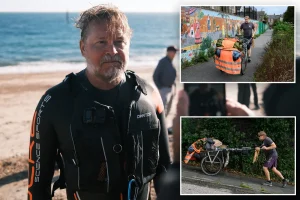



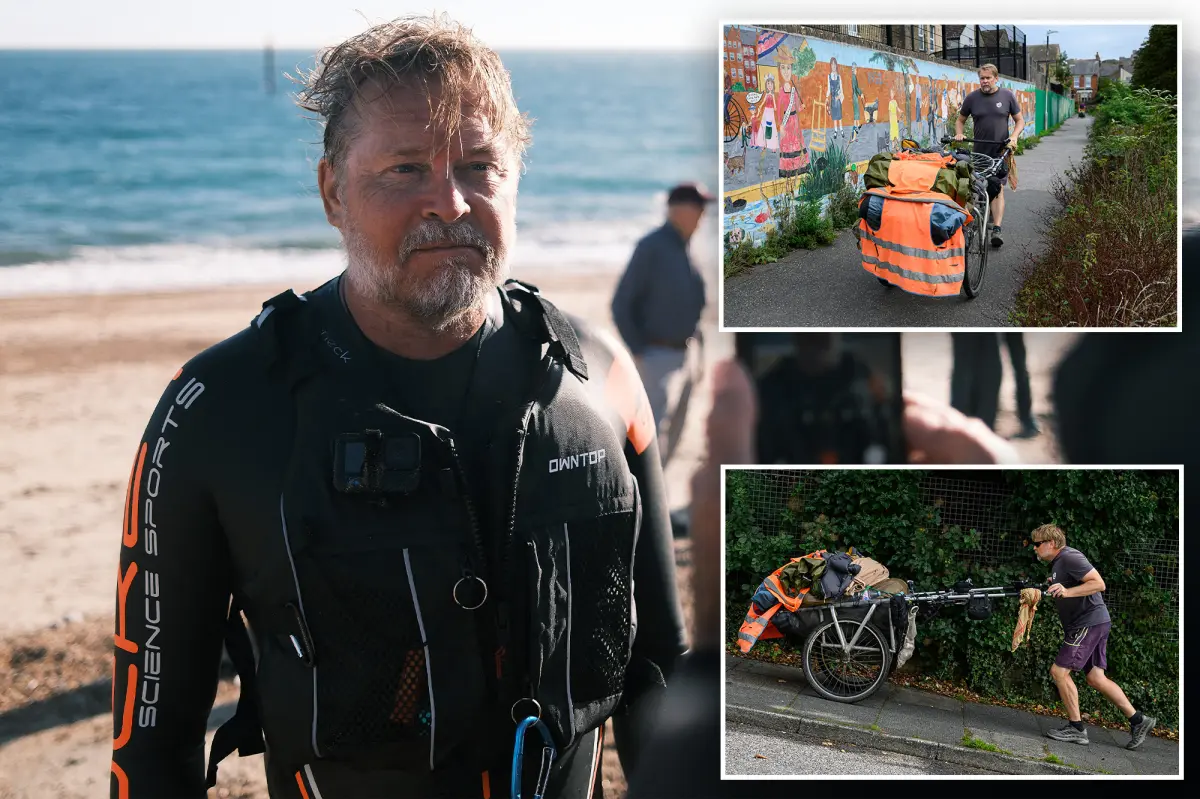
For three days, Karl Bushby floated and kicked and fought his way across one of the busiest shipping lanes on Earth, a 57-year-old body pushed past cramping muscles and whispered doubts. The English Channel, cold and restless, was the last great physical barrier between him and home. By the time he dragged himself onto Shakespeare Beach near Dover on Oct. 5, he had spent about 20 hours in the water, and he still had 250 miles left to walk. “Getting in the water that first day, I thought, ‘Have I taken too much of a bite here?’” he told the BBC. “But you dig deep. Keep on keeping on. You find a rhythm.” That rhythm has carried him for nearly three decades, across four continents and 29 countries, on a journey that began in Chile in 1998 and is now almost complete. Bushby, a former British Army paratrooper, has not seen his mother in 11 years. She is waiting for him in Hull, the port city he left behind as a younger man. He expects to arrive in early November, walking the final 400 kilometers, or about 250 miles, through England with the same stubborn steps that carried him through jungles, deserts, frozen straits and open water. He set two rules at the start: no planes, trains, boats, cars or other mechanized transport to advance his route, and no returning to Hull until the journey was finished. For 28 years he kept both promises, even when the route became almost impossible. The Channel swim, undertaken without any real training for this leg, was a raw test of will. After an hour, cramping and doubting, he wondered if he had finally met the one obstacle too many. But then he found his rhythm, and the rhythm carried him to England.
The journey began with $500 and no sponsors. On Nov. 1, 1998, Bushby stood in Chile with a backpack and a map, ready to walk around the world. He had served as a paratrooper in the British Army, but nothing had prepared him for the sheer length of the road ahead. His route took him up the length of South America, through the Darién Gap—a lawless, swampy wilderness between Panama and Colombia that many consider impassable—and then across North America. In 2006, with French-American adventurer Dimitri Kieffer, he crossed the frozen Bering Strait between Alaska and Russia on foot and over ice, a feat that required timing, courage and an almost unreasonable faith in the weather. He then made his way through Russia and toward the Caspian Sea, swimming about 184 miles of that huge inland sea before continuing west toward Europe. More than 30,000 miles and 29 countries later, he has never once broken his self-imposed rules. There was no vehicle, no engine, no sail to push him along; every mile came from his own legs or arms. There were times when the expedition stalled completely. Visa restrictions kept him in some countries longer than planned. The 2008 financial crisis dried up sponsorships. The COVID-19 pandemic shut borders and locked him in place. Geopolitical turmoil made certain regions too dangerous to enter. Through it all, Bushby kept the two promises he made to himself. He did not cheat. He did not turn back. He found ways to survive: selling books, giving talks, collecting donations, and eventually receiving support from a documentary production company that has followed him for the past 16 years. He learned to be patient, to wait out bureaucratic delays and political storms, to trust that the route would open again. He also learned to be alone with his own thoughts for days and weeks at a time. The road was not just a physical challenge; it was a meditation on persistence. And now, with England under his feet, the end was finally visible.
The English Channel almost broke him. Bushby had not trained for the swim—perhaps because after 28 years of walking, he had learned to rely on something deeper than fitness. But the water was colder and stronger than he imagined. After about an hour, his muscles began to cramp. He floated on his back, stared at the night sky, and tried to think of something other than pain. He remembered that he was far from any city, far from light pollution, and the stars above the Channel were astonishing. “You’re far away from light pollution and have the whole night sky in front of you,” he said. “It gave me something to think about and took my mind off the pain and aches. It was amazing.” He had hoped to avoid the swim altogether. His original plan was to cross into England on foot through the Channel Tunnel’s service tunnel, the underground corridor that connects France and Britain. But authorities rejected the request over safety and maintenance concerns. So he did what he had done countless times before when the world said no: he found another way. He swam. The crossing took three days, not because he was slow, but because the sea does not care about schedules. He had to time his swim around tides, shipping traffic and weather. At night, alone in the black water, he said he felt both very small and very connected to something vast. The pain in his shoulders and legs faded slightly when he looked up and saw the Milky Way. He did not think about the 28 years behind him, or the 250 miles ahead. He thought only about the next stroke, the next breath, the next moment of staying calm. That is how he reached Dover. That is how he has reached every milestone on this absurd, beautiful, impossible journey.
Now the last leg lies ahead. Bushby is in England, but he is not finished. He has roughly 250 miles to walk to Hull, where his mother has been waiting for him since 2015, the last time they saw each other. She has watched him disappear over horizons, appear in news reports, battle through jungles and frozen seas, and somehow keep going. Now her son is coming home. He told The Times of London: “I walked away from that place 28 years ago and that is where we are going to wrap it up. That’s about 400 kilometers from here, so I’ve got to get busy.” There is something deeply human about this final stretch. After so many years of crossing borders, learning languages, surviving storms and official paperwork, he is walking toward the simplest destination: a mother’s front door. The thought of that reunion must feel strange. He left Hull as a young man with a dream; he will return as a 57-year-old with a beard, a body marked by years of exposure, and a story almost too large to tell. But she will not care about the miles or the medals. She will care that he is alive, that he made it, that he is finally home. He has not allowed himself to fly, ride or sail, so he will walk those final 250 miles through the English countryside, through villages and towns, each step bringing him closer to the end of a promise. The expedition will be complete when he reaches Hull, likely in early November, almost exactly 28 years after he left. He has spent more than half his life on this journey. He has missed birthdays, funerals, and ordinary moments that most people take for granted. But he has never stopped.
What kind of person does this? Perhaps one who understands that a promise made to oneself is the hardest promise to keep. Bushby began with no money, no sponsors, no certainty. He had only a belief that he could walk around the world and that doing so would somehow make sense of his life. Along the way, he faced dangers that would have ended lesser journeys: the Darién Gap, with its muddy trails and armed groups; the Bering Strait, where ice could shift and crack beneath him; the Caspian Sea, a 184-mile swim through open water. He was delayed by visa restrictions, by the 2008 financial crisis, by COVID-19, by geopolitical turmoil. At times he must have felt that the universe was conspiring against him. Yet he refused to give up. He sold books, gave talks, asked for donations, and accepted help from a documentary company. He learned that asking for help is not weakness. He learned that the journey is not about conquering the world but about enduring it. The world, after all, is huge and indifferent. It does not care about one man’s dream. But Karl Bushby cared. He cared enough to keep putting one foot in front of the other for 28 years. He cared enough to swim the English Channel without training, cramping after an hour, and still keep going. He cared enough to look up at the stars at night and feel awe instead of fear. This is the human spirit in its purest form: not the dramatic hero who never doubts, but the ordinary person who doubts every day and continues anyway. His journey has not been about glory. It has been about the quiet, stubborn refusal to quit, even when quitting would have been the most reasonable thing to do.
When Bushby finally reaches Hull, he will close a circle that has been open for nearly three decades. The mother he has not seen since 2015 will be there. The city he walked away from will be there. And he will be there, older, weathered, maybe a little slower, but still carrying the same stubborn flame that left Chile in 1998. He has traveled more than 30,000 miles and passed through 29 countries. He has crossed oceans, straits, deserts, jungles and frozen wastelands. He has been delayed by politics, pandemics and economics. He has watched the world change around him, and he has changed with it. But one thing has remained constant: the promise he made to himself. He did not use a plane, train, boat, or car to advance his route. He did not go home before the journey was done. Now the journey is almost done. He has about 250 miles left. That is not far for a man who has walked around the world. It is a final walk through the English landscape, a last chance to let the reality of what he has done sink in. He will probably not make a speech or draw attention to himself. He will simply walk, as he has always walked, until he arrives. And then he will embrace his mother, and perhaps say something simple like, “I told you I’d make it.” The world will call it a remarkable achievement. For Bushby, it will be something more intimate: the end of a long road, the fulfillment of a promise, the return of a son. In a time when so much feels divided and uncertain, his story is a reminder that the human will can carry us farther than we ever imagined—if we keep on keeping on. And after 28 years, Karl Bushby is finally ready to stop walking, and start being home.