



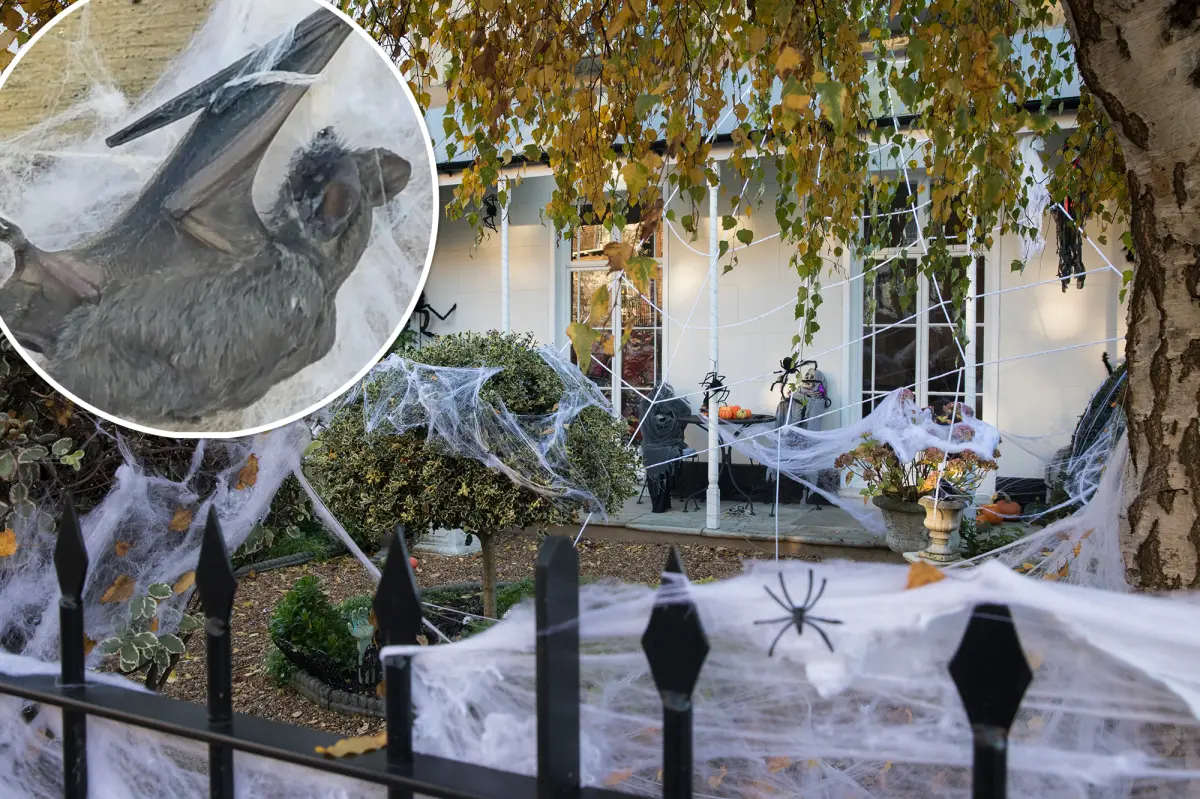
Think all Halloween decorations are the same? Think again. Every October, neighborhoods across the country transform into haunted scenes. Porch railings get wrapped in gauzy white strands, shrubs look like they’ve been claimed by giant spiders, and doorways are framed by webs that seem to shimmer in the moonlight. The look is classic Halloween, the kind of thing you see in store displays and holiday movies. It’s festive, it’s fun, and it’s supposed to be just a little scary. But those cheap, synthetic cobwebs are not as innocent as they appear. For bats and other small wildlife, they can become a real-life death trap. In Northern California, a bat expert who has dedicated her life to saving hurt and orphaned animals is pleading with the public to stop putting artificial webbing outdoors. Corky Quirk, the founder of NorCal Bats, has already seen the damage firsthand this year. Her organization has received two calls from homeowners who found bats wrapped up in their Halloween decorations. One bat had fake webbing wrapped around her mouth and her wings. “It was a mess,” Quirk said. Despite the best efforts of the rescue team, one of the bats died. The other is still in rehabilitation, slowly recovering from an ordeal that should never have happened. What makes this even harder to swallow is that the people who hung those webs had no intention of hurting anything. They were simply trying to create a fun atmosphere for trick-or-treaters. They didn’t realize that the very qualities that make fake spider webs so appealing—sticky, stretchy, durable, and almost invisible—are the same qualities that make them lethal. The webbing is often left up for weeks, through wind and rain and cold nights, and it catches far more than porch light.
NorCal Bats is not a large operation. It is a dedicated rescue group run by people who understand how vital bats are to the ecosystem. A single bat can consume thousands of insects in one night, including mosquitoes, moths, and agricultural pests. Some bats are pollinators too, and their presence helps keep the environment in balance. That is why the calls Quirk has received are so painful. One homeowner found a bat struggling in fake webbing and had no idea what to do. The bat was in terrible shape, with synthetic fibers wrapped tightly around her mouth, leg, and wings. Unlike natural spider silk, artificial webbing doesn’t break easily. The more the bat struggled, the more tangled she became. Bats have delicate bones and thin wing membranes, and pulling or cutting the fibers without skill can cause permanent damage. Quirk’s team had to work carefully, using small scissors and tweezers to free the animal strand by strand. In the end, one bat did not survive the stress and injuries. The other is slowly recovering but may carry scars from the encounter. It is a stark reminder that bats are fragile creatures, and that our desire for seasonal atmosphere can have unintended victims. Bats are also deeply misunderstood. They aren’t scary monsters lurking in shadows. They are shy, intelligent, and ecologically essential. In California, they are a protected and valued part of the natural world, and losing even one individual matters, especially when bat populations are already struggling against habitat loss, climate change, and disease. That is why Quirk speaks so openly about these incidents. She wants the next homeowner to think twice before hanging that bag of fake cobwebs over the front door.
One of the biggest misconceptions is that bats should be able to avoid fake spider webs because they use echolocation. People imagine that bats are constantly sending out sonar waves and reading every obstacle in their path. But that’s not how it works. Quirk explains that bats don’t always use echolocation. When they are simply flying from one place to another, they often rely on their eyesight and spatial memory. When they are hunting, they focus on the sounds and movements of their prey, not on thin synthetic strands hanging in the air. “You might think, ‘It’s a bat, it can echolocate,’ but bats don’t always use echolocation. Sometimes they’re just going from point A to point B,” Quirk said. “Because they’re looking for a grasshopper on the ground so these guys will get caught.” This is exactly what happens on a typical Halloween night. Bats fly low around porches and gardens, searching for insects attracted to house lights. A porch light calls moths from the darkness. A bat follows the moth. The fake webbing is stretched across the railing, nearly invisible in the dim light. The bat flies straight into it and gets tangled. In a panic, it flaps harder, which only makes the web wrap tighter around its wings, legs, and mouth. It cannot groom itself free. It cannot bite through the fibers. If nobody finds it, the bat may die from exhaustion, dehydration, or starvation. It may also be exposed to weather or become an easy target for predators. The webbing is often placed exactly where bats are likely to fly, which makes it an avoidable tragedy waiting to happen.
Bats are not the only victims. Birds and dragonflies also become ensnared in artificial webbing. Songbirds, chasing a moth near a window, can get their wings and feet caught in the strands. Dragonflies, which are beautiful and beneficial predators of mosquitoes, are even more vulnerable because their delicate wings get stuck almost instantly. Bat Conservation International has warned about this exact problem on its website, noting that “unlike real spider webs, artificial webbing doesn’t break easily, meaning bats and birds are easily tangled up in the strands where they risk starvation or weather exposure.” That distinction is critical. Real spider webs are actually fragile in many ways. They are designed to catch small insects, but larger animals can often tear through them because natural silk is stretchy and degrades over time. The fake version, however, is made from plastic-like fibers created to last through an entire season. It doesn’t dissolve in rain. It doesn’t stretch and release. It doesn’t break. For a wild animal, it functions more like a snare than a decoration. And because the strands are so thin, people rarely notice the animals trapped inside until it’s too late. A bird might hang helpless for hours, unable to fly or feed. A dragonfly might die within minutes. Even if someone spots the animal, freeing it safely requires patience and skill. The webbing is an invisible obstacle course placed directly in the path of the creatures that share our neighborhoods, and they have no way to understand it. No amount of Halloween spirit justifies that.
There is another important thing to know: if you find a bat stuck in Halloween decorations, do not try to handle it with your bare hands. Your first instinct may be to help, and that’s noble. But a trapped bat is a frightened wild animal, and it will bite if it feels cornered. Bats are known carriers of rabies, and the California Department of Public Health has reported 320 rabid bat cases statewide this year. That number is not a reason to panic, but it is a reason to be careful. Rabies is spread through the saliva of an infected animal, most commonly through a bite, but it can also be transmitted if infected saliva gets into your eyes, mouth, nose, or an open wound. Once symptoms appear—fever, confusion, agitation, difficulty swallowing—rabies is almost always fatal. However, the disease is nearly 100 percent preventable if you receive prompt medical care after exposure. That means acting quickly is essential. If you are bitten by any wild animal, wash the wound thoroughly with soap and water, seek medical attention immediately, and report the incident to public health officials. If you find a bat tangled in webbing, keep your distance and keep pets away. Take a photo if you want, but don’t get close. Call a local wildlife rehabilitation organization, animal control, or trained bat rescuer. They have the equipment and expertise to capture the animal safely and determine whether it needs medical care. By staying back, you protect yourself and give the bat a much better chance at survival. It also reduces the risk of a preventable rabies exposure during an already stressful situation. The health experts aren’t trying to scare anyone away from being compassionate; they just want people to be smart about compassion.
So what can you do? The simplest solution is to skip artificial spider webbing altogether. There are so many other ways to make your house look spooky. Carved pumpkins, hay bales, skeletons, string lights, foam tombstones, witches, and even plastic spiders can set the same mood without turning your porch into a hazard. If you already have fake web stored in a box, consider using it only inside your home, not outside where animals are moving through the night. If you absolutely must use it outdoors, check it every morning and evening for trapped animals and take it down as soon as Halloween night is over. But wildlife experts would likely tell you that the safest choice is to skip it completely. The fleeting visual effect is simply not worth the risk of killing a bat, a bird, or a dragonfly. And if you see a friend or neighbor hanging fake webs, share this story with them. Most people honestly have no idea that a common decoration can be lethal. Once they know, many will choose something else. This Halloween, let the scary stories stay on the shelf, where they belong. The true horror would be a wild animal suffering and dying because we wanted a little extra ambiance. Halloween is supposed to be a holiday of playful fear, with fake monsters and silly screams. Let’s make sure the only creatures frightened are the ones who want to be. The bats, birds, and insects that share our neighborhoods deserve to survive the season just as much as we deserve to enjoy it. A few small choices can make a huge difference. After all, the best Halloween decorations are the ones that don’t hurt anything, and the best way to honor that is to think twice before we drape a single strand.