


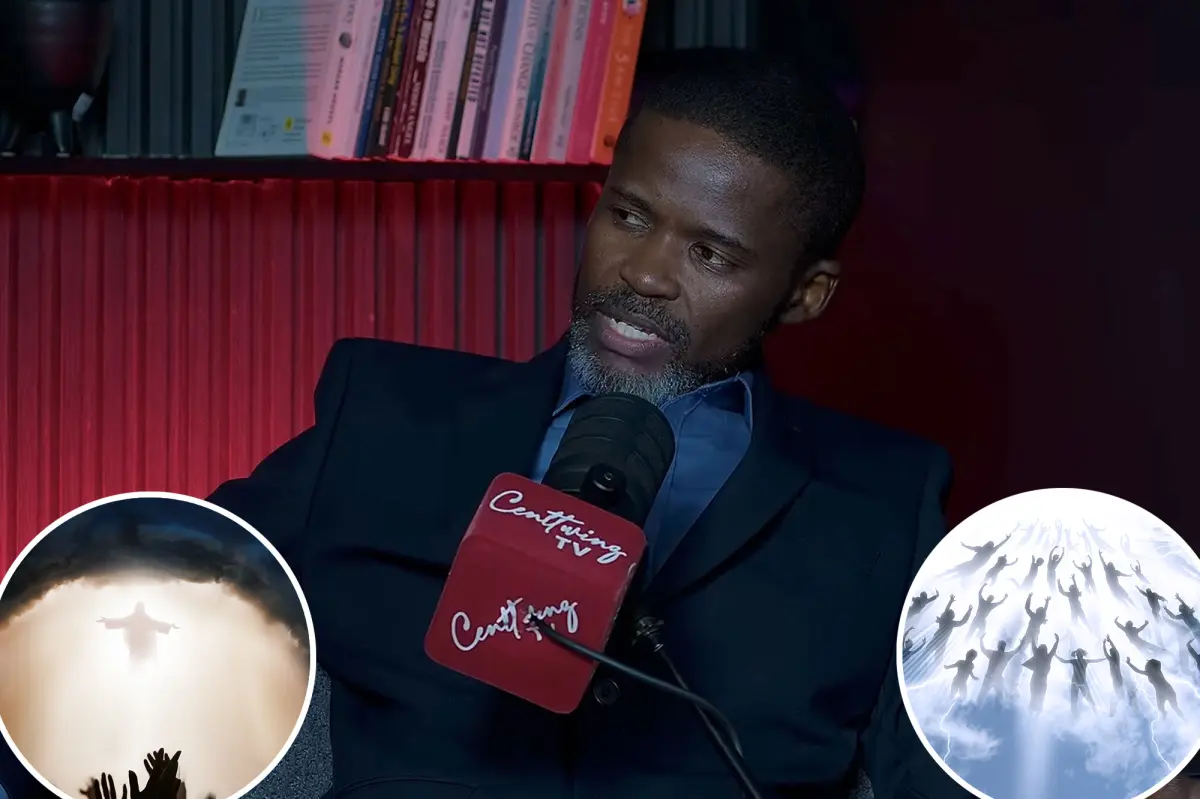
1. For the countless believers who had sold their homes, quit their jobs, and kissed their loved ones goodbye, the morning of September 24 arrived with a quiet, unbearable emptiness. The sky did not split open. The graves did not burst. Jesus did not descend on a cloud to gather the faithful into heaven. Instead, the sun rose as it always does, indifferent to human prophecy, and the world kept spinning in its ordinary, stubborn way. In South Africa, a pastor named Joshua Mhlakela had promised that the Rapture would occur on September 23, a date he had declared not merely as a guess but as a direct revelation from God and Jesus Christ himself. He had insisted with absolute certainty that this was the final date, that the New Testament vision of the elect being snatched upward while the rest of humanity faced tribulation was about to unfold before a watching global audience. But September 23 came and went, and the only thing that vanished was the credibility of yet another self-proclaimed prophet. Rather than fade into embarrassed silence, however, Mhlakela emerged with a new message: Doomsday had not been canceled, merely delayed. The end was still near, he said; it had simply been rescheduled, in the way a flight might be postponed due to weather, or a wedding moved because the venue double-booked. The new date, he explained, was October 12 to 13, which he described as the true Feast of Trumpets, the moment when he would finally meet his savior face to face. It was a breathtaking act of theological reinvention, turning a failed prediction into a mere calendar adjustment and asking his followers to trust him one more time.
2. The human cost of that failed prophecy is not abstract, and it deserves more than a footnote in a story about religious eccentricity. According to reports, many of Mhlakela’s followers did not simply nod along during his sermons; they bet their entire lives on his words. They sold their homes and cars. They quit their jobs, believing that earthly employment would soon be irrelevant. They gave away possessions, settled debts, and made their peace with a world they expected to leave behind in a blaze of divine glory. One heartbroken young person took to TikTok the day after the non-apocalypse to share the wreckage of their decision. “I didn’t do my exams because I [thought] it doesn’t matter,” the message read, punctuated by a crying emoji. “Now look at me.” That single confession captures the tragedy of end-times prediction far better than any theological critique. For the person who wrote those words, the postponement of doomsday was not a moment for smug satisfaction or intellectual victory; it was a catastrophe. Their education, their career plans, their future — all of it had been placed on hold for a promise that failed to materialize. They were left with no diploma, no home, no job, and no easy way to explain to family and friends why they had thrown everything away on the authority of a man who now claimed he had merely misread the heavenly clock. It is easy to laugh at false prophets, and many people did. But behind the mockery there are real stories of people whose trust was exploited, whose desperation was weaponized, and whose faith was twisted into a tool for their own undoing.
3. So how did Mhlakela explain the colossal miss? He did not admit error, at least not in the way most people would understand it. Instead, he reframed the entire episode as a matter of divine recalibration. In a YouTube clip, the self-proclaimed prophet explained that God had spoken to him again and revealed that the true date had always been October 12 to 13, which aligns with the Feast of Trumpets, a biblical holiday with deep eschatological significance. His earlier prediction had been off by roughly a month, he said, because the Passover celebration was taking place under the astrological sign of Pisces. The real Passover, he insisted, must occur when the sun is in Aries, just as it was in the Exodus story when the Israelites fled Egypt. Only then could the prophetic arithmetic work correctly. It was a dizzying mixture of biblical literalism, astrology, and post-hoc reasoning, delivered with the serene confidence of someone who genuinely believed his own revisions. By shifting the celestial goalposts, Mhlakela transformed his failure into a successful test of faith. The Lord, he implied, had used the disappointment to sift the true believers from the fair-weather fans. Those who wavered were never really ready for the Rapture. Those who still believed, despite the missed date, proved themselves worthy of salvation. In this way, a public humiliation became a private virtue, and the prophet was able to stay at the center of his movement by demanding even greater commitment from his followers. Whether this was a calculated manipulation or the self-deception of a man trapped in his own mythology is difficult to say, but the effect was the same: the goalposts moved, and the faithful were asked to carry them.
4. Outside the echo chamber of his congregation, the reaction was swift, sharp, and largely unforgiving. Bible scholars pointed out a rather obvious flaw in his astrological justification: the sun was not in Aries during the historical Exodus, no matter how beautifully the symbolism aligned with his new date. The claim, they noted, was not merely unverifiable but factually wrong, a detail that would matter to anyone who grounds their prophecy in Scripture and astronomy. More importantly, many Christian commentators cited the Bible itself to condemn the entire enterprise. In the Gospels, Jesus is famously quoted as saying that no one knows the day or the hour of the end, not even the Son, but only the Father. To set a date, they argued, is not just to be wrong; it is to contradict the explicit teaching of Christ. The YouTube preacher Vladimir Savchuk made this point bluntly, declaring that anyone who sets a date for the Rapture is directly opposing Jesus’s word. Other voices were less earnest and more sardonic. One theologian on YouTube joked that Mhlakela was actually proving the Bible to be true, since Scripture predicts that false prophets will arise in the last days. The humor was cutting, but it contained a serious observation: the existence of failed prophets is not a bug in the Christian system but a feature of it. The very fact that so many people claim to know the end of the world, and are wrong each time, serves as a kind of dark prophecy of its own. It is a reminder that certainty is not the same as truth, and that religious authority can be wielded by people who are either deeply mistaken, deliberately deceptive, or perhaps both.
5. Yet it is worth pausing to ask a more compassionate question: why do people continue to follow such figures, even after the prophecies fail again and again? The easy answer is gullibility, but that does not do justice to the complexity of human belief. For many, the appeal of end-times prophecy is not the date itself but the promise of meaning in an otherwise chaotic world. Life is uncertain, painful, and often unjust. People struggle to pay rent, to keep their marriages together, to watch their children grow up in a culture that seems to be spinning out of control. The idea that history is not random, that God has a plan, that the faithful will be rescued before the worst of the suffering begins — these are profoundly comforting claims. A prophet like Mhlakela does not simply offer a date; he offers a story in which his followers are the heroes, chosen for salvation and vindicated in the end. To abandon that story is to return to a world where the future is unknown and the struggle has no guaranteed reward. That is why many people double down after a failed prophecy instead of walking away. They have already suffered the social costs of their belief, leaving jobs and homes and credibility behind. The only way to make that suffering bearable is to believe that it was not in vain. This psychological dynamic, sometimes called cognitive dissonance, is one of the most powerful forces in human life. It is the same force that keeps gamblers at the slot machine, investors in failing stocks, and lovers in broken relationships. To admit the prophet was wrong is to admit that one’s own sacrifices were meaningless, and that is a far more terrifying prospect than waiting a few more weeks for the end of the world.
6. As October 12 approaches, the eyes of the world will once again turn toward Joshua Mhlakela and his followers. Will the heavens open? Will the Rapture finally occur? Almost certainly not, if the pattern of history is any guide. End-times predictions have been made for two thousand years, and every single one has failed. But that does not mean the story is without meaning. For those watching from the outside, it is a reminder of the dangers of certainty and the fragility of human hope. For those inside the movement, it is another test of faith, another opportunity to prove their devotion by clinging to a promise that keeps slipping away. The saddest part is not the false prophecy itself but the people who will be left standing on the other side of yet another disappointment, holding the ruins of a life they gave away for a dream. Perhaps, after October 13, some of them will finally begin to ask the hard questions. Perhaps they will wonder why a loving God would require them to abandon their education, their homes, and their common sense in order to be saved. Perhaps they will realize that the voice they heard in the prophet’s sermons was not the voice of God but the echo of their own longing for meaning. And perhaps they will find a way to rebuild, not on the shifting sands of a self-appointed prophet’s revisions, but on the quieter, more durable foundation of faith that does not need a date on a calendar to be real. Doomsday has been delayed, again. But hope, for those who survive the delay, does not have to be postponed forever.