


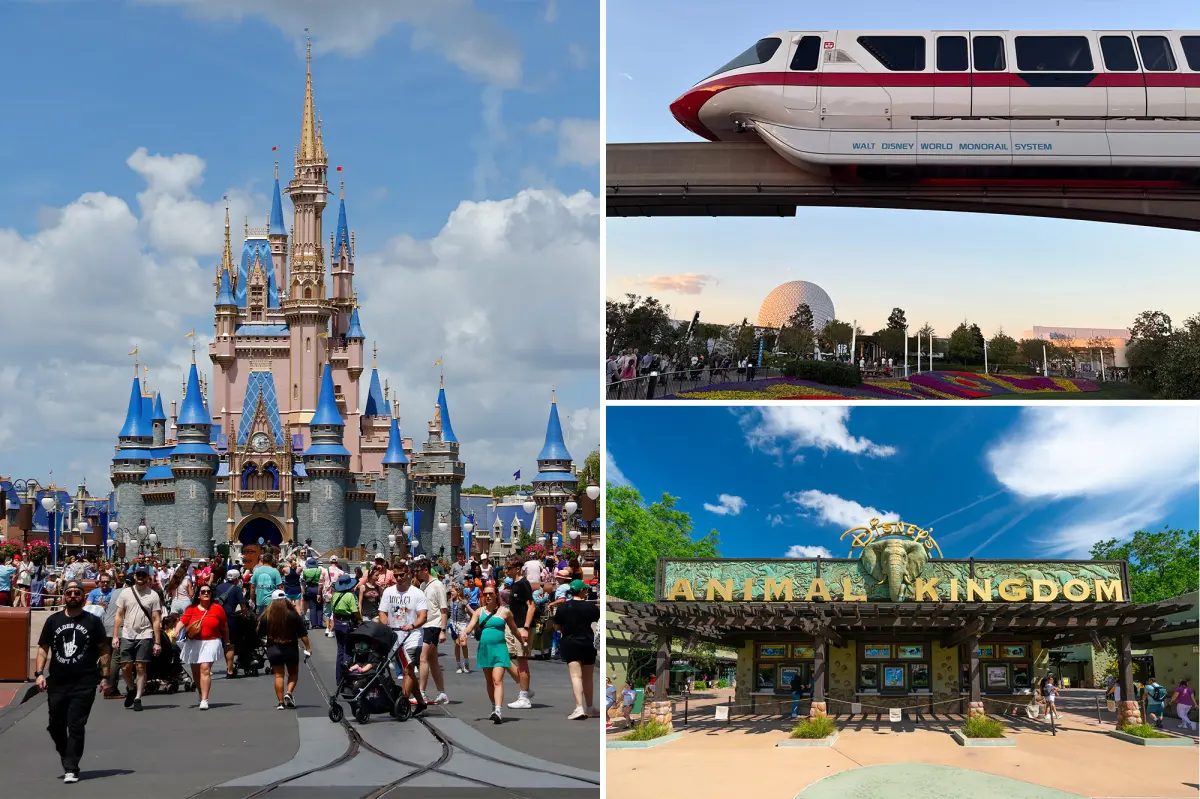
For millions of families, a trip to Walt Disney World has long been a cherished rite of passage—a place where children’s eyes light up at the sight of a castle, where grandparents and grandchildren share ice cream on a hot afternoon, and where the ordinary worries of life are supposed to melt away under the glow of fireworks. Yet this week, Disney quietly reminded everyone that magic has a price, and that price is rising faster than ever. In a move that felt less like a fairy tale and more like a gut punch, the company raised ticket prices across its parks, pushing the coveted one-day Park Hopper pass past the $300 mark for peak weekends. A pass that is advertised at $280 quickly becomes a $301.40 checkout total once mandatory fees and an $18.40 tax are added. What makes this even harder to swallow is that the hefty price tag does not even guarantee entrance—entry remains subject to capacity limits, meaning families who have saved for months could still find themselves locked out on the very day they planned to spend inside the kingdom. For many, the message is becoming unmistakably clear: the happiest place on Earth is increasingly reserved for those who can afford to ignore the price tag.
Even the basic single-day, single-park ticket—once the budget-friendly gateway to the magic—has now pushed past the $200 mark on many dates. The increases on Tuesday were broad and deep: the top-tier single-day passes climbed by $10 to $229, while the VIP line-skipping “Lightning Lane” passes surged by a stunning $50 to $499. The annual pass landscape also shifted dramatically. The “Incredi-Pass,” the only annual pass available to non-Florida residents and the one that allows guests to hold up to five rolling theme park reservations at a time, jumped by $120 to $1,749. That is an enormous amount for any family, and it does not even include food, souvenirs, hotel stays, or travel. For Floridians, the news was only slightly less painful: the state-resident Pixie Dust Pass rose by $10, while the Pirate Pass and the Sorcerer Pass—the latter open to Florida residents and Disney Vacation Club members—both increased by $40. For families who have been loyal to Disney for years, these increases feel less like simple inflation and more like a deliberate recalibration of who belongs in the parks. A trip to Disney is no longer just a vacation; it is a major financial commitment that rivals a car payment or a month of rent.
Looking ahead, the situation appears even more daunting. Multi-park peak tickets at Disney World are now projected to stay above the $300 threshold through 2027, meaning that the soaring costs are not a temporary spike but a new era of pricing. Newly posted rates for the 2027 holiday season show that a single-day ticket to Magic Kingdom on Christmas Day and New Year’s Eve 2027 will hit $229—up from $209 this year and $219 for previously released 2027 dates. Even the more modest options have crept upward: off-peak single-day entry for Animal Kingdom still starts around $120, but weekend tickets now hit $179 or more, climbing past $190 after tax. Out west at Disneyland California, the picture is slightly less grim but still challenging: mid-tier and park-hopper tickets are rising by $5 to $10, though the absolute cheapest one-day ticket remains frozen at $104, where it has been since 2019. That single bright spot offers little comfort, however, when the overall trend points so strongly toward exclusivity. The pricing structure now resembles a tiered membership club, where every level of access costs more and delivers less certainty. The magic is still there, but it is increasingly gated behind financial barriers that many working families simply cannot scale.
Perhaps unsurprisingly, the announcement has sparked a wave of hurt, frustration, and anger from the people who love Disney most. On Reddit, one user vented with a bluntness that echoed the feelings of many: “The middle to low income working class needs to wise up—the way things are right now, these companies DO NOT NEED US. There are enough people doing well to keep them going. Basically, this stuff is no longer for ‘regular’ folks but for people who are affluent.” Another user shared a deeply personal breakdown: “I love going to the parks, but it’s getting insane. I flew down from Northern California and priced out ONE day for two people (flight, 2 nights at a mid-range hotel, park tickets with park hopper and lightning lane for day) and it was about $2,000. That’s before Ubers, food, merch.” These are not the voices of casual complainers; they are the voices of devoted fans who have grown up with Disney, who have saved diligently for years, and who now find themselves squeezed out of an experience they were taught to believe was magical. The emotional toll is real. There is a deep sense of betrayal in these comments, a feeling that a company once synonymous with childhood wonder has become just another corporation extracting maximum profit from an inelastic demand. After all, what parent wants to tell their child that Mickey Mouse is only for rich kids?
The broader implications are significant, not just for Disney but for the idea of shared cultural experiences. When a family of four spends more than $1,000 on a single day of park admission before they have eaten a single churro, the demographic of parkgoers necessarily narrows. The crowds may not disappear, but they will become less diverse, less reflective of the broad American public that Disney has historically celebrated. This shift raises uncomfortable questions about what kind of magic we value as a society. Are theme parks a luxury good, like a designer handbag or a private jet? Or are they a form of entertainment that should remain accessible to teachers, nurses, mechanics, and retail workers—people whose labor keeps the world running but whose salaries have not kept pace with Disney’s pricing strategy? The company clearly believes the market will hold up; indeed, despite the outcry, past price increases have not meaningfully reduced attendance. But for every family that still manages to go, there are many others who now look at the price chart and simply close the browser tab. The magic becomes a memory, a thing they once had, not something they can pass on to their children. That loss is difficult to quantify, but it is felt deeply in kitchens and living rooms across the country.
For those still determined to experience the parks, there are a few pragmatic coping strategies. Disney is quietly experimenting with an AI bot on its website to help deal-hunters uncover bargain dates, prompting visitors with questions like, “What are the cheapest dates to visit?” The tool, reported by USA Today, reflects a company aware of its own pricing pain points—a small concession to families looking for a way in. Indeed, bargain-seeking families can still scout out calendar pricing on Disney’s site to find the least expensive weekends available, traveling during off-peak seasons, midweek, or during school breaks that no one else wants. But the need to strategize around a vacation that was once a simple childhood joy says something sobering about the world we now live in. Disney is still magical—the fireworks still explode, the characters still wave, the castles still stand—but the magic has become conditional, layered behind tiers, passes, fees, taxes, and AI algorithms. For a generation of parents who remember their own childhood trips, the hardest part may be accepting that the Disney they knew no longer exists. It is not just a price hike; it is a transformation of a beloved institution into a premium product. And while the parks will undoubtedly remain busy for years to come, there is a growing sense that something precious has been lost—not just the affordable ticket, but the shared belief that magic should be for everyone. The happiest place on Earth has never looked more beautiful, and never felt further away.