







To truly understand the culinary revolution that took place within the Baldi family kitchen, one must first understand the formidable shadow cast by its patriarch, Giorgio Baldi. For decades, Giorgio’s self-named restaurant in Santa Monica stood as a legendary temple of authentic Italian gastronomy, a coastal sanctuary where Hollywood elites, neighborhood regulars, and culinary purists gathered to worship at the altar of classic, unpretentious cooking. Giorgio was a man of the old world, raised on the sacred, unyielding tenets of Italian culinary tradition where ingredients had designated, immutable roles defined by centuries of regional heritage. Thus, when his son, Edoardo “Edo” Baldi, first approached him with the radical notion of stuffing fresh pasta dough with sweet corn, the elder Baldi’s reaction was not merely skeptical; it was one of profound, old-world dismissiveness. “You give corn to chickens,” Giorgio famously declared, his voice carrying the weight of generations of Italian chefs who viewed corn primarily as livestock feed or, at best, the rustic base for northern Italian polenta, but never as something worthy of being encased in delicate, hand-rolled egg pasta. This sharp, initial rebuke epitomized the classic generational friction between a traditionalist father protective of his cultural legacy and an innovative son eager to write his own chapter. In the humid, flour-dusted air of their family kitchen, this disagreement was about far more than just an unorthodox vegetable; it was a quiet, emotional battle over identity, respect, and the boundaries of heritage in a rapidly evolving culinary world.
The spark that ignited this culinary rebellion did not originate in the sun-drenched hills of Tuscany, but rather in a moment of cross-cultural epicurean discovery that captured the very essence of the contemporary California dining scene. Edo’s epiphany occurred during a seemingly casual meal at a local restaurant, where he was served a velvety, golden sweet corn soup accompanied by a perfectly seared crab cake. As the clean, natural sweetness of the corn mingled with the rich, savory, and delicate notes of the seafood, Edo experienced a moment of intense clarity that transcended traditional culinary boundaries. He realized that this humble ingredient, so deeply rooted in the American agricultural landscape and summer memories, possessed a sophisticated, multidimensional flavor profile that was being criminally underutilized in classic Italian cooking. The natural sugars of the fresh corn, balanced by its earthy undertones and creamy texture when puréed, presented a perfect opportunity to create a bridge between the vibrant, seasonal produce of California and the time-honored pasta-making techniques of his youth. Inspired by this harmonious flavor profile, Edo returned to his workspace with a racing mind, determined to translate this distinctively American ingredient into a refined Italian masterpiece that would challenge the rigid dogmas of his father’s kitchen and prove that tradition could be beautifully reinterpreted.
Driven by this vision and fueled by a quiet determination to prove his culinary instincts correct, Edo set to work crafting what would become the first iteration of the dish: sweet corn agnolotti. He folded the vibrant, sweet purée into delicate pockets of fresh pasta and, defying his father’s skepticism, boldly introduced them to the menus of both the flagship Giorgio Baldi and his own chic Beverly Hills hotspot, e. baldi. The decision was a massive professional and personal gamble, representing a public vulnerability where failure would not only mean a loss of culinary prestige but also the stinging, quiet validation of his father’s doubts. However, the moment the very first plates left the kitchen and landed in front of eager diners, any lingering anxiety vanished into the warm dining room air. The response was immediate, passionate, and overwhelmingly positive, sparking an overnight sensation that Edo recalls as a pure, joyous culinary explosion. Guests were spellbound by the unexpected harmony of the dish, marveling at how a vegetable so often associated with casual summer barbecues could be elevated into something so luxurious, comforting, and deeply sophisticated. It was a triumph that proved diners were hungry for innovation, completely vindicating Edo’s creative vision and setting the stage for a dramatic, heartfelt shift in the family dynamic.
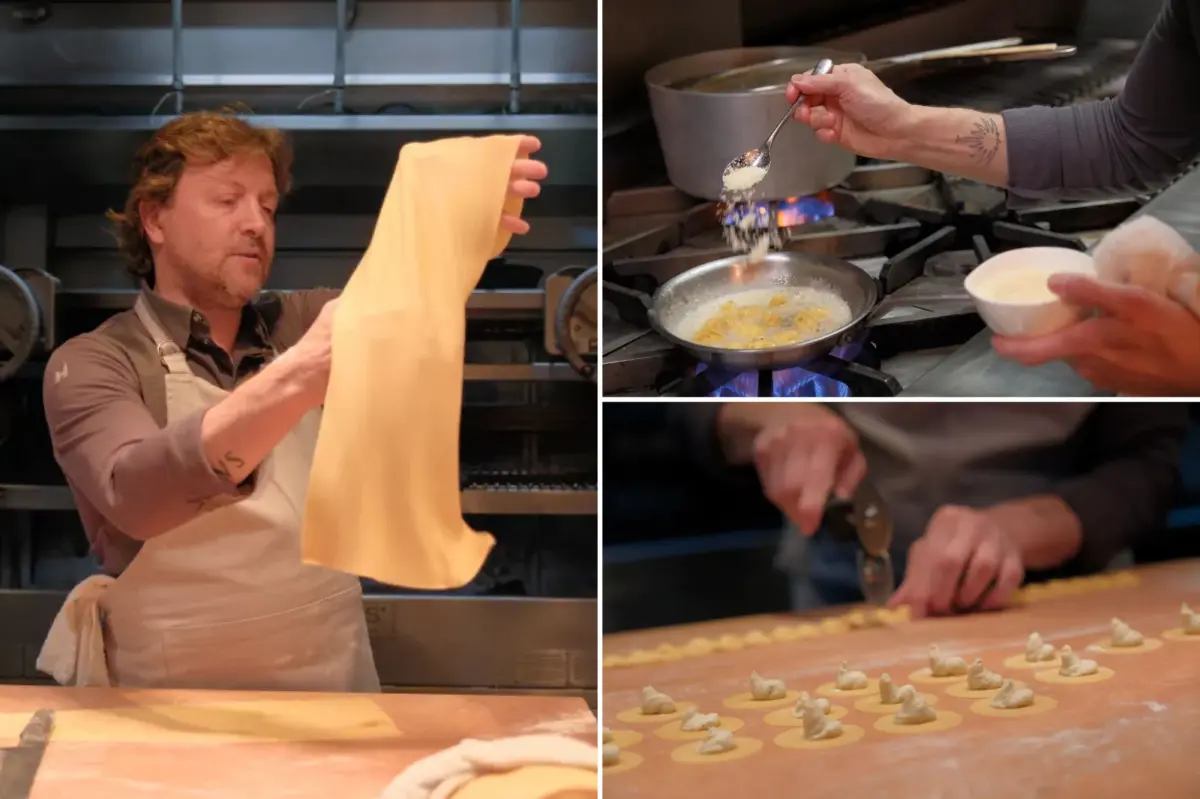
Now, nearly three decades after that initial, revolutionary spark, the beloved family recipe has found a grand new stage and a sophisticated new form at Baldi, which opened its doors in February at the prestigious Waldorf Astoria Beverly Hills. In this luxurious, modern setting, Edo has thoughtfully reimagined the iconic dish, transitioning it from the traditional, flat, pocket-like agnolotti into elegantly hand-folded tortellini. This structural evolution is far from purely aesthetic; Edo explains that the delicate folds, complex ridges, and central crevices of the tortellini shape are uniquely engineered to hold a more generous amount of filling while perfectly capturing the external sauce on the plate. To create this modern masterpiece, fresh sweet corn is puréed to a velvety smooth consistency and blended with a rich, creamy trifecta of high-quality mascarpone, delicate ricotta, and aged Parmigiano-Reggiano cheese. Each individual piece of pasta is meticulously shaped by hand with practiced precision, boiled to a perfect al dente texture, and finished with a minimalist yet decadent glaze of warm butter, more Parmigiano, and a luxurious, aromatic drizzle of white truffle olive oil. The result is a sensory tour de force where the bright, natural sweetness of the corn is elevated by the earthy complexity of the truffle, preserving the nostalgic soul of the original dish while offering an elevated dining experience fit for one of Beverly Hills’ most exclusive venues.
Beyond the culinary acclaim, the glowing reviews, and the satisfaction of packed dining rooms, the true triumph of the sweet corn pasta lay in its profound, transformative impact on the relationship between Edo and his father. Watching the plates return to the kitchen scraped entirely clean night after night, and listening to the chorus of glowing praise from captivated patrons, Giorgio Baldi’s initial disapproval slowly melted into deep admiration and paternal pride. In a poignant, quiet moment of reconciliation that Edo still carries close to his heart, the old-world patriarch offered his son the ultimate validation, acknowledging that Edo’s modern instincts had successfully bridged the gap between their past and their future. “In a sweet way, I got approval from my dad,” Edo recalls with a warmth that speaks to the immense emotional weight of that milestone. From that day forward, Giorgio’s skepticism was replaced by unreserved encouragement, as he gave his son the ultimate blessing to create, experiment, and push the boundaries of their culinary heritage without fear or restriction. This breakthrough did not just heal a professional rift; it solidified a beautiful bond of mutual respect, transforming a simple plate of pasta into a symbol of generational bridge-building, mutual trust, and deep familial love.
Today, as diners gather under the warm, inviting lights of Baldi at the Waldorf Astoria, the sweet corn tortellini stands as a living monument to family, perseverance, and the beautiful evolution of personal taste. What began as a misunderstood ingredient once deemed fit only for farm animals has become one of the most celebrated, enduring, and requested dishes in the Baldi family’s illustrious history. It serves as a gentle, delicious reminder that the culinary arts are never static, but are rather a living, breathing dialogue between the cherished traditions of the past and the bold, courageous innovations of the present. For Edo, every hand-folded piece of tortellini served is a quiet homage to his father’s enduring memory, carrying forward the soul of the Santa Monica landmark while charting a vibrant, independent path into the future. Through this harmonious blend of California sweet corn and Italian craftsmanship, Edo Baldi has created more than just a signature dish; he has woven a rich, edible tapestry of his family’s journey, proving that when tradition is met with passion, respect, and a little bit of courage, the results can be absolutely extraordinary.