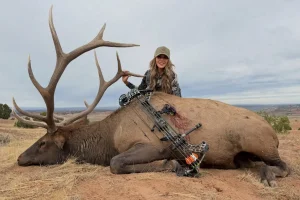





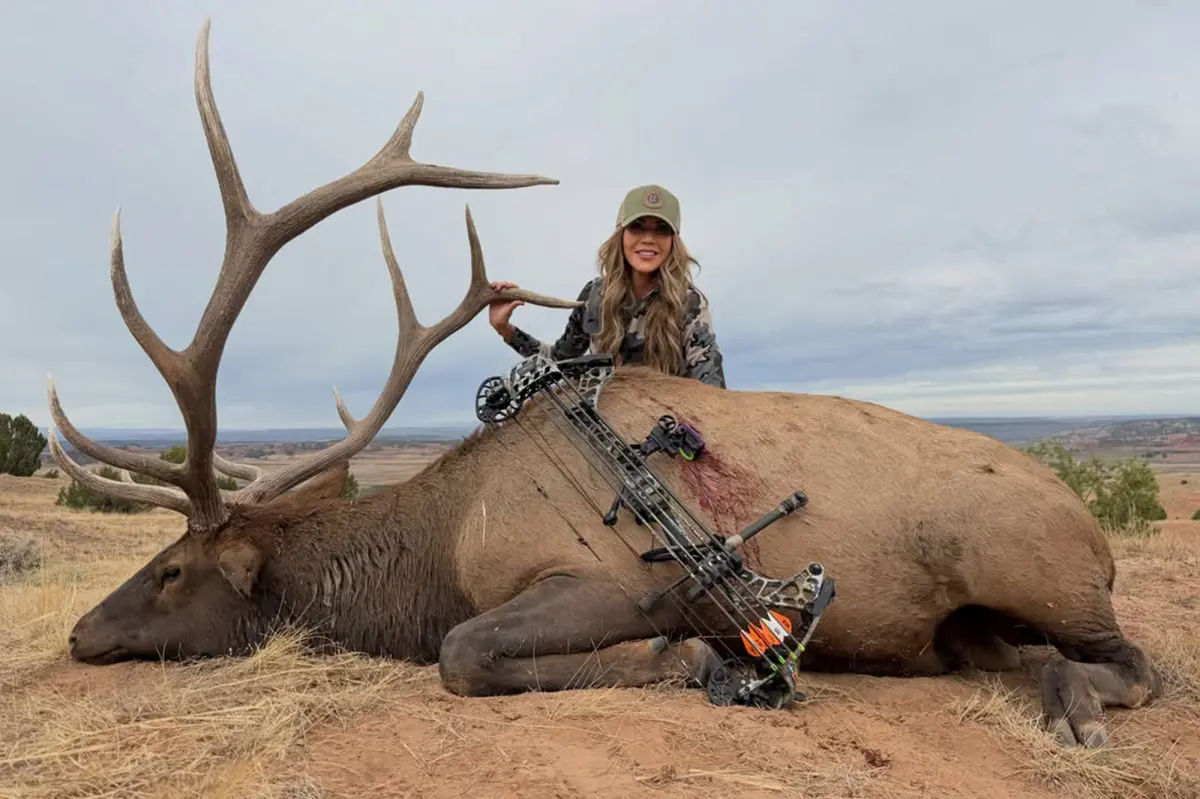
There are some images that simply refuse to let the internet move on, and Kristi Noem has a remarkable talent for creating them. The former Homeland Security chief, known to millions not for her policy positions or political rise, but for the stunning revelation that she once shot and killed her own family dog, recently shared a fresh set of photographs that instantly reignited the old fire. In a six-photo Instagram carousel, Noem, now 54, posed triumphantly behind a massive elk she had just killed during an archery hunt in Wyoming. The lead image is something out of a rugged outdoor magazine: Noem grinning with satisfaction, one hand gripping an antler, a compound bow leaning against the animal’s bloodied carcass, the enormous elk sprawled at her feet. The caption was cheerful, even celebratory. “Finally had a little time to post a few pictures of my archery elk,” she wrote, calling the experience a “super fun hunt” and thanking the friends who helped ensure “the strategy and work paid off” in the successful mission. But for a generation of Americans who first learned who Kristi Noem was because of Cricket, the 14-month-old pointing dog she admitted to killing in a gravel pit, the photograph felt less like a trophy and more like a challenge. The unspoken response from many was immediate and almost theatrical: at least it’s not a dog.
Noem has always leaned into her identity as a rural, gun-toting, conservative woman of the prairies. Raised on a family farm in South Dakota, she grew up hunting with her father and brothers, and those mountain memories have become a core part of how she presents herself to the public. Her elk hunt in Wyoming was not a casual stroll in the woods; it was a serious archery undertaking, requiring patience, skill, and the kind of physical endurance that comes from years spent in the field. In her Instagram post, she made clear that she didn’t stumble upon this animal. There was strategy and work involved, careful planning, long hours of waiting, and the kind of teamwork that hunters often describe as deeply bonding. She thanked her hunting companions for sharing the experience, and one can almost hear the joy in her voice in the written words. For her, this was a moment of pride, an accomplishment to be shared with friends and celebrated in the flicker of a screen. The fact that many people saw the photograph and winced, or felt their stomachs turn, or opened their mouths in anger, seemed to surprise her. She responded with a mix of defiance and theological certainty, calling her critics “ignorant and uninformed” and saying that the elk would nourish her family and many others. “These majestic animals are incredible and I’ve so loved learning their ways from my father,” she wrote, adding, “Shame on you who desecrate and don’t understand the stewardship responsibilities God has given us.” To Noem, hunting is not an act of cruelty; it is a sacred duty, a way of life, and an answer to the empty shelves of a world that has lost touch with the origins of its food.
Of course, no discussion of Noem and animals can escape the shadow of Cricket. In her 2024 memoir, “No Going Back,” she recounted in startling detail how she took the young dog to the bottom of a gravel pit and shot her dead, describing Cricket as “less than worthless,” a hunting dog with an “aggressive personality” that was “untrainable.” She claimed the dog had killed poultry and was unpredictable around the family, particularly their young children. The decision, she wrote, was “hard and painful,” but she presented it as a necessary act of responsibility, the kind of unpleasant task that strong leaders must sometimes perform. The public reaction was swift and merciless. People who had never given a thought to South Dakota politics suddenly had an opinion about Kristi Noem, and it was overwhelmingly negative. Late-night hosts mocked her, animal lovers howled with outrage, and political analysts began to whisper that the dog story might be a career-ending self-inflicted wound. At the time, Noem was widely rumored to be on the shortlist to become Donald Trump’s vice presidential running mate. The controversy, many believed, torpedoed that possibility. Trump eventually chose JD Vance, and Noem was left to rebuild her image in the aftermath of a scandal that just wouldn’t die. Every time she posed with a dead animal, the wound reopened. Every time she talked about the hunt, someone reminded her about Cricket. It became the defining story of her life, a bizarre political albatross that no amount of policy work or public service could fully shake.
The comment section beneath her elk photographs followed a predictable pattern. There were words of praise from hunters and supporters who congratulated her, amused by the outrage, cheering her on from their own deer stands and elk camps. “Nice bull, congrats!” one supporter probably wrote in spirit, celebrating the ancient ritual of life and death. But there were also those who could not get past the image of the massive, beautiful animal lying in the dust, its life cut short for what they saw as nothing more than sport. “You killed a beautiful animal, wow what a hero,” one objector wrote with dripping sarcasm. Another asked, more bluntly: “Do you think this is a great work of yours? Are you heartless???” The exchanges were bitter and heated, a microcosm of America’s larger arguments about hunting, guns, and animal rights. But Noem was not about to back down. She met the criticism head-on, reminding her followers that food does not appear on grocery store shelves through magic. “Go to a store and shop for anything that hasn’t been harvested,” she said, imagining the empty shelves and starving families that would result without hunters and farmers. Her point was a familiar one, often repeated in hunting circles: the meat will be eaten, nothing will be wasted, and the animal lived a wild, free life far better than anything raised in a factory farm. Still, the exchange revealed something about Noem’s relationship with her own public image. She is not a politician who cowers in the face of backlash. She answers, she explains, she fights, and she dares her critics to see the world through her eyes.
What made the elk photos even more striking to some observers was who wasn’t in them. Noem posed with her hunting friends, a group of smiling, camo-clad companions sharing in the victory. But notably absent from the celebration were the two men who have occupied the more complicated corners of her personal life: her husband, Bryon Noem, and Corey Lewandowski, the former Trump campaign manager who has long been described, half-jokingly and half-seriously, as her not-so-secret secret boyfriend. In recent years, Noem’s personal life has become tabloid fodder, perhaps because she sought the kind of national spotlight that invites such scrutiny. Her marriage has been the subject of rumors, her relationship with Lewandowski has been whispered about in political circles, and her public appearances often seem carefully designed to navigate around these questions. The elk photos, with their focus on her own independence and her friendships in the wild, seemed to say something quieter: I don’t need a man in the frame to be complete. She smiled, she stood strong, and she let the elk do the talking. It is a carefully crafted image, the same woman who once rode horses in South Dakota parades and presented herself as a down-to-earth farm girl, but now one with national power, a cabinet portfolio, and an array of enemies ready to pounce at any misstep. Her political career has continued, despite the dog scandal. She served as Secretary of the Department of Homeland Security from January 2025 until March of this year, when Trump announced on Truth Social that she was being replaced as DHS chief. But in the same breath, he named her the inaugural special envoy for his Shield of the Americas coalition, a new initiative focused on targeting drug cartels across Latin America. So, whether her critics like it or not, Kristi Noem remains a prominent figure in American politics, a hunter who has learned to live with controversy.
In the end, the elk photograph is a mirror that reflects whatever the viewer brings to it. To her supporters, it is a symbol of self-reliance, conservation, and a refreshing unwillingness to apologize for the realities of life and death. They see a woman who is unafraid to get her hands dirty, who understands that the wild is not a zoo, and who honors her prey by using it. To her detractors, it is further evidence of a troubling lack of empathy, a person who celebrates killing and appears to revel in the power over life and death. The memory of Cricket hangs over every frame, a persistent reminder of a moment that Noem probably wishes she could take back, or at least explain differently. She wrote in her memoir that the decision was hard and painful, but the way she now speaks about animals suggests she does not struggle with the moral weight of taking a life. She calls elk “majestic,” and claims to love learning their ways, but she still draws a bow and lets an arrow fly. Perhaps that is the contradiction of hunting: you can love an animal and still kill it, you can revere nature and still consume it. Noem has made peace with that contradiction, and she expects others to do the same. The world, she argues, is a place where food comes through blood and sweat, not through plastic packaging. Her critics will never accept that, and she knows it. But as she drove home from Wyoming, with the elk meat in the freezer and the photos safely posted online, she must have felt a sense of victory, both over the animal and over the endless noise of her own legend. It was not a dog this time, but it was yet another chapter in a story that America can’t seem to stop watching.