






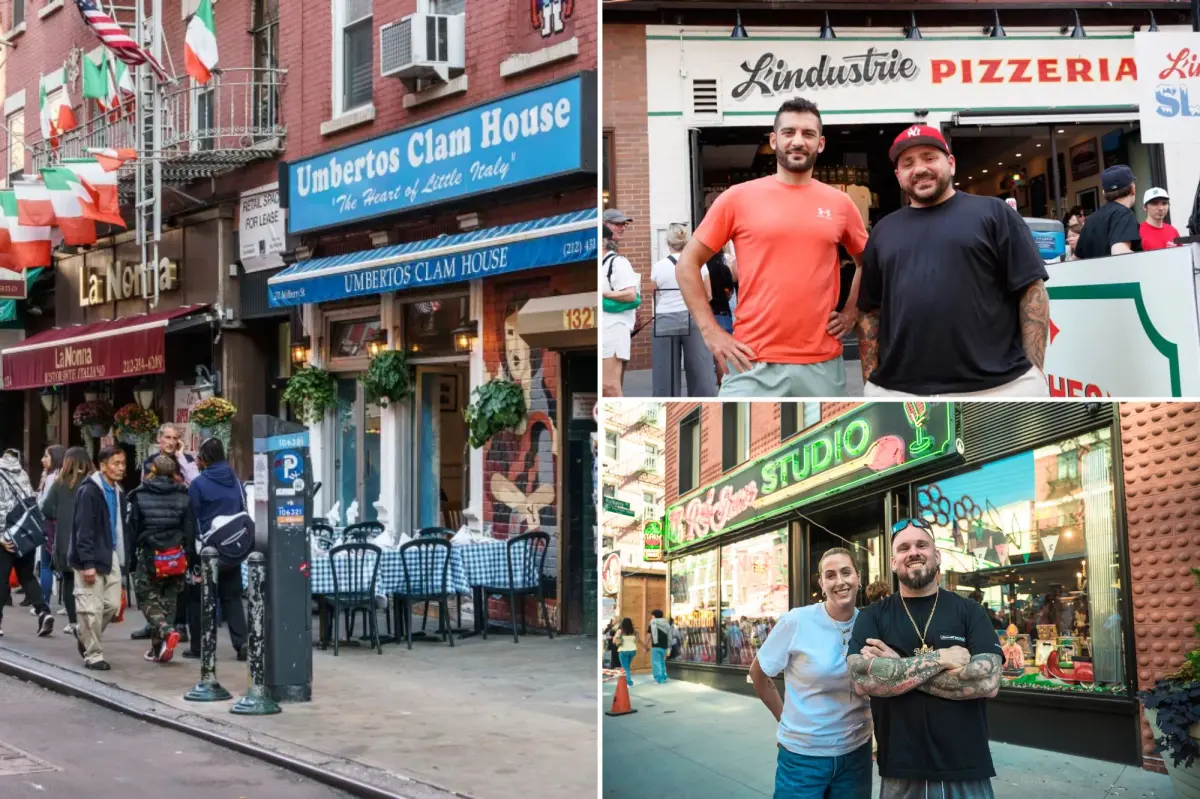
There is a red-sauce-fueled resurgence happening in Little Italy, and for the first time in decades, the neighborhood sounds less like a eulogy and more like a celebration. For years, the story of this Manhattan enclave was one of loss. Once a sprawling, 30-block world of Italian immigrant life, Little Italy had quietly shrunk to just five blocks along Mulberry Street between Canal and Broome. The tenement buildings that once vibrated with the sounds of Sicilian and Neapolitan dialects were emptied out, sold, or converted. Astronomical rents pushed out multigenerational businesses that had anchored the streets for a century, forcing beloved shops and restaurants into an impossible choice: pay up or disappear. Italian families moved elsewhere—out to Brooklyn, Queens, New Jersey, Long Island—seeking the space and prosperity their grandparents could only dream of. Some old-timers even sounded the death knell, muttering that the neighborhood’s glory days were gone forever. But now, as Little Italy celebrates the 100th anniversary of its famed Feast of San Gennaro, a new chapter is being written. A fresh generation of personalities and businesses is moving in, bringing energy, creativity, and a sense of belonging that many feared had vanished for good. It might sound like a clash between old and new—the kind of story that usually ends with the old timers getting pushed out by trendy newcomers. But surprising as it may seem, the old guard is holding the door open.
Instead of resisting, they’re welcoming the change with open arms, hoping that the newcomers will breathe new life into this beloved enclave and keep Little Italy alive for another generation. “The neighborhood is currently reinventing itself, as it’s done constantly,” Ernest Lepore, 61, whose family has run Grand Street’s Ferrara Bakery and Cafe since 1892, told The Post. “From a businessman’s point of view, the crowds bring a coolness to the neighborhood,” he mused. “I’m thrilled when I see the young people. We welcome them all; it’s how the neighborhood reinvents itself. It’s an evolution, and I’ve been waiting for the next wave of fun.” That phrase—“the next wave of fun”—captures something essential about what is happening in Little Italy. The neighborhood has always been more than a collection of buildings; it’s a living, breathing organism that has survived because it knows how to adapt. The current reinvention is not the first, and it won’t be the last. But it feels different this time. There is a hopefulness in the air, a sense that the old stories and new dreams are fusing together into something that could be even richer than what came before. For every cautious cynic who predicted Little Italy would become just another souvenir stand, there is now a young chef, an artist, a podcaster, or a small-business owner proving that the neighborhood still has plenty of heart. The challenge is to honor the past without being trapped by it, and to let the old and new coexist in a way that keeps the spirit of Little Italy truly alive.
Part of that new wave is Massimo Laveglia, the acclaimed pizzaiolo behind L’Industrie Pizza, which landed next door to Ferrara Bakery in March. Born in Pistoia, Tuscany, Laveglia brought his viral pizza joint to Grand Street, opening its third location after Williamsburg and the West Village. Since then, it’s been pizza pandemonium, with hungry fans lining up daily, spilling around the block, and filling the air with the scent of charred dough and imported prosciutto. His shop slings out $47 pies topped with treasures like prosciutto di Parma and burrata, and regularly gets voted one of the best pizza shops in the USA. It was even awarded the tasty moniker of Pizzeria of the Year from PizzaToday.com. “We found an opportunity and took a chance,” Laveglia says, carefully choosing his words. “It’s not that we’re trying to elevate Little Italy, it’s been here forever, but they all know they needed to change, and maybe it’s the beginning of something good.” He’s referring to a previous lack of foot traffic and the pandemic-related slowdown that left many storefronts empty. But his presence, along with others like him, has ignited a spark. On nearby Mott Street, gourmet pizzeria Ceres has been wooing foodies and earning acclaim since opening in January 2025, with meticulously crafted pies priced at upwards of $60. And just blocks away, another acclaimed newcomer has arrived: Dante, the celebrated West Village aperitivo bar, opened an Elizabeth Street outpost earlier this month, bringing Italian-inspired cocktails and fare to a stretch that was once at the heart of old Little Italy. Dante is part of a larger transformation unfolding on Elizabeth Street, where Michelin-starred Italian restaurant Torrisi has been drawing diners since December 2022, despite its reputation for being notoriously difficult to book. These names—L’Industrie, Ceres, Dante, Torrisi—are not just restaurants; they are magnets, pulling people back into a neighborhood that many had written off. And their success is lifting the fortunes of the old businesses around them, proving that a rising tide really can float all boats.
The old guard gets it. “I think change is inevitable, but it’s important that Little Italy doesn’t lose what made it special in the first place,” ‘Baby’ John DeLutro, owner of the 1973-circa Caffé Palermo, told The Post. “The old businesses are a big part of that identity.” DeLutro’s crunchy, creamy cannolis made him a Little Italy fixture. Now, he’s helping usher in its next era, too, with his eponymous Baby John’s Pizzeria, which opened at Mulberry and Grand in 2023. “Today the old businesses carry that history, while newer businesses bring new energy which allows the community to preserve its roots while the neighborhood truly continues to evolve, and that’s what keeps the New York feeling alive,” DeLutro said, nodding to the fact that COVID and high rents pushed out century-old businesses. That includes Alleva Dairy, which reopened this week in Chelsea Market after closing its Mulberry Street location in 2023 following 130 years in Little Italy, the result of a pandemic-era rent dispute. The loss of such a beloved institution was painful, but the new places are helping to fill the void. “Listen, the rents are high here but they’re high everywhere,” pointed out Nicky Criscitelli, who opened Mulberry Street’s Da Nico Restaurant in 1993 with his mother, Annette. “It’s very difficult these days between the rents and the cost of food and labor, but thank God we have a steady clientele.” The 56-year-old says he’s been seeing way more foot traffic recently, and he’s not the only one who’s noticed. Ernie Rossi, owner of Grand Street’s legendary 1910-circa gift shop E. Rossi and Company, is tucked beside L’Industrie Pizza, across from Ferrara. His cramped shop overflows with Italian tchotchkes and memorabilia—a time capsule that has witnessed Little Italy transform over decades. “Many years ago, I thought I’d make more money because I was one of the last shops of our kind, but it didn’t work out that way,” Rossi said. “The more places we get, [the more] it will be a plus, and I can’t believe the lines L’Industrie generates. I wish I could get a line like that,” he cracked. His conclusion is simple and heartfelt: “New places keep Little Italy alive. Otherwise, it’ll die out.”
But perhaps the biggest change is not the restaurants or the shops, but who actually calls Little Italy home. At its peak, more than 10,000 Italian immigrants packed into the neighborhood’s crowded tenements, with the sprawling enclave informally divided by regional roots—Sicilians in one corner, Neapolitans in another. Today, that Italian identity has largely faded. “The new generations in Little Italy are mostly young Americans from all over,” Rossi pointed out, with the most recent U.S. Census showing virtually no Italian immigrants in the neighborhood. “You just don’t have anyone of Italian descent moving in anymore.” Previous immigrants either died off or moved out of crowded tenements as they assimilated into the rest of the city and country throughout the decades. The neighborhood’s dwindling population of Italian immigrants even became a point of contention amid the brouhaha over the Immigrant Enclave Map released by Mayor Mamdani’s office in July. Instead, many of the neighborhood’s residents and business owners are second- and third-generation New Yorkers, with some putting their own stamp on the family businesses they inherited. Among them is thirtysomething Jennifer Prezioso of Albanese Meats & Poultry, the 103-year-old butcher shop once run by her grandfather, known around the neighborhood as Moe the Butcher. It remains the last of its kind in a neighborhood that once had such a shop on every corner. Prezioso took over the family business following her grandfather’s death in 2020, stepping into the role of butcher and proprietor. “It’s been a great honor and a joy of mine to continue telling (my family’s) story,” Prezioso, who has taken the mantle of Jen the Butcher, told The Post. “It’s a slow process, yet extremely rewarding to see changes we once talked about coming to fruition.” She recently restored the shop’s antique walk-in fridge and keeps an active presence on social media. These days, the shop retains its old-school flair while selling delicacies like juicy steaks, along with its own line of merch and a slate of classes and community events. “It’s nice to see younger generations bringing businesses to Little Italy that highlight the small business aspect of the neighborhood,” she said, while also bemoaning the neighborhood’s high rents. “We have lost many loyal and lovely tenants over the years because of extremely greedy landlords. They don’t care that people and places come and go because they don’t live here.”
Little Italy’s cultural scene, once home to a variety of community theaters devoted to puppetry and opera—as depicted in a memorable scene in “The Godfather Part II”—has also experienced something of a comeback in recent years. “I also love seeing newer places popping up that blend tradition with invention,” singer Sal Valentinetti told The Post. Known colloquially as The Voice, the 31-year-old Frank Sinatra-esque crooner regularly performs in the neighborhood, at spots like Red Sauce Studios, which opened in 2023 and serves as a meeting ground and podcast studio that hosts recordings of the popular “Italian American Podcast,” as well as “Growing Up Italian.” “Red Sauce has become a destination for Italian Americans and aficionados from across the globe so I love seeing who might roll through,” Valentinetti said. “The mix of old and new is what keeps Little Italy alive. You need the places that have been here forever and the new places to keep bringing new thoughts to the conversation.” The space is also home to the Italian American Emporium, a curated shop featuring regional brands such as Body by Rigatoni, a lifestyle and clothing line founded by New Jersey native Nicole Ponti. “It’s literally about owning who you are and your culture,” she said of the venture, which was inspired by her late mother, Vera, and draws on design elements from Ponti’s frequent trips to Italy. “There are so many micro-influencers who are popping up, owning their heritage and sharing more about how they were raised, which I think has a lot to do with the resurgence,” she added. “People want to belong to something.” That desire to belong is perhaps the most powerful force driving Little Italy’s revival. It’s not about nostalgia for its own sake; it’s about a generation of Italian Americans and admirers of Italian culture who are seeking connection in a world that often feels fragmented and disconnected. They come to Little Italy not just for the pasta and the pastries, but for the sense that they are part of a story larger than themselves.
Dr. Joseph Scelsa, Ph.D., the founder and director of Mulberry Street’s Italian American Museum, which opened in 2024 after 20 years in development, agrees. “I think there are a number of Italian Americans that have come back to this area, like myself, who are re-reclaiming it and making it our own,” he told The Post. “Just walk down the street any day and you’ll see it. There are young people, many under 30, who are looking for something other than the type of experiences their grandparents had; they want to know what the modern Little Italy is all about.” Over the past two years, he’s noticed an uptick in museum visitors. “It’s very heartening, because people come in and they want to learn more about their families.” To Dr. Scelsa, that curiosity speaks to a culture all its own—one that people are rediscovering. “It’s like we’re the 21st region of Italy,” he muses. “We have our own style and different experiences. They’re beautiful in Italy, but it’s not the same as what we have here.” And that, perhaps, is the truest way to understand Little Italy today. It is not a preserved relic of the past, nor a sanitized restaurant row for tourists. It is a living, evolving community that has learned to honor its roots while making room for the future. The old guard is not fading away quietly; they are choosing to share the stage with a new generation, and in doing so, they are ensuring that Little Italy will not just survive but thrive. The lines outside L’Industrie, the ceremonies at Red Sauce Studios, the foodies flocking to Ceres, the history lovers touring the Italian American Museum—they are all part of the same beautiful continuum. It’s a neighborhood that has always understood that to stay alive, you have to keep changing. And right now, Little Italy is changing in ways that feel true to its soul. The red sauce is still simmering. The cannolis are still crisp. The voices are still loud, loving, and full of life. And after a century of triumph and loss, Little Italy is proving once again that it is far from dead. It is simply being reborn.