




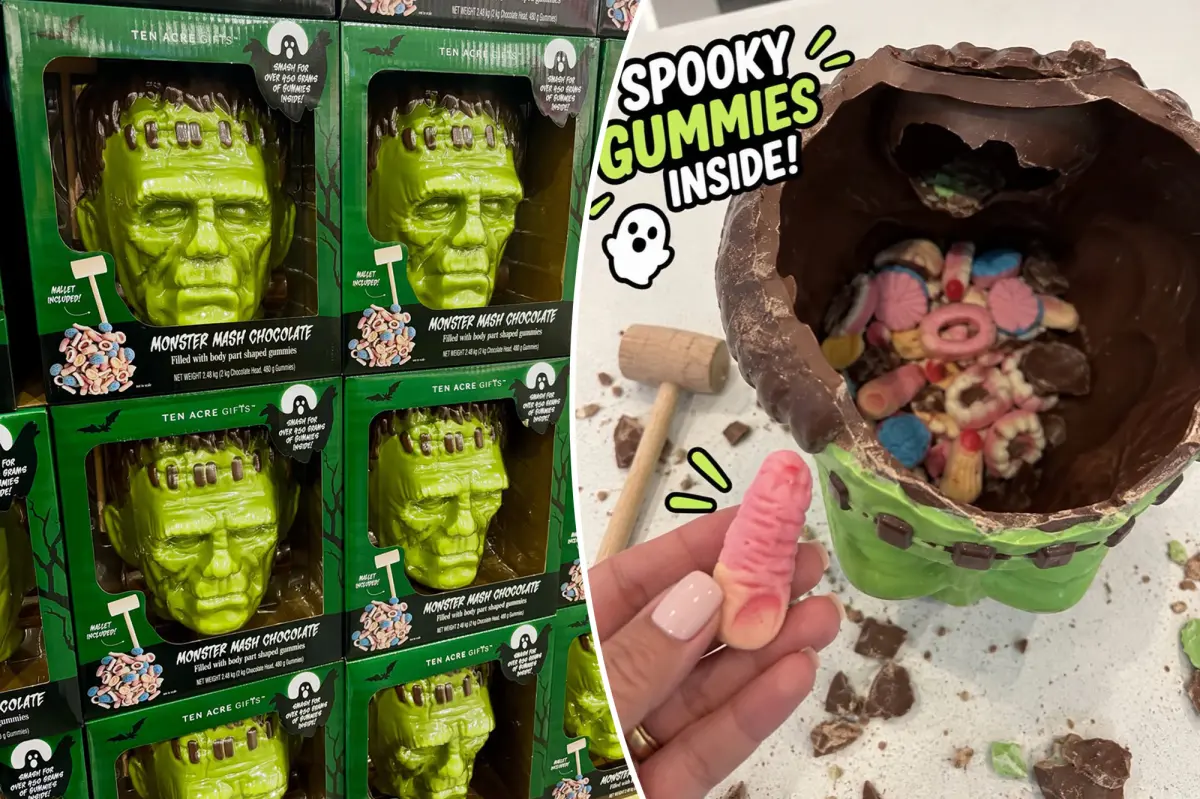
There are moments in the Costco shopping experience that feel almost mythic—when a product arrives out of nowhere and somehow becomes the only thing anyone can talk about. This Halloween, that product is a life-sized Frankenstein head, and it is exactly as absurd and sensational as it sounds. The warehouse giant has unleashed what might be the season’s most unconventional sugar rush: a massive, five-and-a-half-pound sculptural head crafted from 100 percent Belgian chocolate, complete with the iconic flat-topped brow, stitched brow ridge, and the faintly tragic expression that has defined Frankenstein’s monster for generations. But the real twist isn’t just that you’re buying an enormous chocolate sculpture of a horror icon. It’s that the head is meant to be destroyed. Inside its dark chocolate shell sits a full pound of body-part-shaped gummy candies—tiny fingers, ears, brains, and other pleasantly gruesome anatomy—waiting to be liberated by a wooden mallet that comes right in the box. Costco understands that modern entertainment is not just about consumption but about participation. Shoppers, it seems, have embraced the absurdity with open arms. In crowded aisles, you can already hear the jokes about the “monster mash” as carts pile high with these puzzled-looking chocolate faces. Some are buying it as a centerpiece for Halloween parties, planning to make the smashing ceremony the main event. Others just want to stand in the kitchen, raise the mallet, and let out a week’s worth of stress in one glorious, chocolate-shattering swing. Parents are imagining the look on their kids’ faces, not just when they see the enormous Frankie on the table, but when they’re handed a weapon and told, “Go ahead. Smash it.” It’s part dessert, part piñata, part theatrical production, and entirely ridiculous—which is exactly why it has turned into the most talked-about seasonal item in the big-box world.
Of course, none of this comes without a price tag, and that price tag has become its own conversation starter. In Costco warehouses, the chocolate Frankenstein head sells for $54.99, which is already enough to make a person pause. Online, the price creeps even higher—over $60 when you factor in shipping and the obligatory markup. But the real sticker shock happens on secondary marketplaces like eBay, where the head has sold out at Costco both online and in many stores, prompting opportunistic resellers to list the creature for up to $100. The desperation is real. Halloween is a holiday that feeds on rituals, and this product has tapped into a deep well of fear-of-missing-out. What if your kid sees a neighbor’s candy-stuffed monster head and you have to explain that you simply didn’t act quickly enough? What if the party you’re hosting loses its wow factor because you waited one day too long? Costco has perfected the art of creating urgency with its limited-run treasures, and this ghoulish chocolate head is no exception. The fact that it’s already sold out in so many locations only adds to its mythology. Scrolling through social media, you can see shoppers posting photos of empty shelves where the monsters used to be, alongside screenshots of eye-watering resale prices. One person described the hunt as “Black Friday except for Halloween.” Another joked that they were considering offering to pay a friend’s rent in exchange for one. It’s a strange, delightful kind of mania—the kind that makes you forget that this is, at the end of the day, just candy. But that’s the power of scarcity, and Costco knows it. The question becomes not whether you want the chocolate Frankenstein head, but whether you can get your hands on one before they vanish entirely.
The real payoff, though, arrives after you get it home. There is something deeply primal about taking a heavy wooden mallet and striking a seven-pound block of chocolate shaped like a beloved horror icon. You have to find a sturdy surface, maybe clear the kitchen table, and warn the dog. Then you raise the mallet, wind up, and let it fly. The first crack is always a shock. The silence that follows—that brief moment when you wonder if you’ve broken the table—is followed by a shower of dark chocolate shards. Kids scream. Adults laugh. And then everyone scrambles to pull thick hunks of Belgian chocolate off the table, brushing away the occasional gummy finger that rolls out from the wreckage. Inside the head, as promised, is a pound of candy in the shape of various human parts. There are gummy ears, gummy hands, gummy eyes, gummy brains, and other delicately grotesque little treats, all individually packaged and perfectly timed for a Halloween sugar fix. The destruction becomes the entertainment. It’s not just about eating chocolate, although the chocolate itself is reportedly quite good. It’s about the ritual of smashing something enormous, the anticipation of finding what’s hidden inside, and the strangely satisfying mess of it all. Some families have turned the event into an annual tradition before this year’s Halloween has even arrived. Others have posted videos of their children taking turns with the mallet, carefully guarding the largest chocolate fragments as though they were treasure. The gummy body parts add a layer of squeamish delight that keeps kids interested and adults cringing in the best possible way. In a world where so much entertainment requires a screen, there’s something refreshingly physical about a product that demands you use your hands, make a noise, and leave a little chaos in your wake.
But for every family eager to smash a chocolate head, there is another that simply cannot understand the price tag. Social media has erupted with a spirited back-and-forth, and the critics have been loud. One Instagram user captured the frustration with a pointed comment about the state of the economy: “Right now people are just trying to put food on the table and those prices have gone up, plus the cost of the gas to get to the store. Sorry kids maybe when things get better.” That kind of sentiment resonates deeply. Groceries are expensive, rent is expensive, and for many households, spending nearly $60 on a Halloween novelty is simply not in the budget—no matter how cool it looks. Another commenter mocked the price with a pun: “That looks awesome but $50? You’re outta your frankenmind.” The jokes kept coming, with someone else writing, “55 bucks !!! Lil crazy they really know how to squeeze money outta ya for the kids geez.” These are real concerns, and they shouldn’t be dismissed. For many parents, the Frankenstein head represents everything that feels excessive about holiday marketing—the endless push to buy more, spend more, and turn every occasion into an event that requires a credit card. The criticism also reflects a broader anxiety about living in a time when pleasure seems to come with a luxury tax. They’re not wrong: $55 is a significant amount of money, and a family could buy a week’s worth of snacks with it. The fact that the head is sold out despite these objections says something about the divide between the people who can comfortably splurge on seasonal fun and those who have to watch from the checkout line, making difficult choices between magic and practicality.
Yet, for every critic, there is a passionate defender ready to argue that the price is more than fair. They point out, first and foremost, that this is not the waxy, cheap chocolate that usually fills Halloween buckets. This is Belgian chocolate, a distinction that carries real weight among people who know their cocoa. A defender wrote: “Everyone saying $55 is crazy, but a 5lb bag of decent chocolate used for tempering chocolate to make things like this currently costs $50-70 right now depending on the brand and what state you’re in. $55 is actually not that bad.” That argument has a certain logic. Making a hollow, life-sized chocolate sculpture takes skill, time, and high-quality ingredients. You’re not just paying for candy; you’re paying for novelty, engineering, and the sheer audacity of the product itself. Another commenter took a more emotional approach: “Its Belgium chocolate WAY better more legit and cld U fly over to Belgium for $50? NO and its cool so ppl complaining just move on.” It’s hard to argue with that kind of enthusiasm. The chocolate head is, at its core, a meticulously crafted item that would probably cost much more at a high-end chocolatier or a specialty boutique. The fact that Costco, a store known for squeezing margins thin, is selling it for less than $60 is, in the eyes of fans, almost a bargain. They also point out that the experience comes with built-in entertainment value. You’re effectively buying a party activity, a centerpiece, and a dessert all in one. If you split the cost among a group of friends or siblings, it becomes even less intimidating. And let’s be honest: the resale market, where sellers are asking $100, proves that demand is real. People are willing to pay for joy, especially when that joy involves smashing things with a mallet.
The Frankenstein head, though, is more than just a viral Halloween product. It fits into a much larger story about Costco’s strange and powerful place in American culture. The warehouse giant has spent decades building a devoted following, and it continues to expand its empire through delivery partnerships with DoorDash and Uber Eats, making it easier than ever to get big-box goodies without ever leaving the couch. This Halloween, that delivery network means the chocolate monster can show up at your door with the same speed as a pizza, ready to be smashed and devoured. Costco has always excelled at understanding the emotional side of shopping. The store does not just sell bulk paper towels and rotisserie chickens; it sells a lifestyle, a sense of being in on the secret, a membership that feels less like a subscription and more like a tribe. The beloved food court has become a destination in its own right, with recent celebrations erupting over the return of the churro, a long-missed treat that prompted headlines normally reserved for political victories. The candy-stuffed Frankenstein head is just the latest example of this strange magic. It is big, slightly outrageous, and impossible to ignore. It gets people talking, arguing, sharing photos, and rushing to the store. It creates a shared moment, whether you’re on the side of the buyers, the skeptics, or the resellers. And in that sense, the monster mash has already done its job. Whether you smash it, mock it, or simply watch the videos online from a safe distance, you have participated in the spectacle. As Halloween approaches, the chocolate Franks will find their way onto dining tables, creating sticky messes and lasting memories. The cost-of-living argument remains real, but so does the offer of a little unadulterated fun—a moment of childhood silliness in a world that often feels too serious. Costco has always understood the power of making people feel like they found something special, and this time they’ve packaged that feeling in the form of a five-and-a-half-pound chocolate monster with candy guts. It may be ridiculous. It may be expensive. It may be a little bit haunted. But for one holiday season, it is exactly what everyone wants to talk about.