






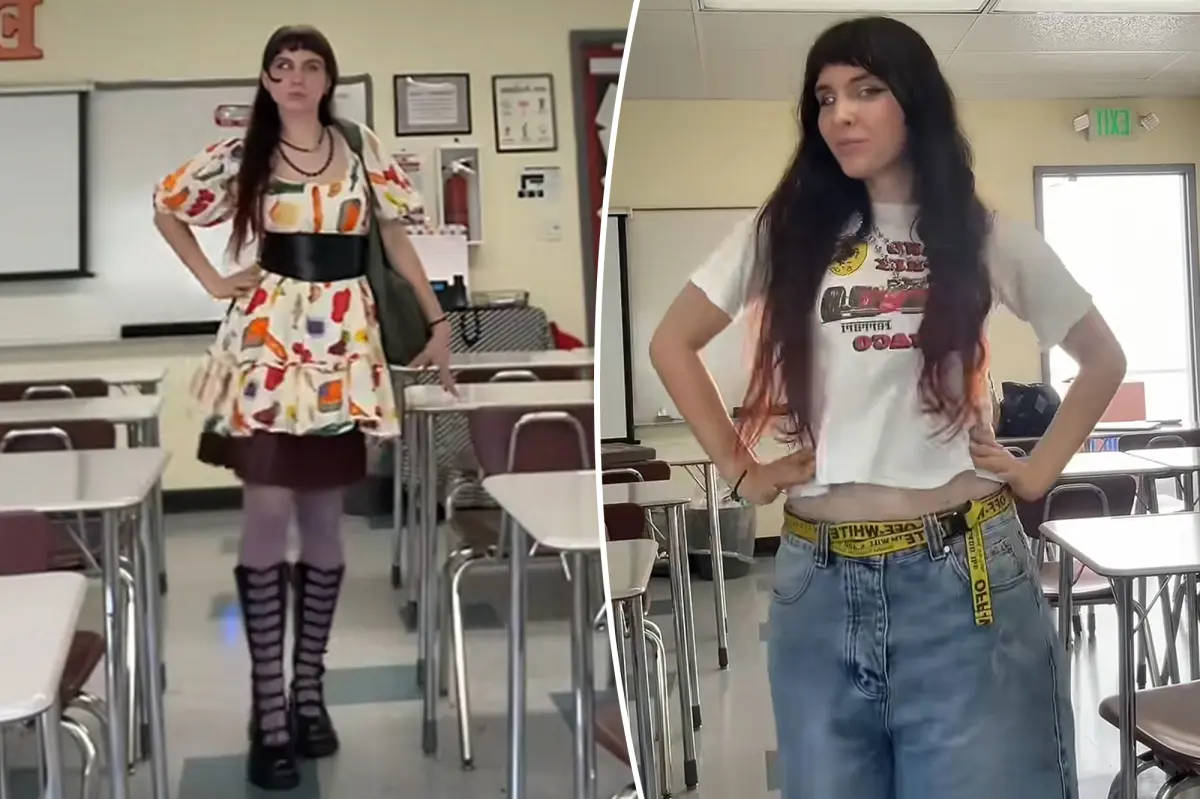
A Los Angeles teacher and social media personality who goes by “HeyMissTeacher” found herself at the center of a heated internet debate this month after a lighthearted TikTok video in her classroom turned into a national conversation about what teachers should look like, how they should act, and who gets to decide what “professionalism” really means. The clip, filmed in an otherwise quiet, ready-for-the-year classroom, showed the woman dancing alone to Lady Gaga’s “Paparazzi” while wearing a playful babydoll dress printed with little food illustrations, purple leggings and knee-high leather boots. She was smiling, moving around, and clearly having fun in the space where she would soon spend her working days. By itself, the video was little more than a cheerful moment of personality. But the internet, as it often does, turned it into a symbol of something much bigger. The video received more than a million views, and the visible wave of reaction that followed drew a line between people who saw a joyful educator being herself and those who felt that teachers should never behave in that way in a school setting. The debate was less about her outfit, of course, and more about what classrooms are supposed to feel like, how much of a teacher’s identity should remain visible, and why an ordinary person having fun at work can upset so many strangers.
The strongest criticism focused on the idea that this woman, whether she was teaching or not, had crossed a line by treating the school as a place for personal expression. One X account, in a repost of that now-scrolling video, didn’t hold back. “This is what ‘professionalism’ looks like now,” the post read. “The adults in charge of forming young minds treating the classroom like a personal content studio. Then parents wonder why kids come home with zero respect for authority, zero attention span, and completely inverted priorities.” Another commenter agreed, asking why school districts had abandoned teacher dress codes. “Schools need to start enforcing proper dress codes on teachers once again. They don’t allow students to wear clothes that are considered distracting, so why are teachers allowed to do so?” They wanted to know, layering the concern that kids are constantly tested for the way they look but then adult staffing were not being held to the same standard. A third voice went further, saying that a classroom is not a platform for self-expression. “A classroom is not a place for a teacher’s self expression, it is a place for a teacher to teach, and if they can’t figure that out then they shouldn’t be a teacher,” the commenter wrote. There was a common theme in the harsher responses: a teacher’s role needed to be, or must appear to be, neutral, contained, and professional in the strictest sense, and any behavior that turned too much attention to the teacher herself was considered an offense against the wider subject. In that sense, the debate was never just about tights or leggings. It was about whether educator can feel like a full person and still be respected.
But the woman’s supporters were just as quick to come forward, and their comments offered a completely different reading of the same video. “I don’t get why she’s getting hate? She’s covered, nothing inappropriate, she’s fun and being herself. She’s giving Magic School Bus vibes. My daughter would dig her 100%,” one commenter wrote. Another wrote: “I’m failing to see what’s inappropriate about this? Her skirt is barely above her knees and she’s wearing leggings. Her dress has food on just,” while another added: “Your students are gonna be loyal to you when they grow up.” These descriptions captured the way many fans saw the video: not as a violation of classroom rules but as an expression of the kind of spark and relatability that often gets pushed out of techers by budget cuts, curriculum pressure, and many strict administrative. The label “Magic School Bus vibes” is significant because it connects the woman to a long tradition of animated and energetic educators, people who made learning feel like an adventure rather than a chore. And there is something telling about the fact that the same clip could be seen so differently by different people. For some, she was a teacher dancing in an empty classroom, or for others, she was a wedge in a culture war. Universities such as the University of Memphis have questioned whether “female teachers and “short ’ skirts-bearing outfits” are criticized because they are women. The supportive comments were filled with people who said they wished they had had a teacher like her, meaningful to the idea that children don’t necessarily learn best from neutral people. children know when an adult is engaged, creative, and present, and that relatability forms lasting feelings of connection.
This was not the first time that the teacher of professionals owned in front of the online audience. In a separate video posted August 5, she was seen wearing a crop top shirt and jean shorts for something called “professional development day” at her school. One commenter wrote under that video, “I remember when teachers were professional.” Then hodge, someone may very strongly have pulled up the entire clip, refusing the local context for what she was wearing. But you had to look for the specific reply in order to find the truth. The teacher explained, in a written comment, that she was not actually teaching that day. “It says I don’t meet the kids till “the initial song” though,” she wrote. “It should be clear I’m not wearing this while actually teaching. I’m just setting up my classroom.” In many ways, that explanation did not matter. Online arguments depend on short images and short bursts, not long contextual details. A photo of a person in a jean short inside a school is enough to launch a hundred responses, no matter whether the students were even in the building. The fear is that she will someday show up in a crop top or a printed outfit in front of a full class, but a cover photo with a classroom table and luminous banners is the He for a case that would otherwise disappear quickly. It also shows how difficult it is to become a teacher on social media. The same platforms that allow her to flip her teachers side, create income, and share humor can also turn her into a user with no feelings, no backstory, and no legitimate reason for the simplest things.
Most importantly, the human side of this story was and is staggeringly. The teacher, who used to continue under the same name and posts on social media, also lost one eye when she was very young and now does not have a prosthetic eye with a star-shaped iris consistent with her personality. In a video she posted after the controversy. She defended her capacity to happy and weird. “I’m not normal, I was never meant to be normal,” she said. “I lost my eyeball when I was five years old. I have to wear a prosthetic eye, and my prosthetic eye is fun and beautiful and amazing.” She is, in other words, someone who carries a visible marker of difference into the classroom. A difference she could try to camouflage, but one she chooses to embrace. Less than most, she knows what it feels like to be looked at or to be judged as a quick reaction. But rather than shrinking, she has decided to intentionally wear outfits that bring her joy, and to show that institution and creativity can coexist. She knows that for many people she will always challenge a certain mold of what a teacher should look like because she already does simply by showing up. The criticism about her clothing can feel truely focused in that context. In response to people who claim her outfits are distracting, then he explained that she actually sees her visual boldness as preparing her students for real lives. “If anything, I’m preparing my students for encountering people who look unique, and who are expressive, and not having that impeded by their ability to learn and grow.” She also reminded them: “By the gellan is, I teach high schoolers. I don’t know why you’re acting like I teach kindergartners and I’m wearing a sparkling disco ball.”
In the end, that simple phrase is maybe the best reminder of all. A student surrounded by weirdly “distracting” adult is not a student who knows nothing in the real world. The world beyond school is full of all kinds of tests, people with piercings, tattoos, scars, prostheses, outfits, hairstyles and choices that generation differences, and with one purpose of schools is to help young people learns how to pay attention anyway, to measure what really matters to them instead of taking the surface as a threat. The woman’s own line about students who are happy and filled with joy learning better is not just a nice slogan. There is a growing recognition in education that relationships come before, inputs, and that boredom and fear of being watched actually reduce learning. A teacher who laughs, who dances in an empty classroom while planning her heart, who wears an outfit with food on the dress and into Ricky boots, might not look like any adult we expect, but she also might be precisely the kind of adult that makes a classroom feel alive. That doesn’t mean every teacher should dress like her, and it also doesn’t mean that school rules are irrelevant. But it means that one brief video, and most important at all. She has built an online presence by showing what teaching is like, including the fun, strange, human moments of preparing a class for all people. The fact that she walks into a school building with a prosthetic star in her eye and chooses to find oxygen in her own image is not something to correct. It is something to defend. As onelf her fans said, students are happy to want to be like her when they grow up. You’re probably worse. It may be easy to mock a dancing teacher from the other side of the screen. Its harder to admit that a child of all stories wakes up one day, maybe after years of trying to hide what makes them different, would be a grown-up standing in front of a classroom, not to be denied of being that way. The deepest lesson in the video may not be about dress codes at all but about honesty, joy and the courage to teach as a fully visibly, exactly as you are.