






The $35 Jelly Bag That’s Humiliating Hermès
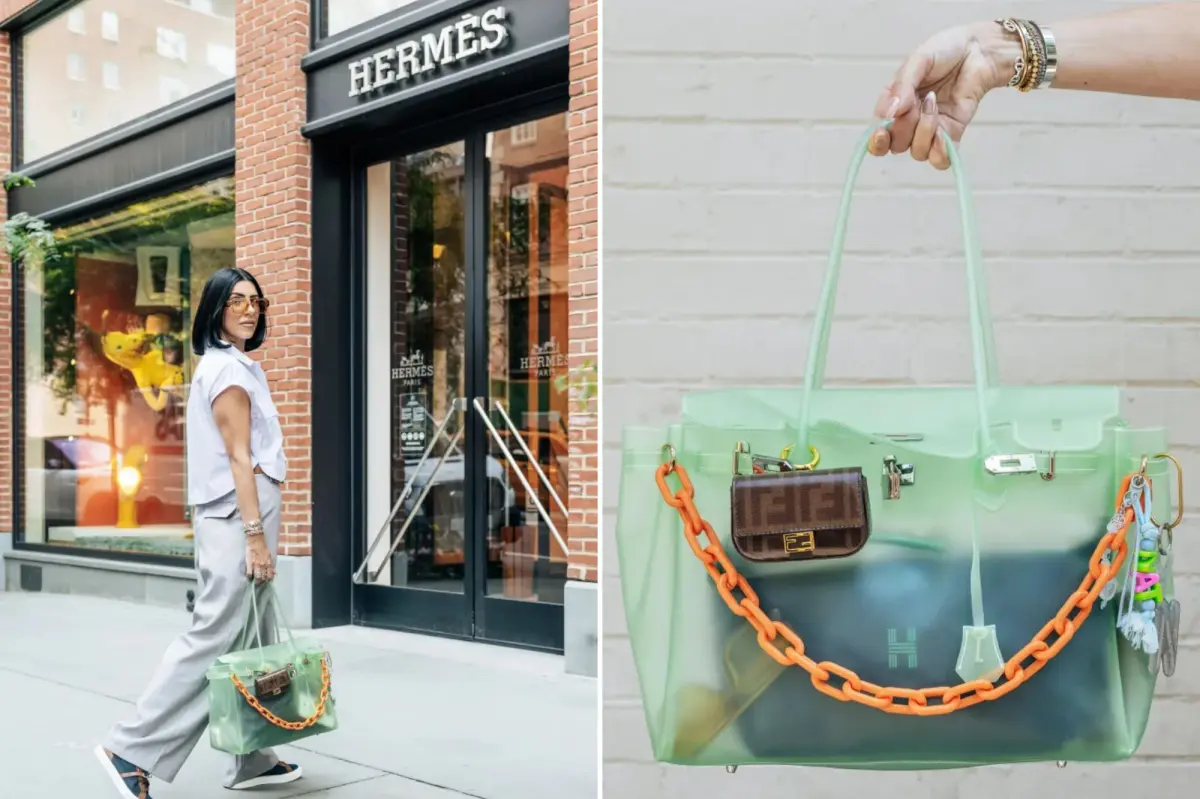
The rain is coming down in sheets over the Upper East Side, and the kind of droplets that would send most luxury handbag owners into cardiac arrest are rolling harmlessly off the shiny plastic surface of Natalie Mileo’s new favorite accessory. She’s carrying the Jelly Firkin, a blush-pink, gel-filled plastic doppelgänger of the most famous handbag in the world, and she doesn’t mind the wet one bit. For years, Mileo, a 40-year-old Queens resident who documents her luxury hauls on social media under the more extravagant alias “Bratty Natty,” would have been panicking, tossing a silk scarf over her arm to protect her precious Chanel flaps and Fendi Baguettes from the very idea of inclement weather. But today is different. Today, she’s toting plastic, and to her, that’s the most liberating fashion statement she’s made in years. The Jelly Firkin, a bizarre and unexpected viral phenomenon, is a handbag shaped like the Hermès Birkin, but made from the kind of gummy, flexible material you’d expect to find on a dollar store toy shelf. It’s simultaneously the most derivative item in fashion and, somehow, the most charming.
The Jelly Firkin isn’t entirely new. In fact, the concept has a bit of a history, with a spiritual predecessor known as the Jelly Kelly that briefly graced the arms of early-2000s It-girls. It was a time of low-rise jeans and frosted eyeshadow, and somehow it made perfect sense that actresses like Reese Witherspoon would be photographed carrying a translucent, rubbery tribute to the elegant Kelly named after Grace’s successor. Back then, the manufacturer, a savvy upstart, knew exactly what it was doing. It got the bags into New York’s legendary department store Henri Bendel, where they sold out instantly, generating a frenzy of press and a devoted following of fashion insiders who appreciated the joke as much as the aesthetic. But like all good fairy tales, the series of events came to an abrupt end. The Hermès legal department, with the efficiency of a hawk spotting its prey, descended on the unsuspecting jelly makers. Cease-and-desist letters were dispatched, legal threats were made, and the Jelly Kelly was unceremoniously yanked from the shelves.
Fast forward to our current social media-saturated, chaos-driven world, and the Jelly Firkin is back with a vengeance, experiencing a resurrection that makes the biblical tale seem lukewarm. The unlikely catalyst for this cultural moment was K-pop star Kya, who was photographed in May with a lime green version. Almost instantaneously, a global frenzy was ignited. Across Asia, the bags became the must-have accessory, selling out in stores that had only just received their shipments, and then appearing on second-hand sites with a mark-up that mocked its cheap origins. Google searches for the term “jelly handbag” spiked a dizzying 5,000% in a single week. The trend sat dormant for a while, a strange artifact from a pre-millennium moment, but the internet has a way of resurrecting the obscure, the weird, and the absurd, and the Jelly Firkin is all three. This time, however, the internet didn’t just bring it back; it supercharged it. And soon enough, it was only a matter of time before the trend hopped the pond, landing clumsily but triumphantly on the shores of the United States via the very specific algorithm of TikTok Shop.
It’s on TikTok where we meet marketing whiz Madison Hopkins, a 26-year-old Brooklynite who claims she first saw the bags flooding her feed in April. Like many, she was charmed by the juxtaposition of high and low, of luxury and kitsch. “I paid thirty dollars for my Jelly Firkin and honestly, it’s better than the real thing,” she tells me, a mischievous glint in her eye. “It’s more whimsical. It’s not snobby.” And she’s not alone in that sentiment. Across the city, and indeed the world, the bag has become a unifying symbol of irreverent, fast-fashion fun. It represents a certain spiritual exhaustion with the tired, stuffy, and often politically fraught pursuit of quiet luxury. Why spend $20,000 on a bag only to be judged if it isn’t perfect, when you can spend $30 on a bag that actively mocks the very idea? As the rain continues to fall on the Upper East Side, it seems the real joke is being shared by the masses, one increasingly confident slouch of the shoulders at a time. The result has been a feeling that perhaps, just perhaps, the joke isn’t just on the status-obsessed elite, but on the very concept of status itself.
That feeling of disillusionment extends to the upper echelons of the fashion industry. The resale value of the real Birkins has taken a hit, with average prices falling almost $2,500 since January 2025. The immutable logic of the luxury market is being challenged by a global pandemic and a generation that has reassessed its relationship with materialism. The bags are no longer the guaranteed financial vehicles they once were. Even an unnamed A-list editor, whose name we’ll never know, admitted the shine has worn off. They are seeing, perhaps for the first time, that the obsession with the Birkin might have reached its saturation point. As this editor explained, carrying one now feels less like a statement of personal style and more like a morning commute with a neon sign blazing above your head. The idea of spending a down payment on a car just to avoid a single drop of rain feels less aspirational and more like a cry for help. The public mood is changing, and it’s leaving a very expensive and increasingly desperate-looking pile of luxury leather in its wake.
Enter the world of Remy Solomon, a California filmmaker who sees the Jelly Firkin not just as a trend, but as a subversive political statement. He writes it off as performance art, a way to reclaim the power dynamic of brand worship. His sly commentary on status and domination is a far cry from the squeaky-clean world of French luxury houses, and it’s this very tension that makes the Jelly Firkin so perfect for the moment. In a world saturated with stealth-wealth marketing and micro-generation-specific status symbols, the bag is a glorious, budget-friendly middle finger. You aren’t buying a handbag; you’re buying the punchline. Showing up to a high-end restaurant with a Jelly Firkin says more about you in five seconds than a Birkin ever could. For Brittni Taylor, a 25-year-old from Washington Heights, her $35 Jelly Firkin has made her a neighborhood celebrity, with friends begging for selfies.
Yet, the future of the Jelly Firkin remains a precarious one. As suddenly as it appeared, the trend seems to be facing an early demise. The internet is already mourning its absence, with the once-prolific “Jelly Firkin” tag on TikTok now returning a fraction of its former results, leading many to speculate the gummy, protein-folding legal eagles of Hermès have once again struck. It’s a cat-and-mouse game that mirrors the perpetual whack-a-mole of knock-off culture. And yet, despite the inevitable legalities and the ever-fickle nature of virality, the bag has left its mark. It’s a reminder that true luxury isn’t about the price tag; it’s about the joy it brings, the smile it sparks on a rainy subway platform, and the audacity to be the only one at the party who is in on the joke. At its core, the Jelly Firkin is a testament to the simple truth that the most precious commodity you can have—more than a silkscreen-printed logo or a hermetically sealed compartment for your phone—is a sense of humor.