





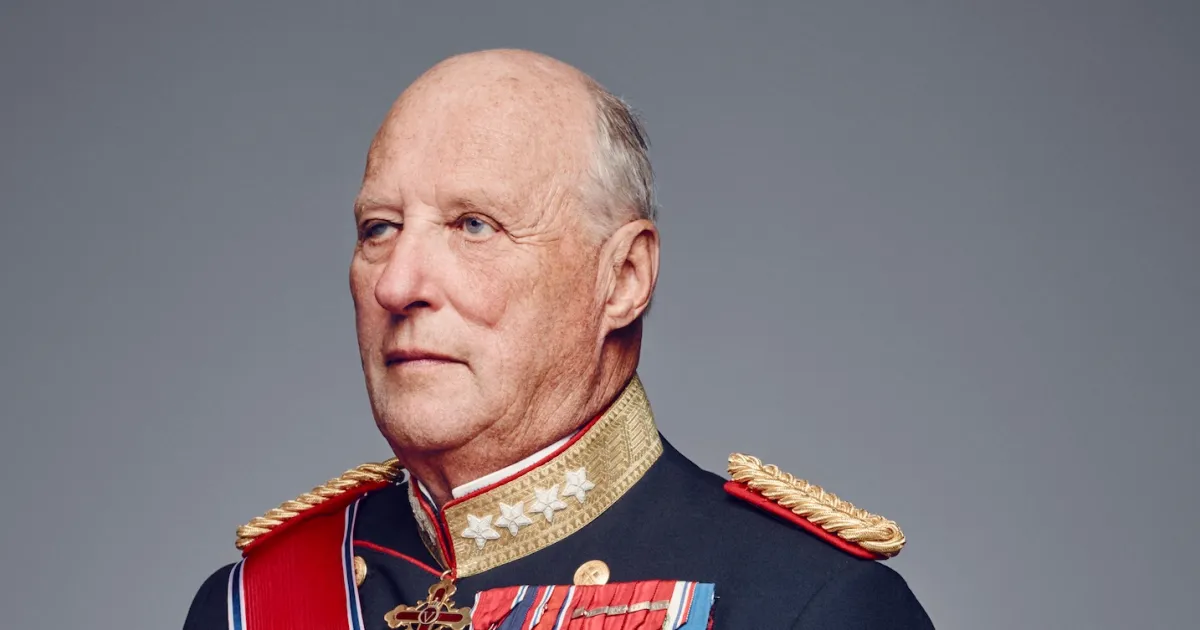
Norway woke to a terrible stillness on Friday, August 28. The quiet news came from Oslo University Hospital Rikshospitalet at 6:35 a.m. local time, but it reached the whole nation as one long, sorrowful breath: King Harald V had died, and the country had suddenly become smaller. He was 89. The Norwegian monarch had been admitted to the same hospital on August 17 with a bacterial blood infection, and for more than a week the royal household had given the country cautious, careful updates. Then came the day before his death, when the palace said the King’s health had “deteriorated” and that the condition was “very serious.” Those words were measured, but they carried enough emotion to make people listen. For Norwegians, the end was not entirely unexpected—the King had been here before, had faced illness with stubborn calm, had returned home with strength that amazed the doctors. Yet the finality of Friday morning tore through the everyday rhythm of life. On the steps of the Rikshospitalet, television reporters lowered their voices; outside the palace, the young and the old laid flowers; inside the hospital, the family faced the private sadness that no one can rule over. Queen Sonja, his wife of many years, and their two children remained close behind those last days, trying to hold back time in the way that only families do. Later the palace confirmed what the nation already felt: the King was gone, survived by Queen Sonja, their daughter Princess Märtha Louise, their son Crown Prince Haakon, and a people that had come to love him as a steady father and a patient captain. No one ruled as long as he had without leaving an imprint. In his passing, the empty room at the throne was felt in every home, every workplace, every quiet flagpole along the fjord. For most Norwegians, there was no such thing as an ordinary Friday that day. It was the morning their long king was silenced.
Harald had already ruled for 35 years when he finally let go of that great crown. He became king in 1991, after the death of his father, King Olav V, and from the first moment he seemed to understand that the royal mission in Scandinavia was not to stand on top of the mountain but to walk with the people. He was a King who appeared in oversized winter caps and a fisherman’s old sweater, who competed in sailing events, who quietly and repeatedly said that Norway belonged to all of its people. He spoke not in grand, polished language but in direct words that seemed to come from an ordinary kitchen. His death drew attention to a reign that spanned decades and included so much change that the country he inherited was almost unrecognizable from the one he left. During his three and a half decades on the throne, Norway discovered oil and wealth, became a more confident Nordic voice of peace and diplomacy, faced extremism and hatred, and somehow grew more open, more tolerant and more full of meaningful public conversation. The King was not always at the center of those moments, but his quiet presence held the national center to him. He gave bicycles around the King’s and to ordinary Norwegians who struggled to find it, and he gave his allegiance to the principles of democracy with a simplicity that belied his lineage. His family, too, was very human. He married Sonja Haraldsen, a woman of no aristocratic title, against every custom around him, and showed that love could be a royal rule. He raised his son to be calm and stable, and he gave his daughter room to be her own person even when her choices didn’t make everything easier. The monarchy’s own survival in modern Norway has often been explained by citizens with the same phrase: “He was so like yours.” That was not a diminishment. It was Harald’s superpower. There was no heavy ceremony around him, only a whole human presence, a man who chose to be in the middle of the weather because that is where Norway lives.
From across the North Sea, the grief found an English accent. The announcement that King Harald had died was followed within hours by a message from the United Kingdom’s King Charles III. Charles spoke of “my dear cousin, King Harald V of Norway,” and the word “cousin” felt less formal than familial. The British monarch said, “For 35 years, King Harald served his people with unwavering dedication, guiding Norway through times of great change with warmth and humility. As Norway mourns the loss of so towering a figure, my whole family join in the grief of a much-loved kinsman and friend whose kindness, compassion and deep sense of duty echoed from across the sea and across the decades.” Charles also touched on the long family and historical bond between Britain and Norway. He reminded the two nations just how close those royal houses and countries have been ever since Britain was one of the first states to recognize Norwegian independence and establish diplomatic relations in 1905. The two countries were woven together again in the terrible trials of the Second World War, when the Norwegian royal family found refuge and carried with them the spirit of freedom. Decades later, the British King found the right words to say that those bonds have remained thick and personal even as the world moved on. It is not every day that one European monarch speaks of another with such open warmth, but this was not a political tribute. It was an old family connection remembered. In his grief for a beloved kinsman, Charles found a way to say what many monarchies have in common: duty is not a costume, it is love. He ended by turning to the family: “Queen and I extend our deepest and most heartfelt sympathy to Queen Sonja and all her family, as Britain shares in Norway’s grief at this time of such heartbreaking loss.” The words, inevitable in their correctness, carried a sense of shared emotion across the North Sea. For a moment, the world felt smaller; at the same time, the loss seemed greater.
The mourning in Norway was also spoken by the Prime Minister, Jonas Gahr Støre, in a statement that tried to put a national feeling into language. “A whole nation is in mourning and the people of Norway are left with a deep sense of gratitude for a long life in the service of Norway.” It was a formal recognition of hope, but what followed was much more personal. “For more than three decades as monarch, Harald V demonstrated an unwavering confidence in the Norwegian people. He helped us to see the best in the world—not just among us.” There was a weight in the phrase “unwavering confidence,” because it pointed to something the King had always been. Harald had a belief in ordinary people, not as subjects but as partners. When the nation was tested—after the terrorist attacks on 22 July 2011—the King found words to bind them together. Støre reminded the world of that date and those griefs, when the King’s presence became a calm visible part in the storm. He wept with them. He spoke of love and community and hope while others only stumbled. The Prime Minister also had a better memory: “He cheered with us when Norwegian athletes excelled.” And he did. The King was not a remote supporter in a royal box; he was a true spectator who made victory and defeat feel like national family experience. No one who ever saw King Harald in the cross-country skiing of the Olympics could deliver that his joy was real. He guided the country, in Støre’s finality, “with warmth, wisdom and openness, towards a society with a place for everyone.” Those last words were not just royal rhetoric; they were the whole result. The King gave his crown dignity not by being sacred but by making every citizen feel that the kingdom truly was theirs. The Prime Minister concluded, in the same paragraph, “King Harald had a profound love for Norway. And Norway had a profound love for King Harald.” The phrase was so simple that it was almost a love song, but it was exactly the kind of phrase the King himself would have liked: concrete, humble, rather than polished.
Seen from the story of this one life, there is a larger than the suffering and official statements. This was a summary of a human being whose humanity was always the most royal thing about him. He carried the country’s constitution with a sense of legal duty, but, even more often, he carried its heart. From the mast of war-surrendered Norway to the easiest constitution in the world, there has only been one old king, there to be seen with a quiet smile, always ready to mention that Norway was a particularly good place to be born. There were dark moments, old stars of him had been partly lifted from a hand-over of an ancient family and a family story he could not escape: his ancestors had not all been without their own sadness and contradictions. But he held his own shame with a gentleness that puzzled some and comforted many. He knew what it meant to be ill, to be human, to need help, because he had his own human body. In his final year he had repeated hospital stays; old age was his public museum, and he did not hide his weakness. There was no trying to look younger, no denial of time. In a world of refined appearances, Harald rejected all masks. That is perhaps why next morning, when he was gone, the streetlights and morning train in Norway looked different. His private grief was also a public bond. For many younger Norwegians, he was the only king they had known. They had learned to misunderstand the monarchy as something natural, like summer and snow; the loss of him felt like a gap in the land itself. For older citizens, it deeper still: someone with a father, and looked later, they had carried the memory of King Haakon and King Olav through the war and its rebuilding. In the 1950s and 1970s, Harald was the young prince with the promise; in the 1990s he was the sudden ruler; in his later years, he was a noble ancestor. Through all that, the Crown now passed quietly to a new generation. Their new King is Crown Prince Haakon, born as the 53-year-old boy now on the throne, who is alive with calmness and modern values. But the nation will not be hurried to move fully from a man whose reign was so deeply woven into Norway’s own postwar, post-discovery, post-limits identity.
In the end, this is a story about the tender bridge between a man and a people. King Harald V did not die as the majestic monument; he died as a man, in a hospital, at a time when the flag fell and the grief was visible. For that, his country loved him even more. It is often said that a monarchy cannot be made by one human being, but in Norway it was never a more calm, more inclusive institution than during his thirty-five years. That he married a commoner, that he walked through ski tracks with ordinary villagers, that he spoke to children as equals, that he found a phrase for “a society with a place for everyone” — these made his role feel less like a privilege and more like service. His smile could be fragile or sad, but it was always open. Even before his final disappearance, he had given the throne a new meaning: it wasn’t about power; it was about presence. In the hours after his death, the streets of Oslo continued to greet one another as if they had been given a thousand small reassurances. The King’s Queen, son and daughter will now carry their grief forward in private, and across the crown will pass to Haakon. Norway will lower its flag and then raise it again. The North Sea in the wind will not stop, the autumn will come, but the heart anchored in the old Royal will stay. The palace may remain quiet; the silence after Harald is one that no words can fill. But on a Friday at the end, in the small hospital room, the world lost a king; Norway lost a father and every person who ever had a Norway lost a friend. And his most remembered are not the formal proclamations or the constitutional duties, but the way he looked at his people as if they were irreplaceable. Because for him, they were. Norway had a profound love for their King, and in return he gave them every year of his life. That is no small goodbye, and no small mercy.