





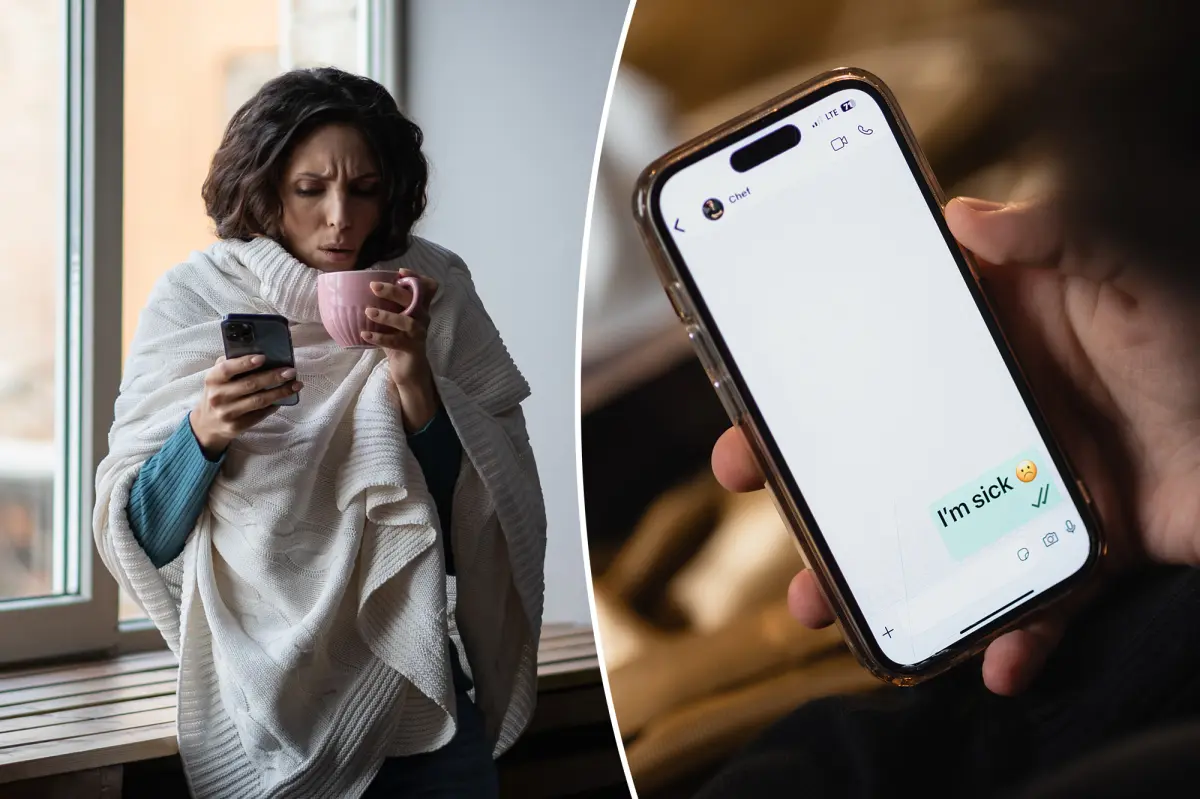
Some say a sick day shouldn’t be so easy to take. Think about what happens in offices across the world every morning. An alarm rings, and a person rolls over, head throbbing, stomach churning, or simply too mentally drained to face the demands of the day. The first thought is not “I need help.” It is “who do I have to tell?” Fingers fumble for a phone, a message is typed: “Sorry, not feeling well. Won’t be in today.” Then the phone is tossed aside and the day disappears into sheets and silence. It is easy, and for many people, it is also lonely. Sometimes the sickness is physical. Often in recent years, it is not. It is anxiety, depression, burnout, or the quiet exhaustion that never appears on a test result. A text message cannot capture any of that. Sir Charlie Mayfield, a senior government adviser in the UK and the former boss of John Lewis, recently told The Times that this common ritual should be changed. He believes workers should not be allowed to simply text, WhatsApp, or email in sick. Instead, they should call their boss and say the words out loud. “You’ve actually got to ring somebody up,” he said. It sounds small, but it is a radical idea in a culture that has learned to hide behind screens. For Mayfield, the call is not about suspicion or discipline. It is about connection. A text closes a conversation before it can begin. A phone call opens it. It forces an absent worker to speak, to explain, and in doing so, to be heard. It also forces a manager to listen, to respond, and to acknowledge that the person on the other end of the line is not a timesheet but a human being. Many people will bristle. They will say that being sick should not require performing sickness. But the deeper argument is that a sick day is not a crime. It is a reality. And reality deserves a voice, not a typed excuse.
Mayfield is not simply an executive who dislikes excuses. He has been leading a government-funded investigation into the 300,000 people in the UK who call out of work every year because of health conditions, many of them mental. His report, “Keep Britain Working,” is not a dusty policy document. It is a serious attempt to understand why so many people, especially the young, are slipping out of the workforce. The findings are striking. There has been a 77 percent increase in the number of 16- to 24-year-olds reporting health conditions that stop them from doing their jobs. Almost half of those cases are mental health conditions. This is not a story about lazy teenagers trying to get a Friday off. It is a story about a generation losing years to depression, anxiety, and stress-related illness. They are not choosing to fail. They are drowning. The numbers are not mere statistics; they are human beings. A young person with crippling anxiety might send a text in the morning with shaking hands. They might feel relief when the reply is a simple “hope you feel better.” But that relief does not solve the problem. It simply ends the conversation. Mayfield’s proposed call matters because it interrupts that silence. If a manager phoned and heard a quivering voice, they could act. They could say “take a breath” and “let’s think about what might help.” They might learn that the employee is not just fighting a cold but fighting a mental battle. That insight can lead to real support: therapy, medication, a lighter workload, or a different role. None of that can happen if the communication stops at a text. Yet Mayfield also knows that many managers are afraid. They worry that asking too much will lead to formal complaints, so they keep their distance. He calls this a “culture of fear” and wants to end it. His report argues that workplaces should make it safer for everyone to talk about sickness, especially mental health, without judgement and without fear of retaliation. The phone call is the first step. It is not a weapon. It is an invitation to speak.
The heart of Mayfield’s vision is old-fashioned conversation. He says it is very important to establish an active dialogue between employer and employee. This is not about keeping tabs; it is about opening a channel. In one of his interview comments, he described what the call should sound like. A manager would listen and then say, “I’m really sorry to hear that. How long is this going to be for? Is there something we can do about it?” Those three questions transform a sick day from a disappearance into a discussion. They invite the worker to share what is happening and, more importantly, to think about what could help. That is the foundation of a “return to work” plan. For a person with a broken leg, the plan might mean a shorter commute, a better chair, or permission to work from home for a few weeks. For someone with severe anxiety, it might mean no meetings for a week, a quieter desk, or fewer hours while they adjust to treatment. For someone with chronic pain, it might mean a different set of responsibilities or a more flexible schedule. The plan is not a punishment. It is a practical attempt to match the work to the reality of human limits. Mayfield wants to “change the norm” so that it is almost never acceptable to be off sick without being in contact with your employer. This applies to the in-person office and the virtual office alike. A remote worker who vanishes for a day is no different from one who stays home without calling. In both cases, the absence leaves a hole. In both cases, a phone call can fill that hole with understanding. The goal is not to make sick days harder. It is to make them less isolating. When an employee is off sick, they are not being absent from a spreadsheet; they are being absent from a community. A call says, “You are still part of this, even when you are away.” Mayfield’s language is sometimes blunt, but his direction is compassionate. He wants employers to care enough to ask, and employees to trust enough to answer. That trust does not appear by itself. It is built in small moments—one call, one honest sentence, one request for help.
Of course, not everyone will greet this advice with open arms. The thought of calling a boss while lying in bed with a fever, or while struggling to explain a panic attack, can feel impossible. There are days when the most generous act is a simple text, not a conversation. There are workplaces where a phone call will be heard as a demand for proof, not an offer of help. A boss who says “How long is this going to be for?” may be asking with empathy, but an employee with a history of being judged might hear a threat. Mayfield’s proposal assumes trust. Not every workplace has it. Some managers are cold. Some are controlling. Some will use a phone call to guilt a sick employee into returning too soon. And yes, some people will abuse sick days. They will fake a cough, stay in bed, or take a trip to the beach. That is not new, and no telephone requirement will stop them. But treating everyone like a liar is worse than assuming the best. There is another complication: managers themselves are often overwhelmed. They are expected to protect their team’s wellbeing while hitting targets, covering shifts, and keeping costs low. They may have no training in mental health. They may have no idea how to respond when a voice on the other end of the line cracks and says, “I just can’t do it anymore.” Mayfield’s vision requires giving managers the skills and confidence to have those conversations without turning them into interrogations. It also requires a shift in how we think about absence. A sick day is not suspicious behavior. It is a normal part of being alive. If a company treats every absence as a problem to be solved, no phone call will ever feel safe. But if a company treats absence as information—as a signal that a human being needs support—then a call can be a moment of courage. It is not a magic bullet. It is a human moment, and human moments are always messy. They can go wrong. They can also go right. The risk of asking “are you okay?” is that the answer might be “no.” That is a risk worth taking.
This is not a uniquely British problem. In the United States, researchers have noticed the same worrying trend. A study published by JAMA Network in 2025 found that American workers are calling in sick much more often than they did before the pandemic. The number is staggering: 1.29 million health-related work absences every month. That is not a small bump. It is a national signal. The authors of the study said the findings should create “a new baseline” for public policy. They urged policymakers to consider expanding interventions and data collection to address the negative impacts of COVID-19 on the labor force. The pandemic was not just a wave of infections. It was a slow-burning fire in the bodies and minds of millions of people. Chronic fatigue, heart problems, autoimmune disorders, depression, and anxiety all became part of the landscape of work. Even people who never had a severe case of COVID feel the aftereffects of two years of fear, isolation, and uncertainty. The old idea of a sick day—a rare, discrete, physical illness that clears up in a few days—does not match this world. Many illnesses now are invisible, intermittent, and long. That makes them harder to talk about and easier to hide. Remote work has made this worse and better at the same time. It allows people with chronic illness to keep working from home, which is a blessing. But it also erases boundaries. A worker can answer emails from a hospital bed, attend a video call with a fever, or spend every waking hour pretending they are fine. When the sickness lasts for months, the text message becomes an inadequate way to communicate. It cannot express pain. It cannot ask for help. It cannot explain why a person needs a different schedule or a different role. This is why Mayfield’s call for conversation makes sense across the Atlantic. The 1.29 million monthly absences are not just a productivity statistic. They are millions of human stories, each with its own diagnosis, its own struggle, and its own hope. The question is whether managers and policymakers will have the courage to listen.
So where does this leave the humble sick day? It leaves it in a strange in-between place, somewhere between a right and a privilege, between private pain and public duty. Mayfield’s phone call idea is not really about the phone. It is about visibility. It is about saying that a worker who disappears for a day is still part of a group, still part of a conversation, still part of a story. That is a comfort for some and a burden for others. The question is how to build a culture where the call is not a test but a safety net. That requires more than a rule. It requires trust. It requires managers who are trained not to hear an excuse but to hear a cry for help. It requires employees who can tell the truth without worrying that they will be punished for it. The statistics from Mayfield’s report and the JAMA study are heavy—300,000 workers in Britain, 1.29 million monthly absences in America. Behind every number is a face. There is a young person with anxiety who needs a different path. There is a middle-aged worker with chronic pain who needs a quieter chair. There is a new mother with exhaustion who needs someone to say “go rest.” If a phone call can create any of that, perhaps Mayfield is onto something. Perhaps the norm should not be to make sick days harder. The norm should be to make them more human. A text message will always be easier. But easy is not the same as meaningful. The next time you feel too sick to work—or too overwhelmed to move—may you have a person to call who answers with kindness. And if you are that person on the other end of the line, may you answer with curiosity rather than suspicion. That is the true change. Not a rule. A relationship. The debate over sick days is really a debate over how much we value each other. It is a debate about whether a worker is a machine that occasionally breaks, or a human being who sometimes needs help. The old system made it easy to disappear. The new system, if Mayfield has his way, would make it possible to return. That is worth getting sick about. That is worth talking about.