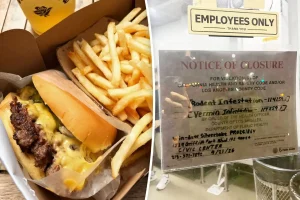





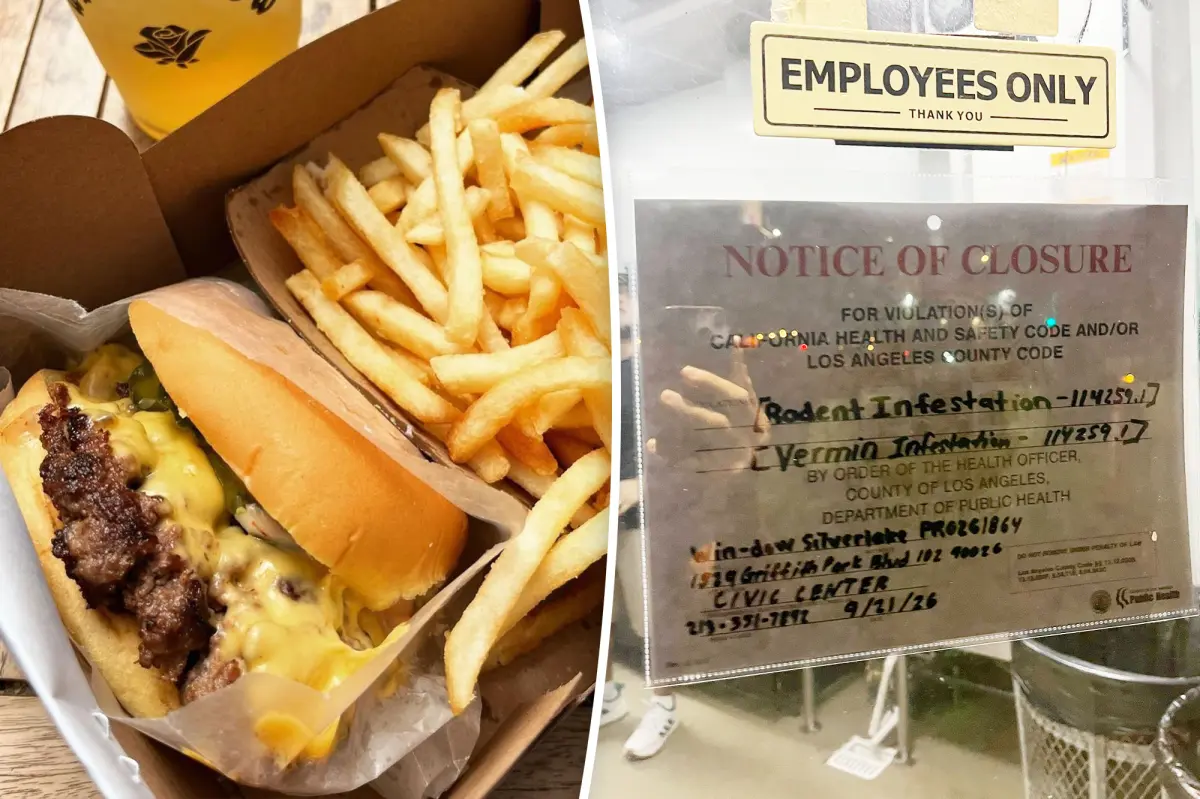
For a certain kind of Angeleno, The Win-Dow was a small miracle: a walk-up smashburger stand that served something genuinely satisfying at a price that felt almost like an act of rebellion in a city where even a modest lunch can quickly become a splurge. It was the rare fast-casual spot that didn’t pretend to be anything more than what it was—no fuss, no frills, no elaborate brand story, just a thin, crispy-edged patty, a soft bun, melted cheese, and a line of loyal customers willing to stand in the sun for it. The brand had expanded aggressively across Los Angeles, from Venice to Hollywood, but its Silver Lake outpost remained something like home base for the city’s burger obsessives. That was why the news hit so hard. When the Los Angeles County Department of Public Health slapped a closure order on that location this week, citing a rodent and vermin infestation, the reaction was not just disgust. It was a feeling of betrayal. People had bragged about this place, photographed their burgers, brought friends from out of town. The whole appeal was honesty and simplicity, and now the restaurant’s best-known secret had become something no one wanted to know: the secret sauce, it seemed, might just have come with whiskers.
What made the situation feel even stranger was the visual evidence that began circulating on Reddit. Photos showed the official county health notice taped to the glass of The Win-Dow’s Silver Lake storefront, right next to a handwritten sign, presumably from management, that tried to reframe the emergency as a routine interruption. It said the restaurant was temporarily closed for maintenance, a phrase that suggests a leaky sink or a broken floor tile, not the presence of vermin. The juxtaposition was almost comical: the official language of public health, cold and clinical, sitting beside a polite, almost apologetic note written by someone who clearly hoped the world would just look away. The public, of course, was not buying it. Comment sections filled with dark, gallows humor, the kind Angelenos rely on when reality becomes too gross to process directly. One online critic summed up the general horror with a single line: “Ratatouille be making my burger.” Another joked that the restaurant’s famous no-frills approach now had a literal meaning. Beneath the laughter, though, there was unease. The Win-Dow had worked hard to project an image of simplicity and authenticity, and that image had been shattered by the sight of a red-and-white county notice taped to the window. The handwritten sign became a symbol of everything that felt wrong: a polite mask over a very messy truth.
Yet the public was not entirely united in blaming The Win-Dow. A surprising number of locals rushed to defend the restaurant, or at least to point out that Silver Lake itself is practically a nature reserve for rats. They argued that no matter how clean a kitchen is, it is nearly impossible to keep rodents out of a neighborhood where dumpsters overflow and the city’s infrastructure has been neglected for years. “Honestly I blame it less on them and more on there just being a plethora of rats in that general area,” one commenter wrote. Another added that “that whole area” has a particularly nasty dumpster nearby, a magnet for pests that would challenge even the most rigorous restaurant standards. There was truth in that. Los Angeles has always coexisted uneasily with its rat population, and the city’s density, mild weather, and overstuffed trash systems have made the problem worse. Rats don’t care about brand loyalty or health inspection scores; they follow their noses. A burger stand in a busy commercial strip, surrounded by other food businesses, is essentially a five-star resort for vermin. The debate that followed was really a question of responsibility: was this a failure of one restaurant’s management, or was it simply the inevitable result of trying to run a food business in a city that is as much the rats’ home as it is ours?
There was also evidence to suggest that The Win-Dow was not the only victim of the area’s pest problem. Right next door, at the same Griffith Park Boulevard address, Modern Bread & Bagel had already been closed by public health officials on Sept. 15 for a vermin infestation. The inspection data painted a grim picture: seven violations totaling 20 points, including an 11-point major violation for the presence of insects, rodents, birds or animals, and a four-point violation concerning clean food-contact surfaces. For anyone familiar with how these inspections work, that was a serious score. The fact that two separate food businesses in the same complex had been shut down for the same fundamental issue suggested that the problem was bigger than any single kitchen. One local commenter connected the dots in a single sentence: “Modern Bread and Bagel is closed too, must be that whole complex infested.” The complex shared walls, pipes, and trash areas, which made it one giant buffet for rodents. This did not exactly absolve The Win-Dow, but it complicated the story. It was harder to point fingers at a negligent owner when the entire building appeared to be overwhelmed by pests. It also raised uncomfortable questions about how much control any small restaurant truly has when the environment around it is working against it.
For a large part of the online audience, however, the cause of the infestation mattered less than what it represented. The Win-Dow’s Silver Lake location had already been at the center of a fierce controversy the previous summer, when it reportedly served Immigration and Customs Enforcement agents. In a neighborhood as politically conscious as Silver Lake, that news had landed with the force of a scandal, and the backlash never fully faded. So when the health department’s closure order arrived, many people treated it as a kind of overdue justice. “May they have the abysmal future sales they deserve,” one person wrote. “I hope it turns into a rat cafeteria.” The cruelty of the remark was matched only by the satisfaction behind it. A rat infestation is one of those punishments that cannot be spun away; it feels fated, written into the walls and the floorboards. For those who had already decided The Win-Dow was worthy of punishment, the health closure was a gift. It allowed them to feel vindicated without having to argue about politics. When an employee at The Win-Dow answered the phone and immediately hung up, there was no official comment, no smooth explanation, no way to make the image of a rat-filled kitchen disappear. The silence only made the story more human: a beloved brand, humiliated, with no good answer and nowhere to hide.
In the end, the closure of The Win-Dow’s Silver Lake outpost is not just a story about health code violations. It is a story about the gap between what we want from our favorite restaurants and what restaurants are actually made of. The Win-Dow offered an affordable, no-nonsense burger in a city that desperately needed one, but it could not offer immunity from the rats that share the streets. It will likely reopen after a deep cleaning, and in a few weeks the entire episode may be nothing more than a rumor people whisper when they order a smashburger. But for a moment, the city was forced to laugh at the absurdity of it all: the handwritten maintenance note, the official notice, the Ratatouille jokes, the two health closures in the same complex, and the uncomfortable truth that no amount of branding can keep the outside world from coming inside. Los Angeles loves a bargain and a downfall in equal measure, and The Win-Dow gave it both in one greasy, unforgettable package. The secret sauce may have come with whiskers, but the real recipe was always about something deeper: our stubborn, slightly disgusting faith in the places we choose to love.