






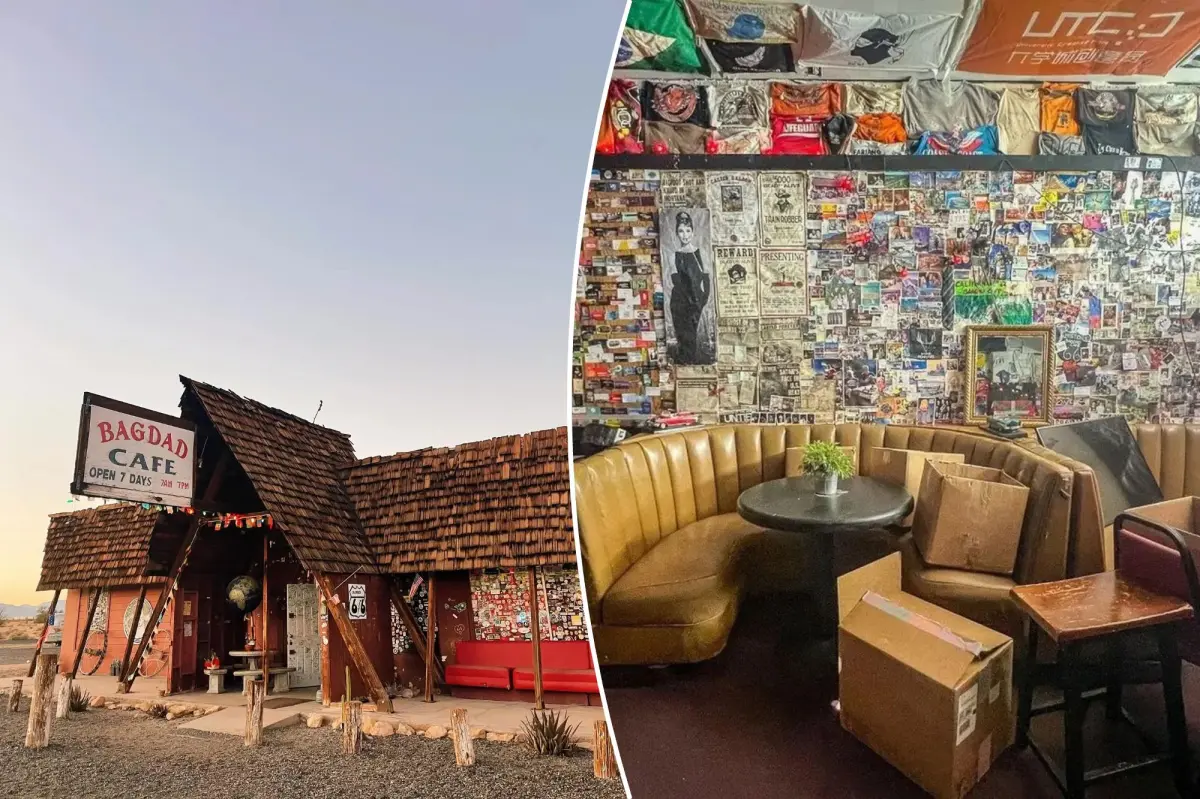
Along the sun-baked ribbon of Route 66, in the high desert community of Newberry Springs, there is a small A-frame building that has long felt less like a business and more like a handshake between strangers. The Bagdad Cafe, named for the cult film that inspired it, has been a place where road-weary travelers could step out of the heat and into a kaleidoscope of human memory, its walls covered with license plates, flags, jerseys, postmarks, and handwritten notes from nearly every corner of the planet. For decades, it has been a quintessential slice of roadside Americana, a spot where the journey mattered as much as the destination and where no one stayed a stranger for long. But today this landmark stands at a precarious crossroads. The kitchen is dark, the grill silent, and the woman who brought it all to life, Andrea Pruett, has died at 85. Her family says they are still figuring out what comes next. For now, the cafe remains open in a diminished form, accepting visitors for photographs and souvenirs, but no longer serving the meals that once made it a genuine waypoint. The uncertainty has left those who love the place holding their breath, aware that a piece of the Mother Road’s soul could disappear just as Route 66 celebrates its 100th year.
Andrea Pruett’s story began far from the desert, but it found its home in this strange, wonderful place. She opened the Bagdad Cafe in 1995 after being inspired by the 1987 film of the same name, a German-made arthouse classic in which a tourist, played by Marianne Sägebrecht, is stranded in the Mojave Desert and ends up creating a cafe that becomes a gathering place for lost and lonely souls. Life imitated art in the most beautiful way. Pruett transformed a modest A-frame building into a living tribute to that film and to the idea that a small, out-of-the-way place can hold the world together. She filled the space with memorabilia from the movie, kept the jukebox playing the film’s haunting theme song, “Calling You,” and covered every available surface with souvenirs brought by visitors from distant countries. But the true magic was Pruett herself. Her grandson, Greg Landers, remembered that when people walked through the door, it was as if a director had called “Action!” She would immediately launch into welcoming them, telling them where to sit, answering their questions, making them feel as though they had arrived at exactly the right place. She was not just running a cafe; she was hosting a never-ending gathering of friends she had not yet met.
Over the years, the Bagdad Cafe became a magnet for all kinds of people, from ordinary families on summer road trips to celebrities who wanted to experience its quirky charm. The actress Renée Zellweger spoke about visiting the cafe on “The Tonight Show,” and Prince Albert of Monaco made his way to Newberry Springs to see the legend for himself. On a good day, according to Matt Parker, one of the cafe’s caretakers, as many as three tour buses would pull up, disgorging travelers from all over the world. They came for the film, for the lore, for the simple pleasure of standing in a place that felt untouched by the ordinary rules of time. The cafe’s walls became a kind of global tapestry, each flag or license plate representing someone who had passed through and left a small piece of themselves behind. But the pandemic changed everything. The lockdowns kept travelers away, and the cafe never quite recovered. Today, locals no longer come in, and the kitchen no longer cooks. As manager Mark Bradley put it, “We don’t get any locals, and we don’t cook any food right now. But we’re definitely on the map to see … it’s magic that takes place here.” That magic, however, has become harder to sustain.
The cafe has weathered more than just the pandemic. In 2023, a heavy storm associated with Tropical Storm Hilary dumped so much rain on the region that the cafe’s roof collapsed under the weight. For a moment, it seemed like the end. But the outpouring of love from around the world proved otherwise. More than $25,000 was raised through an online campaign, enough to patch the roof and keep the doors open. That wave of support showed how deeply the cafe had burrowed into people’s hearts. Around the same time, a French filmmaker named Leá De Carmo was completing a documentary about Pruett’s final years, titled “The Keeper of Bagdad.” The film captures not just the cafe but the woman who guarded it, a woman who, even as her memory began to fade in old age, never let go of the place she had built. “One thing she never forgot was the cafe,” De Carmo told the Los Angeles Times. “She always knew where she was and that it was the place she wanted to be.” That devotion was mutual: the cafe kept her anchored even as the rest of the world grew hazy, and she, in turn, kept it alive with her presence.
Now, with Pruett gone, the cafe exists in a strange, suspended state. The kitchen remains closed, but the doors are still open for visitors who want to take photographs, wander through the memorabilia, and buy a small souvenir to carry home. In many ways, it has become more museum than restaurant, a shrine to a certain kind of American optimism and to the simple belief that a roadside stop can be a sanctuary. The family has not made any final decisions about what will happen next. They are, as Landers said, still “figuring out” the future. Those who care for the place now see themselves not as owners but as caretakers, holding on to something that belongs to everyone who ever loved it. Parker captured that feeling when he said, “You can’t recreate this. We’re just caretakers of it. It’s a museum and church, in a sense, with all this stuff. Mrs. Pruett really focused on protecting it, protecting these people’s stuff — their mark.” That idea of protecting other people’s marks is at the heart of the cafe’s strange power. It was never really about the coffee or the food. It was about the evidence that people had been here, that they had crossed the desert and found a moment of connection.
As Route 66 marks its centennial, the Bagdad Cafe stands as a reminder that the Mother Road was never just a highway. It was a promise that the journey itself could transform you, that you could set out from one life and arrive at another. The cafe embodied that promise in the most unassuming way possible, with dusty walls and a jukebox and a woman who knew how to make every stranger feel expected. Its future is uncertain, and it is entirely possible that the little A-frame building will one day close its doors for good. But even if that happens, the place has already done its work. Every person who ever sat beneath those flags, every traveler who heard “Calling You” drifting through the desert air, every heart that was warmed by Andrea Pruett’s welcome, carried a piece of it away. The cafe cannot be replicated, not because of the building or the decor, but because it was built on a kind of generosity that is rare in any era. Pruett is gone, but the magic she created has left its mark on the world, and as long as people remember her and the little cafe in the high desert, the road will still lead home.