





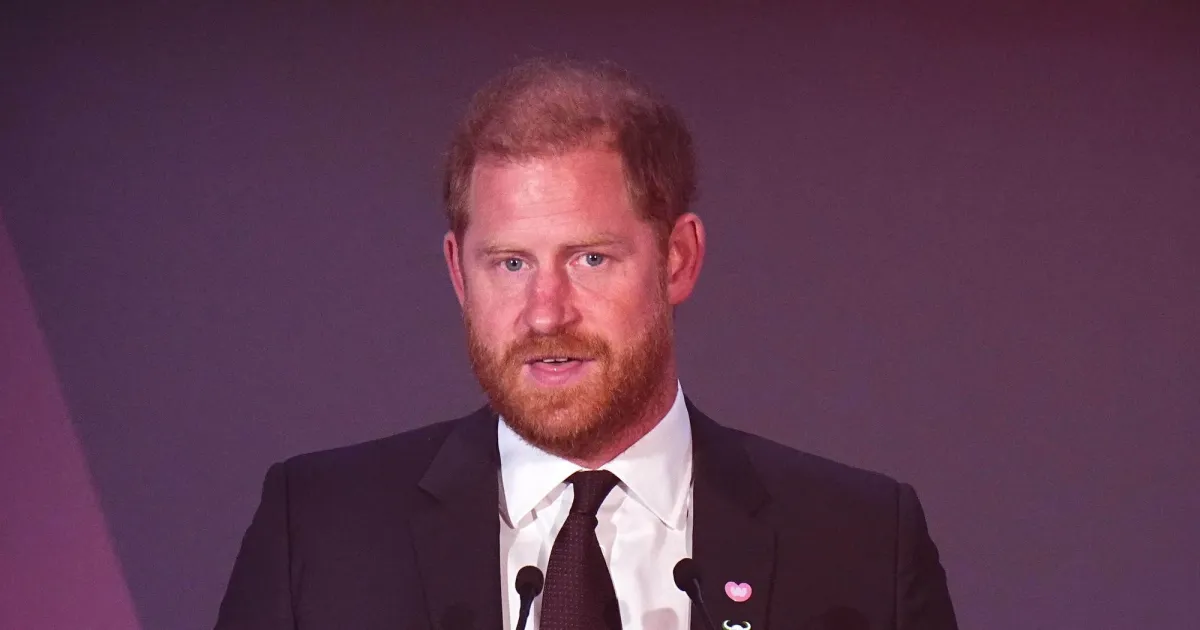
Some mornings demand more than coffee. They demand a small act of imagination. Prince Harry was in the middle of one such morning recently, standing in a kitchen with his two children, Prince Archie and Princess Lilibet, watching them push cereal around their bowls. The end of summer had arrived, and with it came the familiar heaviness that affects children everywhere. Archie and Lilibet did not want to go back to school. Harry recognized the mood instantly. “At breakfast this morning, they had a bit of Monday morning blues,” he told Hello! at the 2026 WellChild Awards, held at London’s Royal Lancaster Hotel. “There’s always something like Sunday night blues or boarding school… when you’ve been away, or before you go to school.” Most parents would have tried to ease the pain with promises of new shoes and old friends. But Harry did something else. He decided to tell them exactly where he would be that night. He told them about the WellChild Awards, the annual celebration of seriously ill children and the people who care for them. “At breakfast this morning, I decided, ‘You know what? You’re being a little bit tricky, so I’m going to tell you exactly what I’m doing tonight,’” he recalled with a smile. The reaction surprised even him. Archie and Lilibet were “genuinely fascinated,” he said, “asking all sorts of questions.” In that small, ordinary moment, the award ceremony stopped being just another item on a crowded royal diary. It became a doorway through which his children could step into his world. And Harry, a father who has spent much of his adult life trying to protect his family from the glare of publicity, chose not to shut the door.
That simple breakfast conversation reveals something important about the way Harry approaches fatherhood. He has been a patron of WellChild since 2007, long before he had children of his own. But becoming a father changed the meaning of that work in ways he could not have anticipated. “Once you become a parent, it does change everything,” he said. He was careful, almost humble, when he added, “It’s not the fact that for all the years that I wasn’t a parent that meeting the kids didn’t matter as much, but you suddenly realise how grateful you are to have kids that aren’t sick.” It is a raw, honest admission, the kind that is not often heard in official speeches. Harry was not saying that well-child families mattered less before he had children. He was saying that his own heart has expanded in a way he did not know was possible. Because he now knows what it means to lie awake listening for small feet in the hallway, he has come to understand that the parents of seriously ill children carry an invisible weight that never quite leaves them. He has also come to understand his own gratitude. That gratitude is not the saccharine, mentioned-during-thank-you-speeches kind. It is the deep, steady gratitude that appears in the middle of the night when your child is sleeping peacefully because they have no pain, no hospitals, no fear. And it is something he wants to share with Archie and Lilibet. “Like with all of my work and their mum’s work as well, whatever we can do to try to instill some of that awareness, I think is absolutely crucial,” he said. It was a phrase quietly spoken, but there was nothing small about it.
For Harry, the WellChild Awards are not just another charity gala. They are one of the most emotionally difficult nights of his year. The room is filled with families who have spent more time in children’s hospitals than in their own homes. There are children who have fought sepsis, parents who have learned to read tracheostomy machines, nurses who have held a child’s hand while the child took its last breath. Harry has stood with these families for nearly two decades, first as a young prince looking for meaning in his royal role, and later as a father trying to make sense of his place in the world. He spoke this time about the end of a long summer holiday, when children everywhere are tired and grouchy and reluctant to begin another school term. He let his mind drift back to the morning’s breakfast table and the little faces of his own children, who had no idea how lucky they were. “Day in, day out, coming off the back of kids being out [of school] for 11 weeks… but you find yourself going, ‘Wow, in that room with those parents, you really can’t complain about anything.’” He paused, then added, “Of course, it’s all relative, but the inspiration that I get from these guys — not just the kids, but the parents themselves — it fills me up for a whole year.” It is an odd choice of words, “fills me up,” for an event that can bring even the most seasoned professional to tears. But that is what Harry means. He is not drained by the stories. He is fed by them. The courage of a ten-year-old child with a long and uncertain future, the quiet stamina of parents who have not slept through the night in years, the tenderness of a nurse who remembers what a child loved before the illness took hold — these are the things that follow Harry out of the room and into his car, his home, his own children’s bedrooms.
The evening also had a kind of extraordinary timing. Harry arrived at the Royal Lancaster Hotel alone, a light drizzle falling outside, and took his seat among the award nominees with the ease of a man who had found his place. It was his second U.K. appearance in as many weeks, following the Invictus Spirit Gala Dinner and Awards earlier in September. Meghan, now 45, stayed at home. She has been sharing little glimpses of the family’s new life through social media; she has not yet appeared alongside Harry at an official public event in Britain. That has created its own quiet narrative, the same committee of voices that has been commenting on their marriage, their choices, and their children since the day they met. But on this night, there was no sign of strain. Harry simply moved through the room with the confidence of someone who knows that the work is bigger than the speculation. Maybe that is because the cause has always been close to him. Maybe it is because he has learned to stop reading the commentary and start listening to the thing inside him that first made him choose WellChild all those years ago. Whatever the reason, he seemed at ease. The Duke of Sussex, ever the story’s most reluctant leading man, was not there to make headlines. He was there to keep a promise.
Behind the speeches and the smiles, however, there is another story unfolding, one that involves hidden decisions and tight-lipped security briefings. The family had only just arrived in the U.K. when they sent Archie and Lilibet off to a new school. Then, suddenly, the plan changed. A spokesperson for the Duke and Duchess of Sussex issued a short statement explaining that the decision to move their children once again had been made “following a discussion with the family’s security team about the practicalities of their current arrangements.” The parents, the statement said, remained “extremely grateful to all the teachers and staff for the love, care and effort they have shown their family.” And then came a vital clarification, one designed to sidestep an embarrassing scandal: “This decision should in no way be interpreted as a reflection on the school or the exceptional care the children have received there.” The statement said nothing about which school they had chosen, or where Archie and Lilibet would now go. It simply left those details where they belonged: in the private world of a family that has spent the past six years being watched, photographed, and analyzed from every possible angle. Because the truth is that Harry and Meghan have never had anything close to a normal family life. They stepped away from senior royal duties in 2020 and moved to the West Coast, looking for space and anonymity. They built a new life in Montecito, with its leafy streets and hidden gates. Now they are back in Britain, trying to build another version of the same dream. But for their children, the dream must not include the trauma of public exposure. It must include the luxury of being ordinary.
In the end, the WellChild Awards were never really about Prince Harry at all. They were about children like the ones who arrive at the ceremony in wheelchairs, their siblings in matching bright T-shirts, their parents holding balloons and trying to remember what it felt like to be carefree. But Harry’s presence that night mattered. It mattered because he came back. It mattered because he remembered the names. It mattered because, across all the noise and drama of his own life, he still knows how to sit in a ballroom and listen to a story that is not his own. And it mattered because he went home afterward and shared that story with two small children who were waiting for him by the cereal bowls. “At breakfast this morning, I decided, ‘You know what? You’re being a little bit tricky, so I’m going to tell you exactly what I’m doing tonight,’” he had said, and the result was not a lecture or a lesson but a conversation. Archie and Lilibet were fascinated. They wanted to know everything. And perhaps, in that small exchange, Harry found the answer to the question people have been asking for years: how does a man with so much privilege, pain, and baggage remain so determined to do good? He does it the way all parents do under difficult circumstances. He wakes up in the morning. He makes breakfast. He tells his children the truth. He tries to help them understand that their lives are not the center of the universe, even when they are the center of his. And then he walks out the door, stands in front of a crowd of people who have endured more than any parent should have to, and lets them fill him up for another whole year. That is the quiet, spectacular message behind those brief, almost offhand comments about a Monday morning. Parenting is not about having perfect children or perfect timing. It is about showing up, again and again, with love, with patience, and sometimes with nothing more than a story about where you are going tonight. Prince Harry did not need to say all of that aloud. He lived it. And in doing so, he reminded everyone in that London hotel of the most human truth of all: we are all just trying to do the best we can for the people we love, one breakfast at a time.