


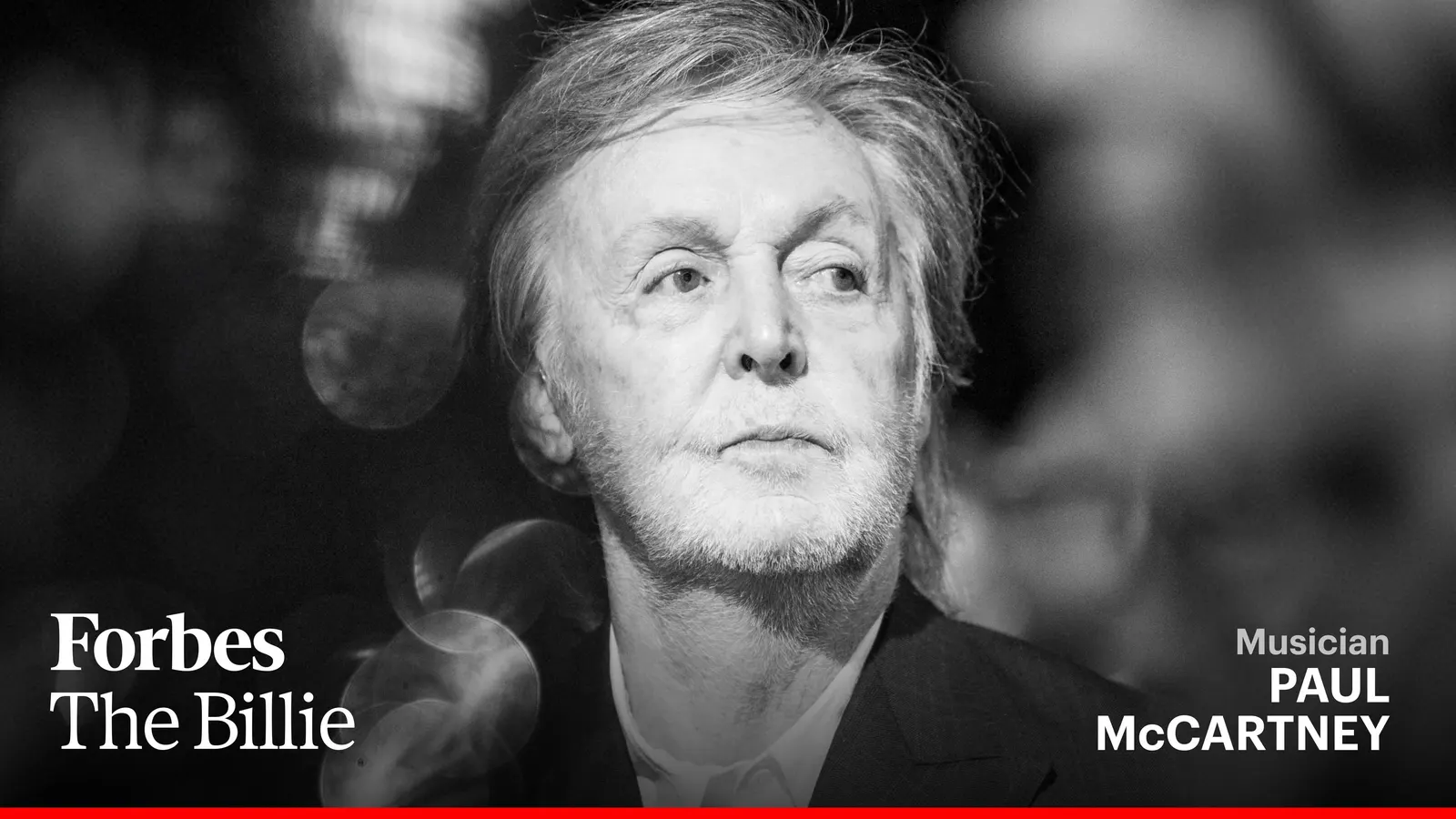
Welcome to The Billie, Forbes’ newest newsletter, named for the internal shorthand for “billionaire.” And for the first edition, we have an exclusive that feels both inevitable and improbable: Paul McCartney is now a billionaire. For more than six decades, we’ve known McCartney as the cute Beatle, the melody maker, the man who sang that he “don’t care too much for money” and “may not have a lot to give.” Yet behind the gentle, avuncular image is one of the most determined businessmen in music history. Forbes now estimates his fortune at $1.4 billion, making him the third-richest musician in the world, behind only Taylor Swift at $2 billion and Jay-Z at $2.8 billion. It’s a fortune built not by accident or by one lucky hit, but by decades of singing, suing, countersuing, touring, and toiling. McCartney has spent his whole life proving that art and commerce can not only coexist, but can build an empire. The little boy from war-torn Liverpool who watched adults struggle to make ends meet decided very early, as he once put it, “I’ll solve that. I will try to get money.” And he did, in ways that are still paying off every time a Christmas song plays in a shopping mall or a high school theater group puts on Grease.
The story of how McCartney became a billionaire begins, paradoxically, with how little money he and his bandmates made during Beatlemania. While the Beatles were conquering the world, their record deal paid them less than a penny per album sold. Their publisher, Dick James, controlled the copyrights to the lyrics and melodies that John Lennon and Paul McCartney wrote, meaning the men who created some of the most beloved songs of the twentieth century did not actually own them. McCartney later described the situation in blunt terms, writing in a 2017 Forbes essay: “It turned out to be basically a slave contract, no matter how successful we made the company, we didn’t get a raise.” Imagine the frustration: You have written “Yesterday,” one of the most covered songs in history, and yet you have to watch someone else collect the lion’s share of the money. The Beatles were the biggest band on Earth, but their early financial rewards were shockingly tiny. It was a harsh education in the music industry, and it shaped McCartney’s approach to everything that followed. That experience of being young, famous, and yet still financially trapped turned him into a hungry, strategic businessman. He decided that he would never allow anyone else to control his artistic destiny again. It was a lesson learned in the spotlight, and it made him fiercely protective of his work, his royalties, and his rights for the rest of his life.
McCartney declared his independence in 1969, months before the Beatles officially broke up. That year, he launched his own publishing company, MPL Communications, with the goal of controlling his solo-career publishing and master recordings. This gave him a much larger cut of his own future royalties, but he didn’t stop there. Decades before the current music-catalog boom sent valuations through the roof, McCartney was quietly buying the publishing rights to other artists’ work. He bought the catalog of early rock-and-roll pioneer Buddy Holly. He bought Broadway musical scores. He bought timeless Christmas standards. Today, MPL owns thousands of songs, and it has become McCartney’s biggest business, worth at least a quarter of a billion dollars. The true beauty of this catalog is its ubiquity: these are not obscure tracks that only collectors know. They are songs that play during holiday dinners, at school plays, on classic rock stations, and in the background of a million wedding receptions. Anytime “Blue Suede Shoes” is streamed, anytime a local theater group performs Grease, anytime someone puts on “The Christmas Song (Chestnuts Roasting on an Open Fire)” or “Baby, It’s Cold Outside,” a small piece of the royalty flows to Paul McCartney. He owns “It’s Beginning To Look a Lot Like Christmas,” he owns “Blue Christmas,” and of course he owns his own holiday composition, “Wonderful Christmastime.” It’s the kind of catalog that never stops giving, and it is the quiet engine behind his fortune.
But McCartney’s own Beatles songs have been an even longer and more winding road. For decades, his publishing rights passed through the hands of others, including the famous and painful period in the 1980s when Michael Jackson bought the Beatles catalog out from under him, and then the 1990s when Sony bought a stake in it. McCartney spent years fighting to regain his U.S. rights, and over the past two decades, he has succeeded. Now his share of the Beatles songwriting copyrights—the holy grail of music publishing—brings him at least $10 million per year and is worth at least $200 million. Meanwhile, the Beatles’ own recordings have generated enormous wealth through their Apple Corps holding company. The group’s music streams, vinyl reissues, and endless merchandising bring in upward of $50 million annually. Paul, Ringo, and the estates of John and George each receive a 25% cut, an income stream Forbes estimates is worth more than $150 million apiece. It is amazing to think that the same band that once made less than a penny per album now earns tens of millions every year. All those years of negotiations, renegotiations, lawsuits, and reconciliations have paid off. McCartney has never been content to sit back and let his legacy fade. He has fought to control his songs, protect his royalties, and make sure that the Beatles’ work is valued as the cultural and commercial treasure it is. It is a testament to both his stubbornness and his deep understanding of the music business.
Beyond the publishing and recording rights, McCartney has padded his fortune with relentless work. Ringo once called him “the workaholic of our band,” and that hasn’t changed with age. McCartney has spent decades on the road, playing enormous stadium tours that have earned him hundreds of millions of dollars. He has never stopped writing, recording, and performing. He has also invested wisely in real estate, with properties across the UK and the Hamptons, and he owns a collection of art that includes works by Picasso and Magritte. Add it all together—the music catalogs, the royalty checks, the touring income, the property, and the art—and McCartney’s net worth reaches at least $1.4 billion. For a man who once joked that money had changed him only by making him richer, he has built one of the most enduring cultural and financial empires in music history. And he seems genuinely at peace with the balance he has struck. In his own words: “Is it more noble if we don’t write for money, if we just write for art and love? I think the two can coexist. I’m happy to enjoy both.” That philosophy may be the most human part of his story. He never pretended to be purely an artist or purely a businessman. He simply refused to see a contradiction between creating beautiful music and being paid fairly for it.
The road to this fortune has not always been smooth, and the world has watched some of its twists and turns. Back in 1965, the Lennon-McCartney songbook was actually traded on the London Stock Exchange as Northern Songs, Ltd. Many financial writers, including Forbes, dismissed the stock as an early meme stock driven by nothing more than Beatlemania. The Times warned, “This is definitely not an issue for Auntie.” The Daily Mail said, “I would not touch Northern Songs with one of Ringo’s sticks.” The Daily Express simply said, “Nay, Nay, Nay.” At the time, the stock gave the public a chance to own a piece of the Beatles’ music, but it was a chaotic and speculative ride. Decades later, McCartney has outlasted nearly everyone. He got his rights back, built his own publishing empire, and turned the very copyrights that were once dismissed as fads into a billion-dollar foundation. His story is a reminder that wealth in the creative world is rarely just about talent. It takes patience, business sense, and the courage to take back control when the system is rigged against you. Now, at last, Paul McCartney is a billionaire—and he got there the old-fashioned way: by never trusting anyone else with his songs again. The Billie will bring you more stories of amazing success from the three-comma club, but it’s hard to imagine a more fitting opening chapter than this one.