


Some campaigns are lost on policy; others are lost on character. The final weeks of Ohio’s governor’s race offered a painful example of the latter. Amy Acton had a story that should have been beyond political attack: a physician who became Ohio’s public face during the pandemic, admired by many for her calm and criticized by others for the sacrifices she asked of families. Her private history was more fragile still. As a child, she had been the victim of sexual abuse, and her mother had lost custody after her husband was indicted for raping Acton when she was 12. Into that wound, Vivek Ramaswamy stepped. In the closing stretch of the campaign, he ran a television ad featuring Acton’s estranged mother calling her own daughter a liar. The ad did not mention the custody case or the indictment; it simply weaponized a mother’s grievances against a daughter who had already endured too much. The reaction was swift and unusual. Republicans and Democrats alike condemned the ad, including Ohio’s Republican governor, Mike DeWine. But President Donald Trump, Ramaswamy’s political role model, praised it. Ramaswamy kept the ad on air for more than a week and defended it in public, betting that the attack would resonate with the same voters who loved Trump’s bare-knuckle style. It was a miscalculation. CNN called the race for Acton on Tuesday night at 10:50 p.m. with 85 percent of the vote counted. Ramaswamy had managed to lose a governor’s race in a state Trump had carried by more than eleven points in 2024. The race had been practically tied in the weeks before Election Day; after the ad ran, polling showed Ramaswamy slipping. He did not need to lose Ohio. His own campaign, and the decision to embrace a devastating personal attack, helped turn a winnable race into a decisive defeat.
Ramaswamy did not stumble into this trap by accident; he built his political career on a single large bet—that Donald Trump would come back. After Trump lost the White House in 2020 and Republicans underwhelmed in the 2022 midterms, many observers wrote off Trump as damaged goods. Ramaswamy saw an opportunity. He calculated that Republican primary voters had not abandoned Trump but had absorbed his grievance and would reward anyone who mirrored it. That gamble initially paid off beyond his imagination. It made Ramaswamy a national celebrity, gave him access to the most powerful circles in Republican politics, and eventually secured Trump’s endorsement for his Ohio gubernatorial bid. But a strategy designed for the 2024 primary was not necessarily suited for a general election in Ohio in a very different climate. Trump’s coalition, though still formidable, had begun to fray at the edges. Voters were increasingly skeptical of billionaires who claimed to represent the working class, especially when their wealth was impossible to ignore. Ramaswamy embodied that contradiction. He was worth an estimated $2.2 billion, largely from Roivant stock and other investments, and he was proposing tax cuts—beginning with capital gains—that legislative researchers estimated would deliver more than half of their benefits to people earning over $1 million a year. In other words, the man asking ordinary Ohioans to trust him was offering a plan that would enrich the very economic class to which he belonged. What had looked like the future of MAGA in January looked by Election Day like the past of a movement that had already moved on. The alliance with Trump, once his greatest asset, had become a weight he could not shed.
For those who knew Ramaswamy before he entered politics, the transformation was almost impossible to watch. He had arrived in public life with an establishment resume any politician would envy: Harvard, Yale Law School, a lucrative career at the hedge fund QVT, where he made partner at twenty-eight. In 2014, he founded Roivant Sciences with nearly $100 million in backing, not to protest the system but to work within it. His mission was to rescue drug candidates that other companies had abandoned, and his company quickly became a Wall Street darling. The most dramatic early bet was Axovant, which raised $360 million in a 2015 initial public offering around an Alzheimer’s drug acquired for just $5 million upfront. On its first day of trading, the company’s valuation approached $3 billion. The drug failed a clinical trial two years later, and Axovant eventually wound down, but Roivant survived and prospered. In 2019, Sumitomo paid $3 billion for five Roivant drugs and an 11 percent stake in the parent company, creating a $176 million windfall for Ramaswamy. He stepped down as Roivant’s CEO in 2021, and his book that year, Woke, Inc., recast him as a corporate insider who had seen the hypocrisy of corporate social responsibility—companies embracing progressive causes to polish their reputations and deflect scrutiny. By that time, Roivant was not a villain of the pharmaceutical industry; it was a mainstream player. Ramaswamy made Juneteenth a company holiday and had a constructive working relationship with the Food and Drug Administration. But in politics, he went further. He dismissed Juneteenth as “useless,” called the FDA “corrupt,” and demanded it be dismantled. A child of immigrants, he called for ending birthright citizenship for U.S.-born children of undocumented immigrants. Former colleagues were baffled. Donald Berwick, an Obama-era health official who served on Roivant’s advisory board, remembered the younger Vivek fondly: “The Vivek I thought I knew is not the public persona we see today. The rhetoric and conversations we pursued were about acting in a socially responsible way.” What happened to that version of Vivek was the central mystery of his career.
Ramaswamy’s political evolution followed the same pattern: the more he wanted something, the more he became what he needed to be. In 2023, he told Forbes, “I think I share a fundamental disdain for the existing political establishment and the donor class that Trump did. He was the outsider in the [2016] race and I’m the outsider in this one.” He was already fashioning himself as Trump’s heir. His second book, Nation of Victims, attacked a culture of grievance—and, at first, he did not exempt Trump from his criticism. He criticized Trump’s response to the 2020 election loss and praised Mike Pence for resisting pressure to overturn the result. That version of Ramaswamy might have made a different kind of Republican. But as the 2024 presidential primaries approached, polls showed Trump’s grip on the base was unshakable, and Ramaswamy recalibrated. At the first Republican debate, held on August 23, 2023, he called Trump the “best president of the 21st century.” He embraced conspiracy theories helpful to the former president, claiming the Jan. 6 attack on the Capitol was an “inside job” and that the 2020 election had been “stolen by Big Tech.” A former Roivant colleague, watching from the sidelines, said, “What’s surprising is all of the intelligence and rigor that I saw him apply in business is gone.” But it wasn’t gone; it was redirected. Ramaswamy threw himself into the presidential race with frantic energy, crisscrossing Iowa and New Hampshire and pouring roughly $30 million of his own money into the effort. His poll numbers rose, he reached the debate stage, and he introduced himself to a national audience. After finishing fourth in the Iowa caucuses, he dropped out and immediately endorsed Trump. The gamble seemed to pay off when Trump won the presidency in 2024 and floated the idea of a Cabinet role. Instead, Ramaswamy joined Elon Musk to help create the Department of Government Efficiency. By Inauguration Day in January 2025, however, he had already left that project, with reports swirling that he was laying the groundwork for a run for governor of Ohio.
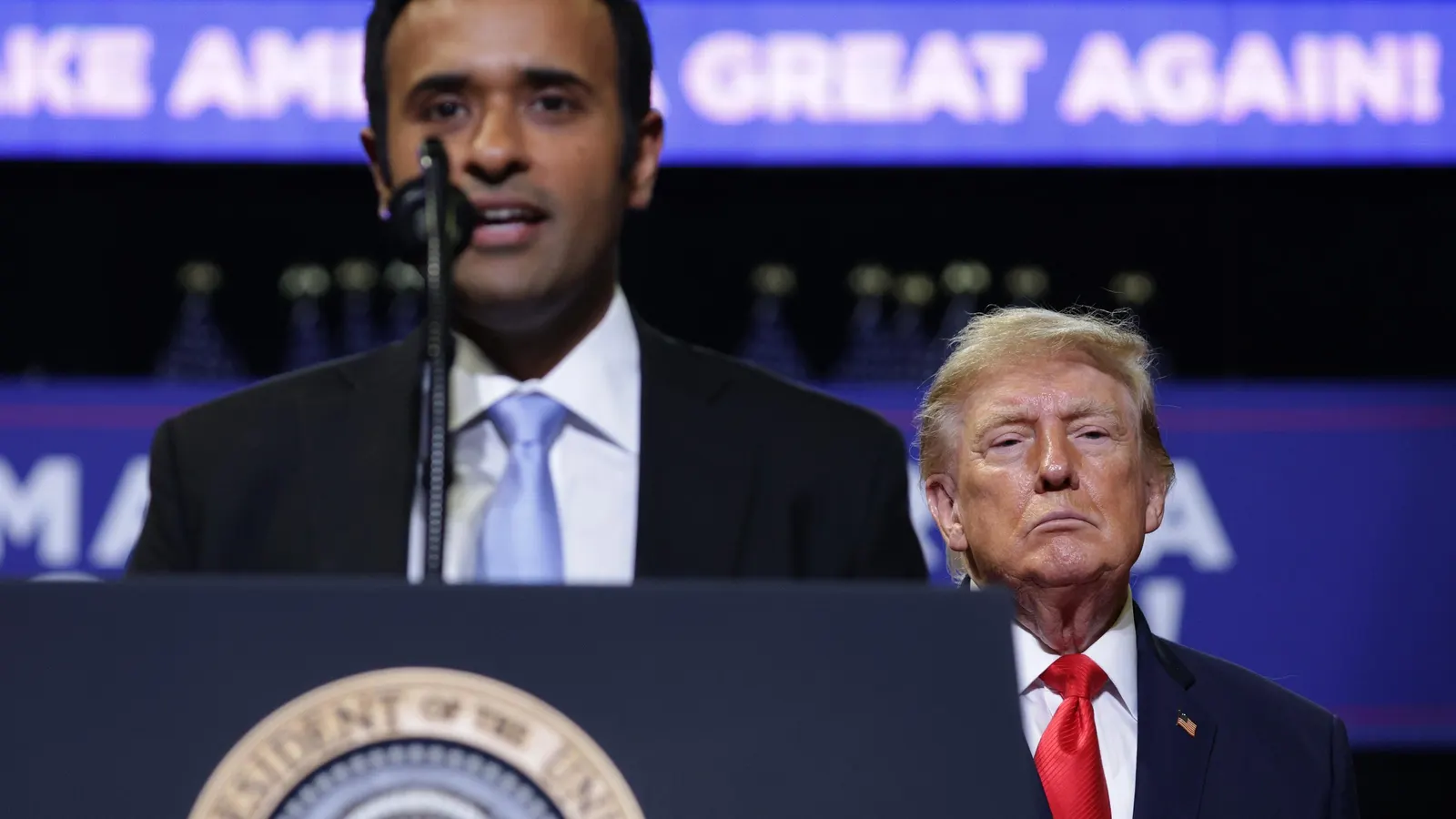
A month after leaving Washington, Ramaswamy made it official. In a speech at a warehouse near the Cincinnati suburbs where he grew up, he announced his candidacy for governor and wrapped himself in the president’s mantle. “President Trump is reviving our conviction in America,” he said. “We require a leader here at home who will revive our conviction in Ohio.” Trump promptly endorsed him, giving Ramaswamy the blessing he had spent years pursuing. He also gave himself every financial advantage. Through October 14, Ramaswamy had lent his campaign $41.3 million; his campaign’s total spending reached $79.5 million, compared with Acton’s $34 million, according to an OpenSecrets analysis of campaign disclosures. A separate super PAC supporting him drew checks from billionaires Jeff Yass, Bill Ackman, and Elon Musk. Yet all that money could not buy a consistent message. He promised sweeping change: phase out Ohio’s state income tax, beginning with capital gains, which legislative researchers said would channel most of the benefit to people earning over $1 million a year. He declared that Ohio had too many universities and proposed consolidating them, using higher education as a source of budget savings. His attempts to seem like an ordinary guy often made things worse. In September, he promoted a ten-point agenda in a batting-cage video, punctuating each promise with a swing of the bat; the internet responded with merciless mockery. At a rally with Trump in Vandalia on October 3, he offered to pick up a young boy onstage, then struggled to hold him and nearly dropped him. Not every obstacle was self-inflicted. As an Indian-American man and a practicing Hindu, Ramaswamy surely faced conscious and unconscious bias from some voters, and he had experienced it firsthand during his presidential run. In 2023, Forbes watched an older white woman outside an Iowa diner tell him she liked his message but was unsure she could support him because he was Hindu. For all his wealth and bravado, he was still other to some people. But in the Ohio campaign, the self-inflicted wounds outweighed the unfair ones.
The erosion of Ramaswamy’s campaign was not the work of a single moment; it was a pattern. As the race wore on, his attacks on Acton became more explicitly Trumpian, trading substance for savagery. In April, he released a video suggesting Acton offered little beyond an ability to “complain about what someone else did to her”—a line many viewers heard as a sneer at the childhood abuse she had survived. Later, a Ramaswamy ad featured Republican activist Linda Caudill blaming Acton’s pandemic policies for her mother dying alone in a nursing home. It was a devastating story, but it was also false. Public records showed Caudill’s mother had lived and died in Kentucky, and that her death came after Ohio’s stay-at-home order had ended and after Acton had resigned as health director. The ad with Acton’s estranged mother was the logical endpoint of this strategy. In normal times, a candidate who used a woman’s childhood trauma as a political weapon would be ostracized. Instead, Trump praised Ramaswamy, and Ramaswamy kept the ad on the air, doubling down on the calculation that cruelty was strength. The voters of Ohio disagreed. The backlash crossed party lines, and the polling slide began almost immediately. By Election Night, the toss-up had become a comfortable win for Acton, and CNN called the race with 85 percent of the vote in. Ramaswamy had lost a state that should have been well within his reach, a defeat made all the more striking by the money he spent and the national figure he had become. He remains a billionaire with the wherewithal to restart his political career at any time. But this loss was more than a data point; it was a verdict on the persona he had constructed. The smartest man in the room, the eager heir to Trump, the crusader against victimhood who used victims as props—Ohio voters saw through it. Whether Ramaswamy can shapeshift again is an open question, but each reinvention requires voters to forget the last one. That is a harder sell than any campaign ad.