



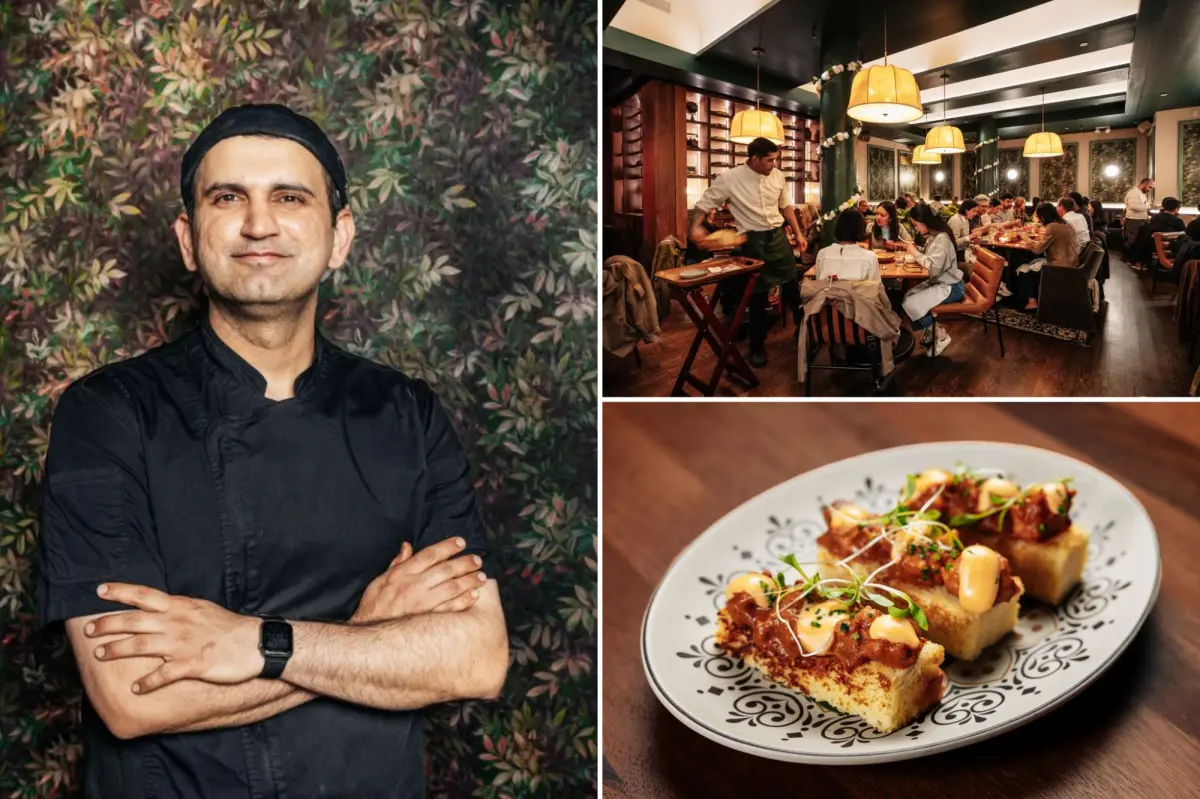
There’s a certain kind of New York restaurant that doesn’t announce itself with fireworks. It doesn’t need a velvet rope, a celebrity chef cameo, or a dish that looks like a sculpture. It simply opens its doors, offers something genuinely delicious, and lets word travel the way it always has in this city—by friends telling friends, by one great meal becoming a story you can’t stop telling. Passerine, a newly revitalized Indian restaurant in Manhattan, feels exactly like that kind of place. When it first opened in November 2024, it struggled to find its footing, offering a somewhat stiff $140 seven-course tasting menu that seemed to keep diners at arm’s length. But three months ago, the restaurant made a bold and welcome pivot. Talented chef Gaurav Bhatla, previously of the glossy and much-hyped Ambassadors Clubhouse, took over the kitchen and completely reshaped the concept. Out went the fixed menu and its formal expectations. In came an à la carte format built around what the team calls a “New York bistro” sensibility. It’s a clever reframing, and one that immediately makes sense when you sit down in the warm, inviting space and start reading the menu. As co-owner Alvina Buxani puts it, “We wanted a New York restaurant with Indian food, not one transporting you to India.” That single sentence explains the entire magic of Passerine. It’s not about recreating some idealized version of the Subcontinent, complete with heavy drapes and intense gravitas. It’s about bringing the flavors, techniques, and soul of Indian cooking into the lively, pragmatic, ever-evolving context of New York City. The result is a devilish counterpoint to the current wave of high-profile, sometimes intimidating Indian eateries that have been dominating the city’s culinary conversation—places that are beautiful and serious, but sometimes feel like they’re testing you. Passerine would rather welcome you, feed you, and send you home happy. And in that simple act of hospitality, it discovers a corner of the Subcontinent that feels entirely new: a fantasy zone where khameeri naan can meet Big Apple cream cheese, and where tradition and playfulness coexist without apology.
The room itself does a lot of the heavy lifting when it comes to putting you at ease. With only seventy-seven seats, Passerine is small enough to feel personal, but it avoids the cramped, hard-edged quality of other buzzy Indian restaurants like Adda or Semma. Those places have their fans, but they often left me feeling like I was balancing on a stool and shouting across a tiny table. Passerine, by contrast, is cozy and comfortable in a way that feels almost rebellious in today’s dining scene. The walls are covered in colorful jungle prints that add a sense of whimsy without trying too hard. The tables and chairs are a bold, warm shade of ochre, giving the whole dining room a sunny, slightly bohemian vibe. It’s a refreshing departure from the over-the-top opulence you find at places like Mustaafer or even Bhatla’s former home, Ambassadors Clubhouse. There’s no gold leaf dripping from the ceiling, no elaborate light fixtures that look like they belong in a palace, no sense that you need to dress up just to feel worthy of the space. Instead, there’s a deliberate, quiet intention to make everyone feel comfortable. Buxani explained it simply and beautifully: “We wanted everyone to have a soft seat.” That philosophy extends beyond the physical furniture. It applies to the pacing, the service, the tone of the staff, and the way the menu is written. The front of the house has a bar and small tables, perfect for dropping in for a quick drink and a snack. But the rear dining room is where the restaurant truly shines, especially the booths, which are actually easy to enter and leave—something that should not be as rare as it is in New York restaurants. You sink into them, you relax, and you feel like you could stay for hours. In a city where so many restaurants are engineered for maximum turnover and maximum drama, Passerine feels like a deep exhale. It’s a place that understands that luxury isn’t about being pampered by expensive things; it’s about being allowed to be yourself. That’s a human quality, not a trend, and it’s why the restaurant feels so special.
Nowhere is that approachability more evident than on the menu, which is wonderfully free of the anxiety of authenticity. The team isn’t interested in lecturing you about micro-regions or strict traditional techniques. Instead, they treat Indian food as a living, breathing language that can be spoken in a New York accent. The starters alone are a joyful celebration of that philosophy. Take the “Bombay schmear,” an eighteen-dollar creation that looks and tastes like an everything bagel crossed with a tandoor-baked naan. It’s filled with masala cream cheese, and it’s exactly as gloriously weird and wonderful as it sounds. Bhatla says he was inspired by Leon’s Bagel on upper Broadway, a beloved chain that knows a thing or two about chewy, seeded perfection. The dish is a little bit of a gut bomb, in the best possible way, so the menu wisely warns that you’d better have it to share or you won’t have room for much else. Then there’s the burrata chaat, which at twenty dollars rivaled the finest Italian starter I’ve had in years. The secret is smoked tomato slices sourced from the Union Square Greenmarket, which add a deep, charry sweetness that plays beautifully against the cool, creamy burrata. A dash of cilantro makes a half-hearted stab at Indian affinity, but honestly, the dish doesn’t need it. It’s a testament to how Indian flavors can collaborate with other culinary traditions without losing their identity. The lobster rolls are another happy fusion: three rectangular brioche slices topped with thin slices of Maine lobster and a smoked tomato gravy that carries a whisper of cardamom. They’re fun, playful, and completely successful, the kind of dish that makes you smile before you even take a bite. But as good as these starters are, they’re not the real high ground of the menu. That distinction belongs to the more fully Indian offerings, where the kitchen’s talents are on full display. The curries here are mostly lighter and less creamy than typical Indian restaurant fare, which means you can actually taste the spices rather than being smothered by them. It’s a modern approach, but it doesn’t feel washed-out or stingy. Instead, it feels thoughtful, letting each ingredient speak clearly while still honoring the deep, layered complexity that makes Indian food so beloved.
Among the main courses, a standout is the paneer makhmali, priced at thirty-two dollars. The name alone sounds like a luxury, and the dish delivers on every level. Silky-smooth buffalo milk paneer cheese sits in a tangy achari masala that’s been twice-sparked with chili chutney. The texture is almost impossibly soft, barely holding its shape, while the sauce is bright, punchy, and full of pickled-spice tang. It’s the kind of dish that makes you pause after the first bite, not because it’s shocking, but because it’s so perfectly balanced. Then there’s the braised short rib pot pie, which at forty-six dollars is Bhatla’s unabashed love letter to New York comfort food. He calls it “obviously New York style,” and he’s right. It’s a simmering, saffron-infused indulgence that’s steeped in cloves, nutmeg, and cumin, all tucked under a golden, flaky puff pastry crust. Crack through that crust and you find tender, fall-apart short ribs in a rich, warmly spiced gravy that feels like a hug in a bowl. It’s the kind of dish that makes you want to curl up on a rainy day, the sort of food that reminds you why braising was invented. But perhaps the most extravagant menu item is the “crab experience,” a ninety-five-dollar feast for two that feels like a celebration from the moment it lands on the table. The dish places a large soft-shell crab in an amusing, crab-shaped bowl, surrounded by a generous load of shrimp and crab sauce and slow-cooked dum biryani. The rice is richly seasoned with coriander and cardamom, each grain separate and fragrant, and it’s served with a side of chili-sparked cucumber for brightness and crunch. The presentation is playful, but the flavors are deadly serious. Soft-shell crab is going out of season soon, and the kitchen plans to replace it with king crab in a week, which seems like an equally indulgent swap. Either way, this is a dish meant to be shared, savored slowly, and talked about for days. It’s the kind of experience that makes you feel like you’ve discovered something, even if the restaurant has only been in its current form for a short time.
Dessert continues the theme of comfortable nostalgia with a twist. There’s no kulfi on the menu, which feels almost intentionally contrarian given how traditional Indian restaurants usually close the meal. Instead, there’s a delightful banana split, made with vanilla and mango gelato. It’s a playful, refreshing end to a meal that has already broken all the rules, and it works precisely because it doesn’t try too hard. The banana split is creamy, sweet, and a little bit silly, the kind of dessert that makes you feel like a kid again. It’s also a reminder that Passerine isn’t trying to dazzle you with molecular gastronomy or rare ingredients. The restaurant’s version of luxury is much more straightforward: it’s about making you feel happy, satisfied, and eager to come back. That ethos extends to the overall dining experience, from the soft seats to the colorful jungle prints on the walls to the genuinely friendly service. It’s rare to find a place that balances so many elements so effortlessly. In a dining scene that often rewards exclusivity and intimidation, Passerine has chosen a different path. It doesn’t want you to be impressed by its seriousness; it wants you to be seduced by its warmth. It wants you to linger, to laugh, to tear off a piece of that Bombay schmear and dip it into something delicious. It wants you to feel like you belong, whether you’re a seasoned Indian food aficionado or someone who’s only ever had chicken tikka masala. There’s a generosity to that approach that is deeply, fundamentally New York. It’s the same generosity that makes the best corner deli feel like a local landmark and the best neighborhood restaurant feel like an extension of your own living room. Passerine has captured that spirit in a beautiful, delicious package, and the city is better for it.
In the end, Passerine offers a soft landing for New Yorkers who love Indian cuisine but are weary of its pretensions. It’s a restaurant that understands the difference between reverent and rigid, between playful and disrespectful. It takes the traditions of Indian cooking seriously enough to build a menu around them, but it isn’t afraid to let a little New York swagger into the room. That balance is hard to pull off, and it’s a testament to Bhatla’s skill and Buxani’s vision that the restaurant manages it so gracefully. The menu is small enough to be carefully curated, but varied enough to offer something for every mood. The dishes are familiar enough to be comforting, but surprising enough to feel new. And the room, with its jungle prints and ochre chairs and soft, welcoming booths, wraps the whole experience in a feeling that is all too rare in modern dining: genuine ease. There’s no need to translate, no need to perform, no need to prove anything. You just sit down, eat something wonderful, and leave feeling like you’ve been taken care of. That’s the kind of hospitality that builds loyalty, the kind that turns first-time visitors into regulars. Passerine may have started its life as a tasting-menu restaurant that didn’t quite find its audience, but it has reinvented itself as something far more valuable: a neighborhood gem with a global soul. It’s the kind of place you want to bring your parents, your best friend, a date, or even just yourself on a night when you need a little tenderness. It’s a reminder that the best dining experiences aren’t always the fanciest or the most dramatic. Sometimes, they’re simply the most human. And in a city that never sleeps, where everything moves at speed, it’s a gift to find a place that says, sit down, stay awhile, and let us feed you. That’s the magic of Passerine, and it’s why this newly revitalized restaurant feels like the discovery of the season. It’s not trying to transport you anywhere. It’s just trying to make you feel at home, right here, in the greatest city in the world, one delicious dish at a time.