


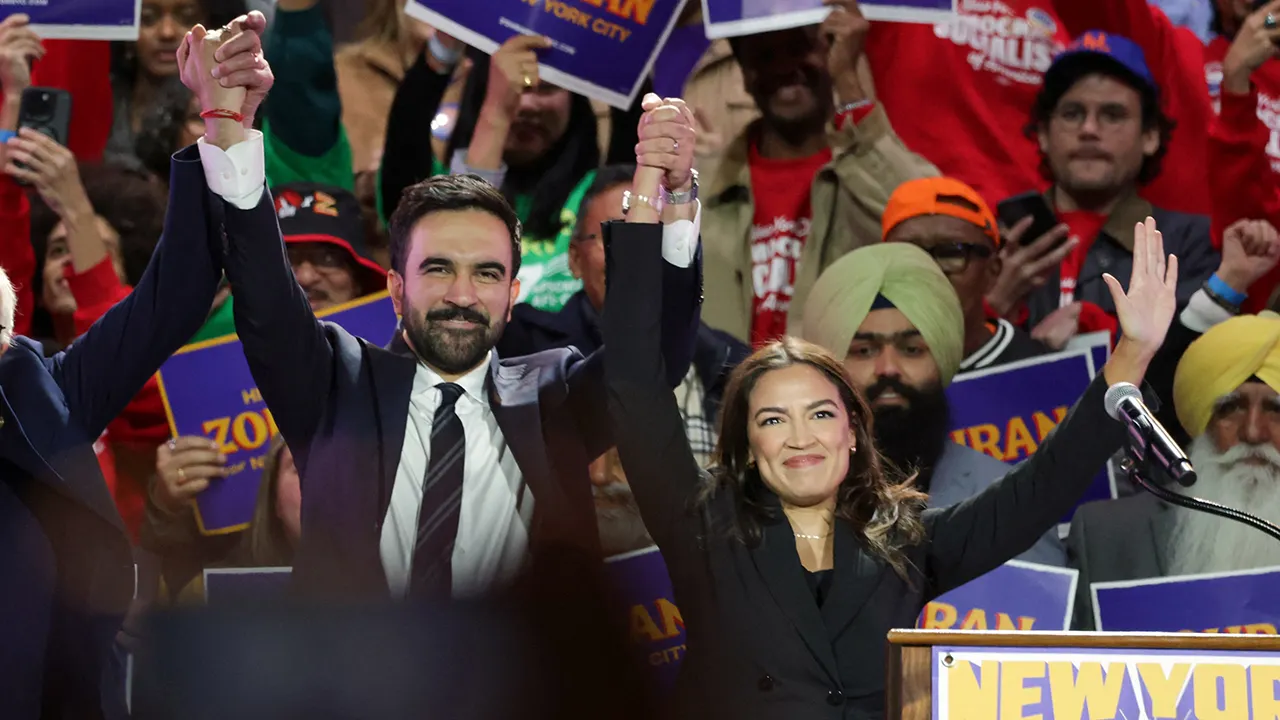
There’s a new chess player quietly moving pieces in the Democratic Party’s early 2028 game, and it’s not someone who will ever appear on a presidential ballot. Zohran Mamdani, the socialist mayor of New York City, has suddenly become one of the most intriguing behind-the-scenes figures in American politics. He won a historic mayoral victory in 2025, instantly making him a powerful voice for the left wing of the Democratic Party. But because he isn’t a natural-born U.S. citizen, Mamdani can’t run for president himself. That hasn’t stopped him from trying to shape who does. Behind closed doors, with sleeves rolled up and no cameras around, he’s been meeting with labor leaders and talking about the urgent need for a union-aligned or genuinely left-wing candidate to enter the race for the White House. He’s not looking for just anyone, either—he’s looking for someone who can carry the progressive banner into the primary fight and keep the movement from being steamrolled by a more centrist establishment favorite. In a party still buzzing from last week’s dramatic midterm victories, Mamdani seems to believe the moment is fragile, and he’s determined not to let the left’s momentum dissolve into another round of disappointment. He wants the progressive ecosystem to move fast, stay disciplined, and be ready to rally around a standard-bearer if and when a moderate starts pulling ahead. In many ways, he’s becoming the person progressives turn to when they’re wondering whether their politics will actually have a champion on the biggest stage.
The source of Mamdani’s concern is fairly simple: he’s not sure whether his close political ally, Representative Alexandria Ocasio-Cortez, will actually run for president. AOC, as she’s widely known, is arguably the most recognizable progressive in the country, with a massive social media presence and a devoted following that spans generations. If she stays out of the 2028 race, Mamdani worries, progressives could find themselves without anyone to carry their ideas into the primary. That would leave a more moderate, establishment-friendly candidate to glide toward the nomination without a real fight, and it could push the party further from the grassroots energy that has been building for years. Axios was the first to report on Mamdani’s quiet conversations, and sources say he’s especially focused on making sure the progressive movement doesn’t lose the momentum it gained from the midterms. Those elections were a clear rebuke to Republicans, with Democrats winning a massive House majority and taking control of the Senate, and Mamdani believes that kind of energy can’t be wasted. He’s not trying to force anyone into a race, but he is trying to build the kind of infrastructure and coordination that could make a progressive campaign viable from day one. It’s a softer, more strategic approach than the fiery rallies and social media clashes that often dominate left-wing politics. Instead, Mamdani is working the phones, meeting with union bosses and movement leaders, trying to get everyone on the same page before the 2028 race truly begins. He’s acting like a political organizer rather than a would-be candidate, which makes sense—because in this scenario, his role isn’t to run but to make sure someone else can.
AOC, for her part, is doing her best to pump the brakes on all the speculation. She just won re-election to a fifth term representing parts of New York City, and she’s been publicly insisting that voters are more focused on what Democrats can do with their new congressional majorities than on who might run for president in 2028. Speaking to reporters on Monday night, she brushed aside questions about the next election, saying that what people actually want to hear about is the legislative agenda, the investigations, and the concrete work ahead. It was a carefully measured response, especially considering that hours earlier, a new political group called Ready for AOC had formally launched, aiming to convince her to run by gathering names and building a visible wave of grassroots support. The group describes itself as a people-powered movement asking Ocasio-Cortez to run for president in 2028, with no campaign and no money, just names. It’s an attempt to show her that millions of Americans are ready to fight for her if she decides to enter the race. But AOC has been cautious, saying that people are less concerned about the horse race than they are about the immediate work that needs to be done. She’s also been clear about her own uncertainty. Back in September, she said she was weighing what to do next, including a possible White House run or a bid for the Senate seat currently held by Minority Leader Chuck Schumer. She told The New York Times that her decision, which could come after the midterms, would ultimately come down to one question: where can she do the most good? That kind of thoughtful, deliberate framing keeps her options open without making any promises, and it leaves Mamdani and the rest of the progressive movement waiting to see what she’ll do.
What makes this moment even more interesting is how wide open the 2028 field appears to be. Veteran Democratic strategist David Plouffe, who managed Barack Obama’s 2008 campaign and later advised Kamala Harris, recently offered a striking assessment: if AOC runs, she’ll likely start with about 20 to 25 percent support, and the big question is whether she can build from there. If she doesn’t run, then the primary is completely open, and Plouffe suggested that might lead someone like Abdul El-Sayed—the newly elected senator from Michigan who made history as the first Muslim elected to the U.S. Senate—to seriously consider jumping in despite just winning office. Plouffe described the race as so wide open that some people will probably run who surprise us, and some people will probably stay out who surprise us. That uncertainty is exactly what Mamdani is trying to navigate. He knows that if AOC decides to skip the presidential race, progressives need another figure who can step into the spotlight and compete against a more centrist front-runner. But he also understands that the political landscape is unpredictable, and today’s favorite can easily become tomorrow’s afterthought. The left has been burned before by believing that momentum alone would carry a candidate to victory, only to watch establishment power brokers consolidate around someone else. Mamdani seems determined to avoid that outcome in 2028, even if it means working quietly behind the scenes, forging alliances, and preparing for multiple possible scenarios. It’s a long game, and he’s playing it carefully.
Meanwhile, Ocasio-Cortez isn’t the only prominent progressive whose name is being floated. Representative Ro Khanna of California, another leading House progressive, has also become a potential presidential contender. Last week, a group of his allies launched a draft committee called “Run Ro” specifically to build support and raise money for a possible 2028 campaign. Khanna has long been seen as a bridge between the party’s left wing and its more tech-forward, future-focused factions, and he’s spent years building relationships with younger voters and progressive donors. If AOC decides not to run, Khanna could become the most viable alternative for progressives looking for an articulate, media-savvy candidate with a national profile. At the same time, there’s still the lingering question of what AOC will do about the Senate. Schumer, who turns 76 later this month, has left his own 2028 plans open and hasn’t announced whether he’ll seek another term. If AOC were to challenge him in a primary, that would create a massive intra-party battle, but it could also give her a different kind of platform and a clearer path to national leadership. For now, she’s keeping everyone guessing, and that’s exactly where she seems most comfortable. The combination of a possible presidential race, a possible Senate race, and a possible decision to stay put in the House means that AOC is at the center of a remarkable set of possibilities. And behind it all, Mamdani is watching closely, ready to help steer progressive energy toward whichever candidate or strategy seems most likely to succeed.
In the end, what Mamdani is doing might matter just as much as what any potential candidate does over the next few years. He’s not running for president, and he may never appear on a debate stage, but he’s quietly building the kind of political infrastructure that can make or break a campaign. His focus on labor alliances, his willingness to work with left-wing activists, and his concern about a moderate candidate rising too quickly all point to a larger strategy: he wants the progressive movement to be taken seriously in 2028, not as an afterthought but as the heart of the Democratic Party’s future. Whether AOC runs, whether Khanna runs, or whether someone else emerges from the left’s deep bench, Mamdani seems determined to make sure progressives have a real fighter in the ring. It’s a role that fits him well—part organizer, part power broker, part dreamer. And while the American people won’t be voting for him, they may end up feeling his influence on whoever they do vote for. The 2028 election is still years away, but the battle for its shape has already begun. If Mamdani has anything to say about it, the left wing of the party won’t be caught off guard, and the next presidential primary will be a real contest of ideas, not just a coronation. For voters who want something different, that’s a hopeful thought. For the establishment, it’s a warning. And for Mamdani himself, it’s just the beginning of a very long, very careful political chess game.