



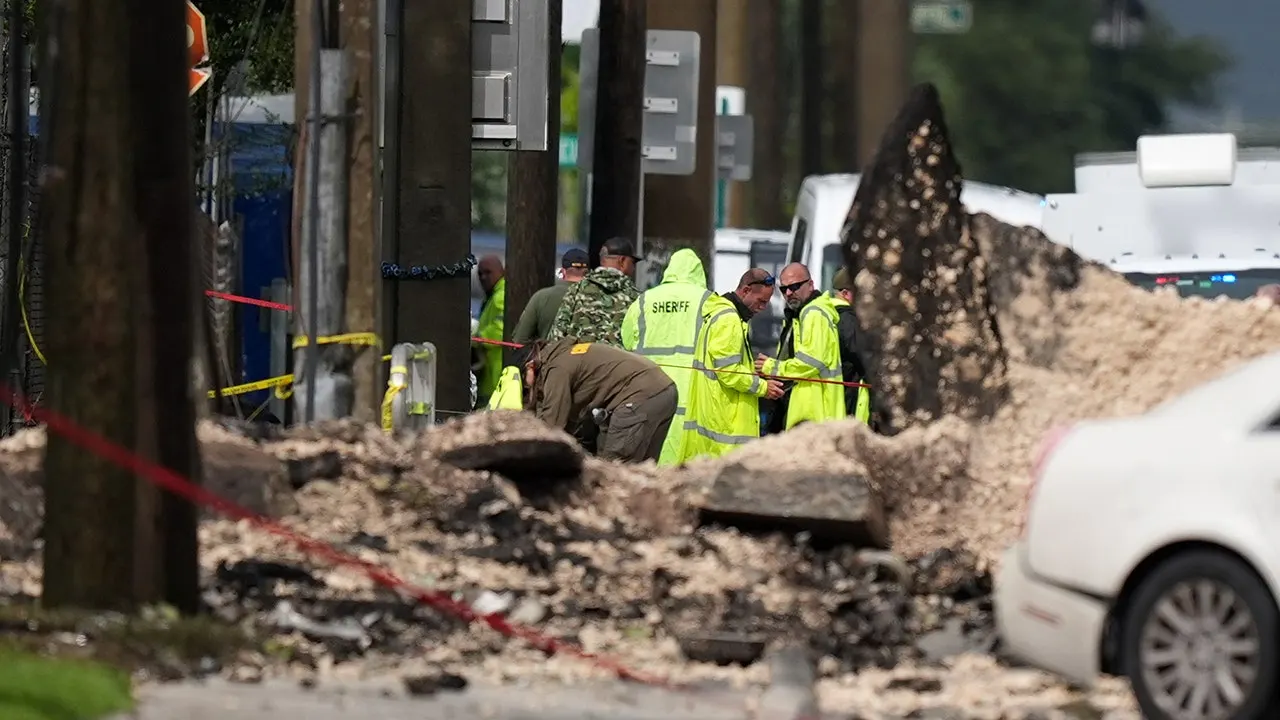
The quiet suburban landscape of Greenacres, Florida, has become the epicenter of a profound tragedy and a meticulous investigation. What was once an ordinary street is now a stark tableau of scattered wreckage and deep emotional shock. Federal investigators, working with painstaking care, have begun to unearth the physical remnants of Sunday’s catastrophic crash, where a Learjet 60 plummeted from the sky, claiming the lives of all nine people on board. The process is slow and deliberate, hampered by waterlogged ground and the need to clear utility hazards, but every piece of debris is being treated as a potential key to unlocking the mystery of why this flight met such a violent end. The recovery of part of the jet’s engine marks a crucial step, offering investigators a physical component to analyze for signs of mechanical failure or bird strike, though the most critical evidence—the aircraft’s “black box”—remains elusive, compounding the uncertainty that hangs over this heartbreaking event.
The investigation, led by the National Transportation Safety Board (NTSB), is unfolding against a backdrop of a violent South Florida weather system that was sweeping through the region at the time of the crash. That storm, characterized by heavy rain, lightning, and severe thunderstorms, is undeniably at the center of the probe. The flight’s final moments, as pieced together from air traffic control communications, tell a story of a crew grappling with deteriorating conditions. The pilot’s last transmissions were not those of a calm, routine flight, but rather requests for assistance, reporting the alarming presence of icing and turbulence and asking the controller if there was a “better ride” ahead. These are the haunting final words from a cockpit that would be silenced forever moments later. The investigators are now tasked with the grim work of determining whether the crew’s actions were appropriate, whether the aircraft was capable of handling the conditions it flew into, and whether the decision to deviate toward Palm Beach County was a fatal error or an unavoidable circumstance of the storm’s chaotic path.
The narrative of the flight’s final hour is a chilling countdown to disaster. The Learjet 60 had departed from Austin-Bergstrom International Airport at 10:37 a.m., bound for a serene getaway in North Eleuthera, Bahamas. For more than two hours, the journey was unremarkable. Then, at an altitude of approximately 41,000 feet, the calm was broken. An air traffic controller alerted the crew to moderate precipitation five miles away and advised them they could steer left or right to avoid it, specifically warning that the turn toward their destination in Freeport “looks pretty bad.” The crew acknowledged the warning and was directed toward a waypoint near Naples, Florida, on the state’s Gulf Coast. It was a decision point, a moment where the pilot’s judgment and the aircraft’s capabilities were put to the test against the raw power of nature. The subsequent deviation toward the east, toward Palm Beach County, is a critical juncture in the investigation, prompting questions about why they chose that specific route and whether they were attempting to thread a needle through the storm that ultimately closed in on them.
The human toll of this disaster transforms a technical investigation into a story of profound loss. The victims were not just names on a manifest; they were vibrant individuals whose lives were interwoven with promise and potential. Adam Robinson, a 45-year-old tech entrepreneur from Austin, was returning home with his family from a vacation. He was a figure of innovation and success, but in this moment, he is remembered as a husband and father. He was traveling with his wife, Helen Sharp, 40, and their two young children, four-year-old Emma and two-year-old Charlie. The innocents on board, whose lives were just beginning, are the most heart-wrenching aspect of this tragedy. Also lost were the children’s nanny, Anita Maria Cetina, a woman who was part of the family’s daily life, and a pair of friends, Rachael Reed and Charmi Fehr. Each name represents a unique story, a web of relationships, and a circle of grieving family and friends left to grapple with the sudden, senseless violence of their deaths. The initial report from the FAA listing the flight as carrying eight people was corrected to nine, a stark adjustment that deepened the impact on the community and the families waiting for answers.
In the days since the crash, the physical evidence recovered from the site has painted a grim picture of the jet’s final moments. The discovery of the left tail elevator, a critical control surface responsible for the plane’s pitch, in three separate pieces—with one section found nearly four miles from the main crash site—is of immense significance to investigators. This suggests that the aircraft experienced a structural breakup before impact, a phenomenon that could be the cause of the crash or a result of the aircraft exceeding its design limits while being buffeted by the storm. NTSB member Thomas B. Chapman called the part a “very important piece of evidence” because it holds the key to understanding whether the plane was intact when it hit the ground. The discovery of debris on the roofs of nearby homes further confirms the violent and widespread nature of the disintegration. It is a painstaking task, piecing together the aluminum puzzle from a scattered debris field that spans miles, but it is a necessary one to answer the fundamental question: did the plane break apart in the sky, or did it break apart on impact?
For the families of the victims, and the broader community, the investigation offers a glimmer of hope for closure, but the pain of the loss remains raw. The suitcases and personal effects of the passengers are scattered among the wreckage, waiting to be cataloged and returned, each item a painful reminder of the lives that were cut short. The intense scrutiny on the weather as a primary factor is a somber reminder of the power of nature and the inherent risks of flight, even in modern, sophisticated aircraft. The search for the cockpit voice recorder (CVR) is now a top priority; without it, the investigators are left with only radar data and radio transmissions, unable to hear the crew’s conversation, the sounds of alarms, or any final attempts to grapple with an emergency. The NTSB’s commitment to a thorough and exhaustive investigation is the only path forward, but the answers, whenever they come, will not fill the void left in the hearts of those who loved Adam, Helen, Emma, Charlie, Anita, Rachael, and Charmi. As the recovery operation continues, the community of Greenacres mourns, and the aviation world watches, waiting to learn from a tragedy that so starkly illustrates the fragility of life and the merciless volatility of the sky.