


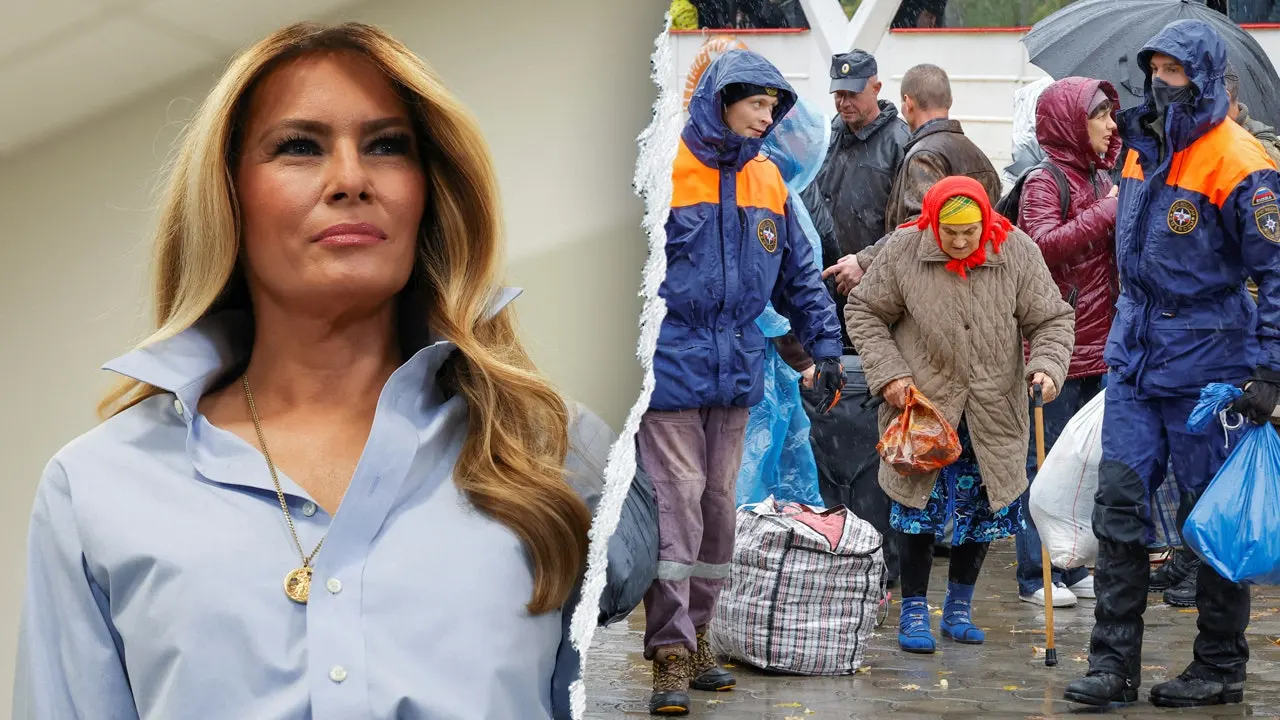
Just before dawn on Tuesday, in a battered corner of southern Ukraine that the world has largely stopped watching, the guns suddenly fell silent. In the small, Russian-held city of Oleshky, on the front lines of a war that has dragged on for years, a ceasefire brokered with the help of an unlikely diplomatic figure went into effect. The pause in fighting began at around 3 a.m. local time, and it was not the result of a major military summit or a United Nations resolution. Instead, it came after weeks of quiet, back-channel work involving U.S. first lady Melania Trump, Ukrainian and Russian human rights commissioners, and a team of intermediaries determined to save the lives of a few thousand mostly elderly civilians trapped in a city on the edge of collapse. According to Dmytro Lubinets, the Ukrainian Parliament’s commissioner for human rights, the humanitarian mission was carried out with the mediation and coordination of Melania Trump, in cooperation with Yana Lantratova, Russia’s commissioner for human rights. For the people of Oleshky, many of whom have spent months or years without reliable electricity, clean water, or medical care, the quiet that greeted the morning was nothing short of a reprieve.
Melania Trump had described the city in stark terms days earlier, calling it a “front-line war city on the brink of disaster.” Her statement painted a picture of a place that has been hollowed out by war, where the remaining residents are not soldiers or strategists, but elderly men and women who simply had nowhere else to go. They are people who lived through the Soviet era, through Ukrainian independence, through the chaos of 2014, and now through the full-scale invasion that began in February 2022. They have watched their neighbors leave, watched their streets crumble, watched the world move on. Many are too frail, too stubborn, or too poor to flee. They need medicine for chronic conditions, food to survive another week, and clean water to drink without fear. They live with limited electricity, often in the dark, and they navigate roads that are sown with mines. They endure regular military attacks, the kind of relentless danger that makes daily life a gamble. Trump said what many humanitarian workers have been saying quietly for months: without intervention, the possibility of bringing aid into the city and evacuating the elderly would be impossible. Her words were not political theater; they were a plea from someone who had been briefed on the ground realities and chose to act.
The White House later confirmed that both Ukraine and Russia had agreed to temporarily stop all military action in Oleshky in order to allow humanitarian aid to enter and to prepare a civilian evacuation through a designated safe passageway. This was not a full ceasefire along the entire front, not a peace deal, not a step toward ending the war. It was a narrow, fragile, and deeply human arrangement: a pause in one city so that old people could get help, and so that those who wished to leave could finally leave. The plan calls for non-military, civilian leaders from both countries to work together, going door to door to visit Oleshky residents in their homes, assessing what each person needs. Some residents will need food and medicine delivered on the spot. Others will need help packing whatever they can carry and being transported to a destination of their choosing. As Trump noted, some may choose to go to Russia, and some to Ukraine. That simple truth speaks to the tangled loyalties and desperate pragmatism of people living in a contested borderland. For many elderly residents, the idea of leaving the only home they have ever known is devastating, but the idea of staying may be deadly. The safe passageway offers them a choice, and in war, choice is a luxury.
Behind the scenes, the agreement was the result of intensive mediation involving not just the first lady’s office, but also senior advisor Marc Beckman, who spoke publicly about the effort on Fox & Friends Weekend. According to Beckman, the deal followed weeks of negotiations that reached all the way to the highest levels of power, involving Russian President Vladimir Putin and Ukrainian President Volodymyr Zelenskyy. That such a localized ceasefire could command the attention of two leaders who have spent years at war with each other is remarkable. It suggests that even in the midst of a brutal, grinding conflict, there is still room for humanitarian gestures when they are framed in terms of human suffering rather than military advantage. The Kremlin, for its part, confirmed the arrangement. Russia’s Defense Ministry wrote on Telegram that, in relation to the conduct of the humanitarian operation in the area of the settlement of Oleshky in the Kherson region, the Armed Forces of the Russian Federation had ceased fire in the Kherson direction. The language was bureaucratic, but the meaning was clear: Moscow was willing to hold its fire for a few hours or days to let the old people of Oleshky receive aid. Whether that willingness will hold in the chaos of the battlefield remains uncertain, but at the very least, it represented a crack in the wall of indifference.
To understand the significance of this ceasefire, one must understand the history and current reality of Oleshky itself. Russian troops have controlled the city since the early days of the invasion, making it one of the many occupied urban centers along the southern front. Before the war, Oleshky was home to roughly 24,000 people, a modest but vibrant community along the Dnieper River in the Kherson region. Its economy was tied to agriculture, fishing, and small-scale trade, and its residents were accustomed to a slow, provincial pace of life. Today, most of those 24,000 are gone, scattered across Ukraine, Russia, and Europe as refugees. Only a few thousand remain, and they are overwhelmingly elderly, people who either could not leave or refused to abandon their homes even as the world collapsed around them. For them, the war has been a slow erosion of everything familiar. The shops closed long ago. The hospitals are barely functional. The streets are empty except for the occasional soldier or humanitarian convoy. The sound of artillery has become as normal as the sound of birdsong once was. And yet, they have survived. They have adapted. They have learned to live without what we consider necessities. The ceasefire, however temporary, is a reminder that they have not been entirely forgotten.
There is, of course, a cruel irony in the timing of this humanitarian pause. Even as the guns fell silent in Oleshky, fresh strikes hit the Ukrainian capital of Kyiv on Tuesday, targeting bridge and subway infrastructure. The war did not stop everywhere; it never does. But perhaps that is precisely why the Oleshky ceasefire matters as much as it does. It demonstrates that even in a conflict defined by absolute positions and deep grievances, there is still space for mercy. It shows that a first lady who has often kept a low public profile can quietly use her platform to broker something real, something that matters to actual people. It reminds us that diplomacy is not always about grand summits and sweeping agreements. Sometimes it is about one city, a few thousand elderly souls, a truck full of medicine, and a road out of hell. The humanitarian mission in Oleshky will not end the war between Russia and Ukraine. It will not bring back the dead or rebuild the ruined buildings. But it may save the lives of people who have already endured too much. And it may offer a small, fragile proof that even in the darkest hours of human conflict, compassion can still find a way through the smoke. As the residents of Oleshky wake up to the sound of silence, they may not know the names of the people who fought for this moment. But they will feel it, in the food that arrives, in the hands that help them pack, in the chance to die at home or to live somewhere else. That is the human story behind the headlines—the reason this ceasefire deserves more than a fleeting news cycle. It is a reminder that behind every diplomatic communiqué, there are faces, memories, and lives that hang in the balance. And for one morning, in one small city, the balance tipped toward hope.