


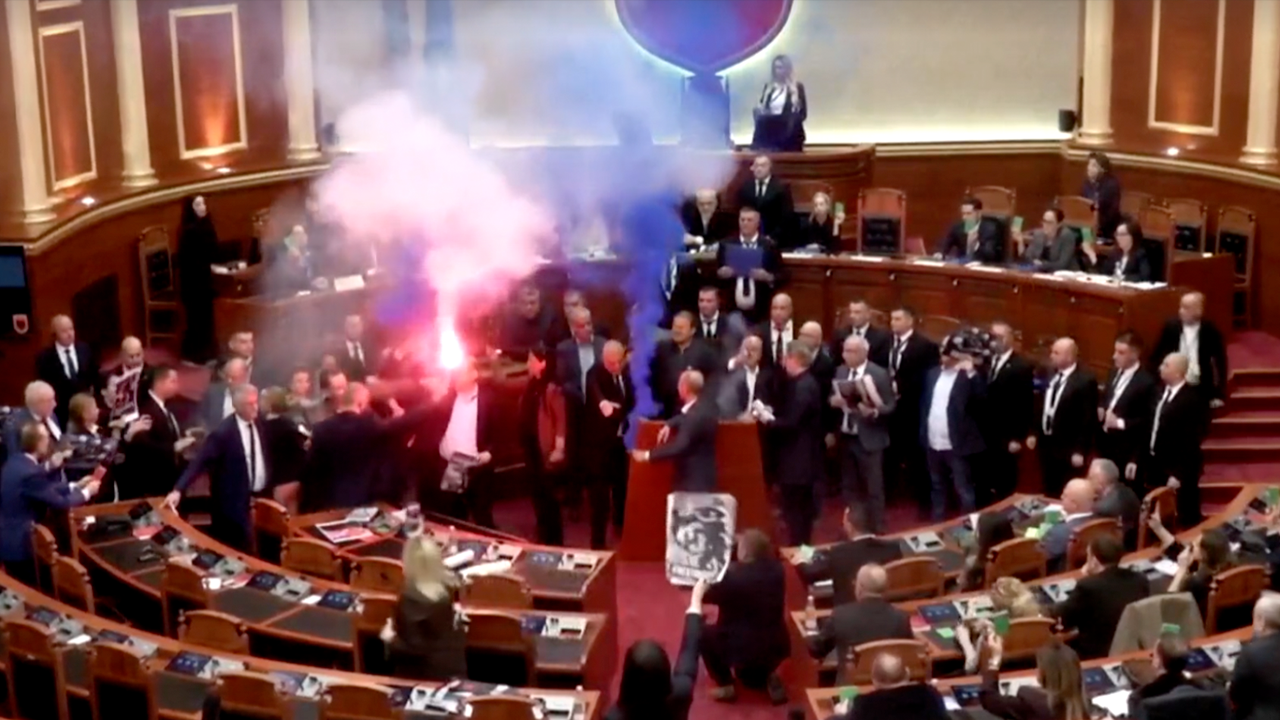
In the ornate chamber of Albania’s parliament, democracy was supposed to unfold through debate, votes, and the peaceful transfer of ideas. Instead, on Thursday, the room erupted into a scene more reminiscent of a war zone than a legislative session. Opposition lawmakers, frustrated beyond words and driven by months of pent-up anger, set off flares that filled the air with thick, colored smoke, turning the marble halls into a surreal and chaotic tableau. The main opposition Democratic Party, acting in coordinated defiance, also blocked access to the podium, physically preventing a vote on a central bank bill. It was a deliberate, theatrical disruption, but one born of a deep sense of desperation. As the smoke curled upward and stung the eyes of lawmakers, the opposition leader, Sali Berisha, stood at the center of the chaos, surrounded by his colleagues who held blue flares—the official color of their party—like torches of rebellion. Their other hands displayed photographs of young protesters wounded by police rubber bullets, images that have become a powerful symbol of the escalating crisis. Berisha’s microphone was eventually cut off, but not before he delivered a scorching indictment of the ruling majority, calling them criminals who, in his words, “deserve tear gas, rubber bullets, cracked skulls, and broken bones—not the young people.” The words were harsh, even violent, but they captured a raw, visceral rage that has been boiling over in Albania for weeks, a rage that has moved from the streets and university campuses straight into the halls of power.
That rage did not appear overnight, nor was it manufactured by opposition politicians. It grew quietly, over years, in the lives of ordinary Albanians—especially the young—who have watched their dreams of a stable, prosperous future slowly wither. The protests that have gripped the country began on October 13 as student-led demonstrations, a spontaneous eruption of frustration from a generation that feels forgotten by the state. Their demands are not extreme or radical; they are fundamental to the idea of a functioning society. The students have called for the resignation of Prime Minister Edi Rama, accusing his government of endemic corruption that has hollowed out public institutions. They have demanded an end to the grotesque underfunding of schools, where classrooms lack basic supplies and teachers struggle to survive on wages that barely cover rent. They have pointed to widespread unemployment, especially among university graduates, and to the stark lack of economic opportunities that forces many of the nation’s brightest minds to pack their bags and leave for Germany, the United Kingdom, or elsewhere. For these young people, the protests are not a game or a political stunt. They are a desperate cry for a future—for a country where hard work might actually lead to something, where education is valued, and where the government serves the people rather than itself. The students who filled the streets in those first days were not professional agitators; they were young men and women with books in their backpacks and hope in their hearts, hoping that their voices would be heard by a leadership that had long seemed deaf to their suffering.
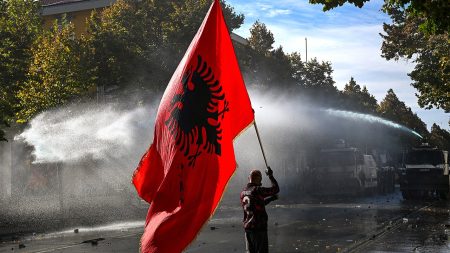
But when voices are ignored, they inevitably rise, and when they rise without response, they can easily turn into fists. The protests, which began peacefully, quickly escalated into one of the most serious political crises Albania has seen in years. Demonstrators clashed with police in running street battles, with the air filling with the sound of sirens, the smell of tear gas, and the shattering of glass. Government buildings were set ablaze, their windows glowing with the orange light of fires that seemed to consume more than just structures—they consumed any remaining sense of public trust. The protesters also targeted Prime Minister Rama’s ruling Socialist Party headquarters in Tirana, the capital, where lines of riot police in full riot gear stood guard like soldiers defending a fortress. The images were jarring: young people throwing stones at shields, police firing rubber bullets into crowds, and medics rushing to treat the wounded. What had started as a movement for educational reform had morphed into a broader and more dangerous uprising against perceived injustice and corruption. The unrest did not remain contained to Tirana; it spread quickly to several other cities across the country, as if a match had been lit in a forest of dry timber. In every corner of Albania, citizens who had long endured economic hardship and political disillusionment suddenly found a common cause and a shared voice. The protests became a mirror held up to the nation, reflecting not just anger but also a deep, collective desire for dignity and accountability.
Prime Minister Edi Rama, who has been in power since 2013 and won a fourth term last year, responded not with the humility of a leader who has heard his people’s pain, but with the defensiveness of a man whose hold on power is being threatened. Rather than acknowledging the legitimacy of the protesters’ grievances, Rama lashed out, blaming “foreign hands” who, in his words, “do not want Albania in the European Union.” He accused outside forces of manipulating the movement, claiming that the demonstrators “represent organized crime rather than students.” It was a familiar and often-used tactic among embattled leaders—dismissing genuine domestic dissent as a conspiracy orchestrated by external enemies. But for the thousands of students on the streets, who had risked their safety and their futures, such words were a deep insult, a denial of their very agency and suffering. Then, instead of opening a dialogue, Rama tightened the screws. He introduced strict new measures designed to crush the protests before they could grow any larger, including staggering fines of $6,000 for anyone who participates in a protest that turns violent, regardless of whether that individual personally committed an act of violence. In a country where the average monthly wage hovers around a few hundred dollars, such a fine is not a deterrent—it is a punishment that could bankrupt a family for decades. The message was clear: the state would not tolerate dissent. But the effect, as so often happens, was the opposite of what was intended. Rather than silencing the demonstrators, Rama’s heavy-handed response only hardened their resolve and expanded their support among ordinary Albanians who saw in the fines a symbol of everything that is wrong with the system.
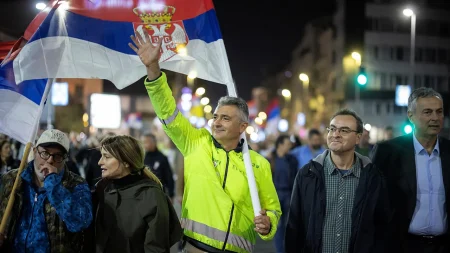
To understand the broader significance of what is happening in Albania, one must look beyond its borders, where a wave of citizen-led anger is sweeping across the region. In neighboring Serbia, a powerful student movement has managed to topple the party of longtime leader Aleksandar Vučić after fourteen years in power, proving that young, determined people can indeed change the political landscape, even against entrenched authoritarian systems. The other articles in the news on the same day as the Albanian flare incident highlight this regional trend: in Brussels, thousands flooded the streets in anti-austerity protests that erupted into clashes with police, and in Serbia, students mounted an election challenge against a leader who is facing his biggest political test. This is not a coincidence. The people of the Balkans and beyond are connected by a common experience of frustration with political elites, economic stagnation, and a feeling that their institutions no longer represent them. In Albania, the opposition’s use of flares and their blocking of the parliamentary podium was, in many ways, an echo of this broader movement—a desperate, symbolic act meant to show that the people’s representatives are willing to go to extraordinary lengths to be heard. The blue flares, which turned the chamber into a sea of color, were also a display of solidarity with the students on the streets, a visual bridge between the formal political sphere and the informal power of the people. Berisha’s inflammatory language, however extreme, was a calculated attempt to align the opposition with the protesters and against the government, even as the government tried desperately to paint the entire movement as illegitimate.
As the smoke cleared from the parliament building, the underlying challenges remained, as stubborn and painful as ever. Another demonstration has already been scheduled for Saturday, and it promises to be larger and more intense than anything the country has seen yet. The students, the opposition politicians, and the ordinary citizens who have joined them are not going away, because their problems are not going away. They are still waiting for a government that will address corruption, that will properly fund schools, that will create jobs, and that will give them a reason to stay in their homeland. They are waiting for a leader who will listen rather than retaliate, who will see them not as tools of foreign conspiracies but as what they truly are: young people who love their country and want it to be better. The road ahead is uncertain and potentially violent, but there is also something profoundly hopeful in this moment. The people of Albania have rediscovered their collective voice. They have remembered that democracy is not just about elections, but about the ongoing struggle to make one’s government accountable. The flares in the parliament were a dramatic gesture, but behind them was a simpler, more human request—the same request that has driven rebellions and reforms throughout history: we matter, our lives matter, our future matters, and we will no longer be silent. Whether Prime Minister Rama and his allies heed that message or continue to suppress it will determine not only the fate of his government, but the soul of the nation itself. For now, the people are watching, waiting, and preparing to take to the streets once more.