

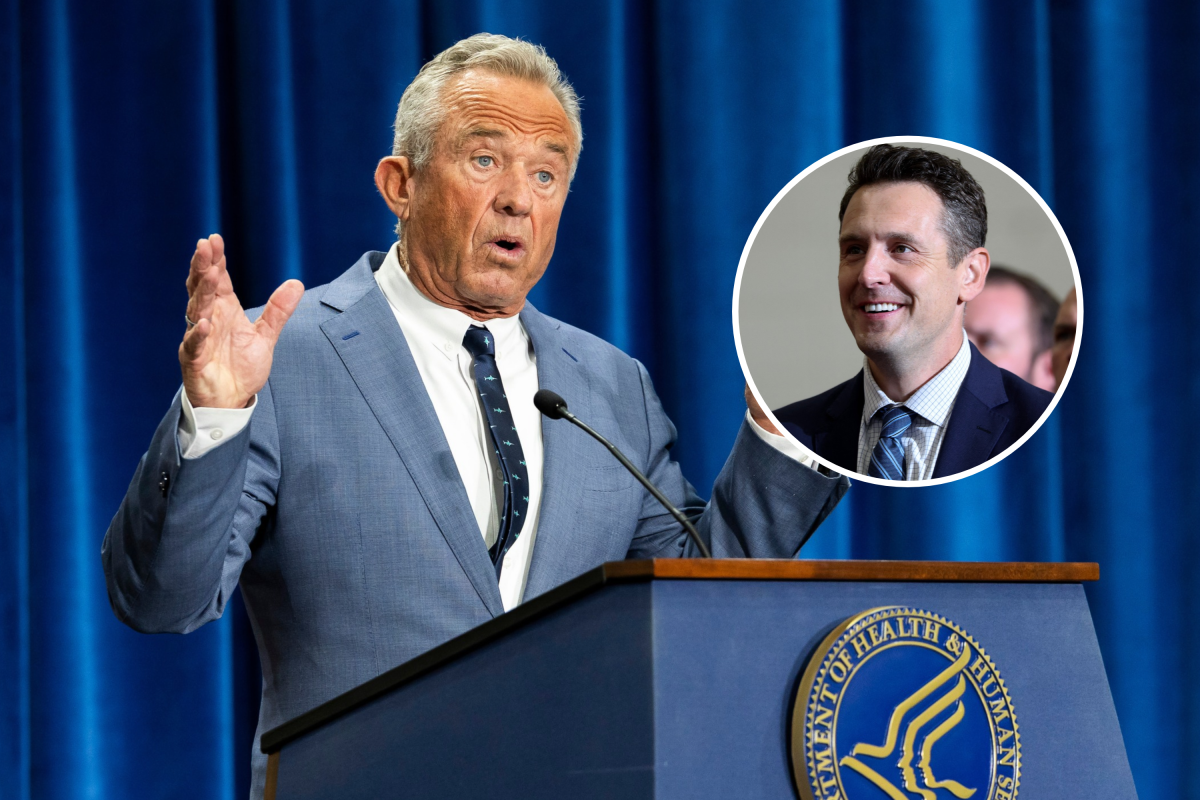
On a crisp Wednesday evening in Des Moines, the political energy is about to shift from the campaign trail to a stage in the heart of Iowa, as Health and Human Services Secretary Robert F. Kennedy Jr. arrives for a Make America Healthy Again (MAHA) rally with just days left before the November 3 midterm elections. The event is more than a health-policy gathering; it is a high-stakes show of force for Republican gubernatorial candidate Zach Lahn and House candidate Joe Mitchell, two men hoping that the health-focused movement Kennedy has helped ignite can carry them across the finish line. This year, the Iowa governor’s mansion is wide open. Sitting Republican Governor Kim Reynolds decided not to seek reelection, creating a rare and dramatic opening for both parties. Facing Lahn is Democrat Rob Sand, the state auditor, who has consistently led in the polls since the primaries—a striking fact in a state that hasn’t elected a Democratic governor since Chet Culver in 2006. Even some Republican-affiliated polls have shown Sand ahead, which underscores how difficult Lahn’s climb has become. For supporters packing the rally, though, there is still hope that a fresh, health-focused message, delivered by one of the most prominent voices in the nation’s wellness movement, might move the needle. The auditorium is expected to buzz with a mix of longtime Republicans, health-conscious independents, and curious voters, all drawn by the promise of a conversation about disease prevention, nutrition, and what Kennedy often calls the “chronic disease epidemic” plaguing American families. For Iowans, the event represents not just a campaign stop but a rallying cry—a final burst of energy meant to remind voters that the cure for what ails both their bodies and their body politic may be closer than they think.
Healthcare has emerged as a dominant, deeply personal issue in Iowa this election season, and the MAHA rally arrives at a moment when voters are more aware than ever of the ways politics intersects with their doctor’s office. According to an October Emerson College Polling survey of 650 likely Iowa voters, the economy remains the top concern, with 42 percent naming it as the most important issue facing the state. But healthcare comes in a strong second, at 18 percent—a significant share that outranks threats to democracy, which drew 10 percent, and education, at 8 percent. These numbers tell a story that goes beyond simple statistics. Iowa is a state where people worry about the cost of insulin, the distance to the nearest hospital in rural counties, and the heartbreaking rise in cancer diagnoses, many of which have been linked to farmland contamination and environmental factors. Democrats, led by Rob Sand and Senate hopeful Josh Turek, have seized on these anxieties, arguing that Medicaid cuts, rising out-of-pocket costs, shortages of rural care providers, and what they describe as a cancer crisis have left Iowa families feeling abandoned. They are betting that healthcare anxiety will trump traditional party loyalty. Kennedy’s presence, however, complicates that narrative. By aligning himself with Republican candidates and blending the MAHA movement’s wellness principles with conservative campaign themes, he offers voters a vision of healthcare that is less about expanding government programs and more about personal responsibility, food safety, and removing chemicals from daily life. The rally is thus a collision of worlds—public health policy, partisan politics, and grassroots health activism—taking place in a Midwestern state where these issues feel less abstract and more like matters of survival. For voters on both sides, the event forces a question: What does it really mean to be healthy in America, and which candidate can deliver that vision?
The appearance of Kennedy in Iowa also adds a fascinating layer to the state’s intensely competitive U.S. Senate race, where Republican incumbent Ashley Hinson and Democratic challenger Josh Turek are locked in a razor-thin battle that could help determine control of the Senate. Notably, Hinson is not on the rally’s list of speakers, and organizers have not said whether she was invited, lacked interest, or was deliberately left off the program. That absence is hard to ignore. Just a week before Kennedy’s visit, former President Donald Trump traveled to the Hawkeye State to stump for Hinson, and he is scheduled to return to Iowa on November 1, highlighting just how critical this race is to national Republicans. Hinson, a former journalist and state legislator, has positioned herself as a pragmatic conservative, focused on energy, agriculture, and fiscal restraint. Turek, a progressive state senator, has hammered away on healthcare, education, and protecting democracy, and recent polling suggests the race is pure deadlock. Into this volatile mix steps Kennedy, a figure who commands intense loyalty from his followers and intense skepticism from others. For Republicans, his MAHA rally is a way to galvanize the health-focused voters who might not otherwise show up for a standard campaign event. For Democrats, it is a reminder of how the party’s traditional advantage on healthcare could be challenged by a message that doesn’t fit neatly into the old left-right framework. Kennedy’s presence is deliberately provocative, designed to make people think differently about what health policy looks like. But his decision to rally with Lahn and Mitchell—without Hinson on stage—raises questions about whether the MAHA crowd will fully coalesce around the entire Republican ticket or whether this is a more selective endorsement, tailored to candidates who have embraced the wellness agenda with open arms.
For those looking at the Senate race alone, the polling makes one thing crystal clear: neither side can afford to take a single vote for granted. The latest numbers from a range of surveys paint a picture of a tight, unpredictable race. An Echelon Insights poll conducted October 16–23 among 403 likely voters gave Turek a narrow two-point lead, 45 percent to 43 percent, with Libertarian Thomas Laehn drawing 7 percent and 3 percent undecided. InsiderAdvantage, surveying 1,200 likely voters on October 21–22, flipped the script, putting Hinson ahead by one point, 47 to 46 percent, with Laehn at 3 percent and 4 percent undecided. YouGov’s October 6–12 poll of 2,245 likely voters gave Turek a one-point edge, 47 to 46 percent, a statistical dead heat. Marist University, surveying 1,100 likely voters in mid-October, showed Turek at 48 percent versus Hinson’s 45 percent, a three-point lead that still fell within the margin of error. Emerson College found Hinson ahead by two points, 47 to 45 percent, while CNN/SSRS had Hinson up by two points as well, 45 to 43 percent, with a notable number of voters saying they supported neither. Suffolk University gave Turek what appeared to be the strongest lead, 48 to 44 percent, but even that margin was slim. What all this means, in human terms, is that Iowans are genuinely torn. They have seen decades of Republican leadership in Washington and Des Moines, but many are frustrated with rising costs and worried about access to medical care. They are also hearing competing futures described by the candidates—one that promises limited government and individual wellness, and another that promises systemic reform and government-backed health protections. With third-party candidate Laehn in the mix, the outcome could easily be decided by voters who have all but stopped paying attention to the major parties and who show up on election day with a gut feeling rather than a fixed commitment. The rally featuring Kennedy, with all its intensity and unpredictability, is meant to sway exactly those voters.
The gubernatorial race, meanwhile, is a somewhat different story. Poll after poll has shown Rob Sand maintaining a comfortable, consistent lead over Zach Lahn. Echelon Insights gave Sand a 50–46 advantage; YouGov had him up 50–44; Marist showed 52–45; Emerson found 49–45; CNN/SSRS gave him a 51–42 edge; Suffolk had him ahead by twelve, 55–43; and the New York Times/Siena University poll, conducted from late September to early October, put Sand at 52 percent against Lahn’s 41 percent, with 7 percent unsure. These numbers are startling for Republicans who remember a time when Iowa reliably leaned red in statewide races. Sand, as state auditor, has built a reputation for transparency, investigative energy, and a willingness to challenge the political establishment, regardless of party. He appeals to voters who may not agree with him on every issue but trust him to be honest and independent. Lahn, a relative newcomer to the highest level of politics, is running on a platform of tax cuts, agricultural growth, and the kind of health-conscious policies epitomized by the MAHA movement. His association with Kennedy is strategic, an attempt to capture the energy of parents upset about school vaccine mandates and families concerned about processed foods. But the polls suggest he still has a steep hill to climb. In a state that hasn’t sent a Democrat to the governor’s office in nearly two decades, Sand’s persistent lead is a remarkable testament to the power of nonpartisan credibility and the shifting priorities of Iowa voters. It also highlights a possible tension within the Republican base: while many conservatives love the MAHA message, they may not be ready to abandon a known quantity like Sand, especially in a state where trust and authenticity often matter more than party labels. For Lahn, the rally on Wednesday night is both a lifeline and a test—a chance to show he can energize supporters, break through the noise, and convince voters that he, not Sand, is the face of Iowa’s future.
As the rally unfolds between 6 p.m. and 8 p.m., a lineup of speakers will take the stage alongside Kennedy, including Lahn, Mitchell, Iowa House District 43 candidate Nicole Hasso, Iowa House District 40 candidate Bill Gustoff, and Florida Surgeon General Dr. Joe Ladapo. The choice of speakers reflects a broader strategy to weave grassroots health activism into the fabric of the Republican campaign—to make the issue of wellness feel urgent, local, and connected to the kitchen-table concerns of ordinary Iowans. For the audience, the evening will likely feel like a blend of political rally, health seminar, and motivational revival. Kennedy’s personal story, which includes his own battles with neurological issues and his controversial views on vaccines and food regulation, lends an emotional, visceral dimension to the policy debates. He speaks about his children, his conversion to a cleaner lifestyle, and his determination to “Make America Healthy Again” in a way that resonates deeply with parents and caregivers. But for all its warmth and emotional appeal, the rally is ultimately about one thing: winning. Iowa has become a proving ground for two competing visions of healthcare. Democrats are telling voters that access, affordability, and public investment are the answers; Republicans, particularly those aligned with the MAHA movement, are telling them that freedom, food quality, and individual responsibility will lead to better health. Whether voters in Des Moines and across the state choose one vision over the other—or split their tickets, keeping Sand in the governor’s office while sending Republicans to Congress—depends on the decisions made in the final, frantic days of this campaign. The presence of so many high-profile national figures in Iowa, from Trump to Kennedy, makes clear that the rest of the country is watching this state closely. On November 3, Iowans will not just pick their leaders; they will send a message about what kind of health policy, and what kind of politics, they want for the years ahead. And on this Wednesday night, in a packed event hall with handmade signs and heartfelt chants, the fight for that future begins in earnest.