



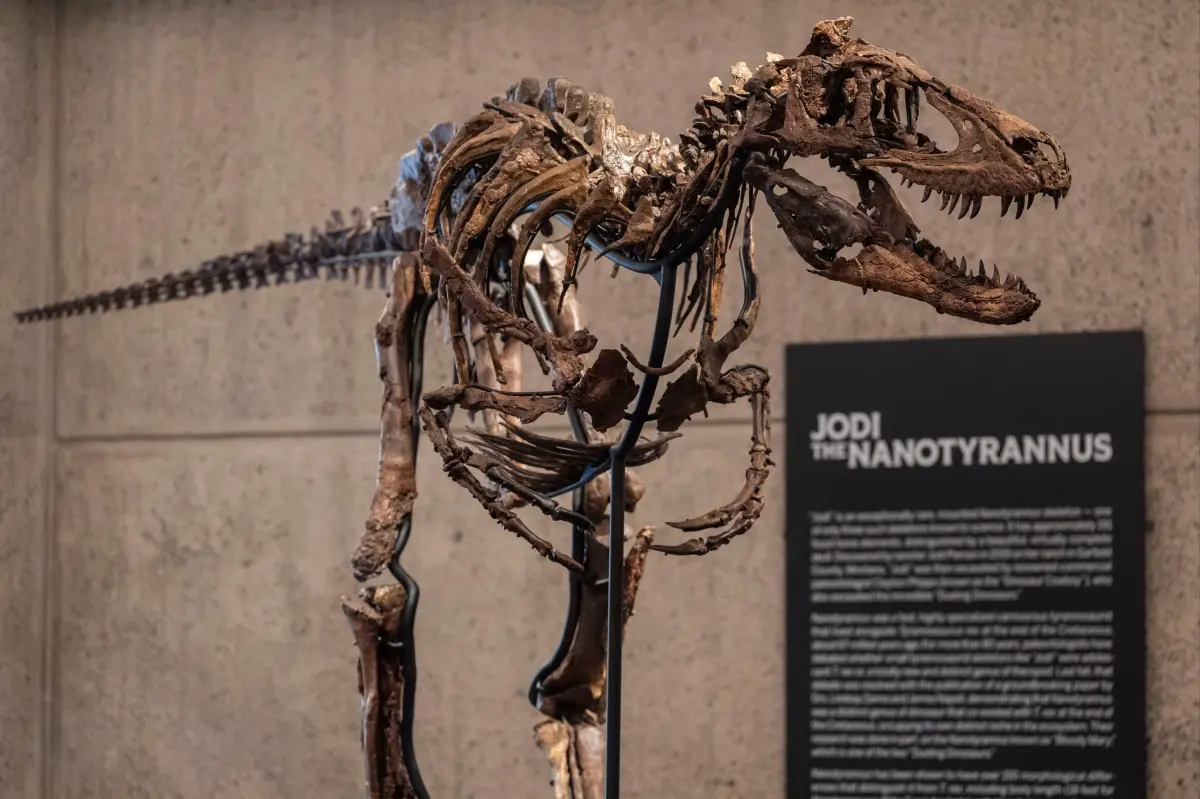
On Tuesday evening, in a crowded salesroom at Sotheby’s in New York, a creature from 67 million years ago did what many living things could never do: it stopped a room full of strangers and made them hold their breath. The skeleton, nicknamed “Jodi,” is a rare Nanotyrannus—a dinosaur that looks like a miniature T. rex, with a smaller body but a fierce, toothy grin. Auctioneers had expected the bones to sell for something between six and nine million dollars. When the bidding finally ended, the price had climbed to $47.3 million, an astonishing sum that left even seasoned specialists stunned. The buyer, one of six people who competed online and by telephone during the roughly twelve-minute sale, chose to remain anonymous. That single bid made Jodi the second most expensive dinosaur fossil ever sold, surpassed only by “Gus,” a T. rex that went for $50.1 million at Sotheby’s this past summer. It was a surreal moment, the kind of scene where ancient history and modern wealth collide. But beyond the money, beneath the gilded chandeliers, what happened was also deeply human: a group of people became so captivated by a set of bones that they fought to bring them home.
What, exactly, did they buy? Jodi is a member of the genus Nanotyrannus, a name that means “dwarf tyrant.” For decades, paleontologists argued over whether these dinosaurs were truly their own branch of the family tree or simply young T. rexes that had not yet grown into their enormous bodies. Just last year, however, new research concluded that Nanotyrannus was a distinct dinosaur genus—a distant cousin of T. rex, not a juvenile version. Jodi lived during the Cretaceous period, around 67 million years ago, at a time when she shared the ancient landscape with her larger, more famous relative. But she was no small copy of that giant. Nanotyrannus was only about half the length of an adult T. rex, with longer forelimbs, larger hand claws, and thinner, blade-like teeth. Jodi herself stood about 6.5 feet tall at the hip and stretched nearly 20 feet from nose to tail. To paleontologists, she is a treasure beyond measure: one of only three Nanotyrannus skeletons known to exist, and one that is almost 70 percent complete. That level of preservation is remarkable. She is not a few scattered bones or a fragment of a jaw. She is a nearly intact story, a dinosaur who walked, hunted, and breathed during the last few million years of the age of dinosaurs.
The scientific significance of Jodi cannot be overstated. For years, researchers were divided: with so much overlap between Nanotyrannus and T. rex, perhaps the smaller skeletons were simply babies that would have changed dramatically as they aged. Maybe those long arms and sharp, slender teeth would have shortened and thickened as the animal grew into a massive T. rex. But the latest study pushed against that idea, showing that Nanotyrannus has its own set of features that do not belong to the T. rex growth pattern. If that is true, then the world of the Late Cretaceous was even richer and stranger than we had imagined. Two tyrannosaur cousins lived side by side, each adapting to different ways of life. The larger T. rex may have been the heavy-hitting apex predator, while the smaller Nanotyrannus may have darted through the same ancient forests, hunting smaller prey with its unusually long arms and grasping claws. The debate over Jodi’s identity is more than just academic trivia. It changes how scientists picture the end of the dinosaur era, a time when the top predators were not a single monster but a whole family of related hunters, each with its own place in the world.
Behind this incredible fossil is an equally compelling human story. Jodi is named after Jodi Pierson, a Montana rancher who discovered the skeleton on her own land in 2019. It must have been a moment no one in the Pierson family ever forgot: walking across familiar ground and suddenly spotting bones that had lain hidden for tens of millions of years. From there, a team of professional fossil hunters took on the painstaking work of excavation, uncovering the skeleton with the care of surgeons. Their efforts were featured in the Discovery Channel series “Dino Hunters” in 2020, turning the discovery into a dramatic television story that introduced Jodi to the world. Sotheby’s, which displayed the skeleton at its upper Manhattan headquarters in the weeks before the sale, made a point of thanking that team. Cassandra Hatton, Sotheby’s head of science and natural history, said their hard work and commitment to preserving the specimen “has helped bring us to this moment, a testament to the fact that we can all make major contributions to science.” The words are remarkably true. A rancher’s sharp eye, a fossil hunter’s patience, a documentary crew’s curiosity, and an auction house’s resources all came together to bring an ancient animal back into the light. Whatever one thinks of the sale itself, the journey from a Montana field to a New York auction podium is a story of human dedication and awe.
Still, not everyone is celebrating. Many scientists have long opposed the private sale of important fossils, and Jodi’s auction is a painful reminder of why. A fossil of this rarity, they argue, is not a luxury item. It is a scientific document, a piece of the Earth’s deep history that belongs to all of us. When such a specimen is sold to an anonymous buyer, researchers may lose the ability to study it. The public may never see it again. Jodi is one of just three known Nanotyrannus skeletons, and she is by far the most complete; placing her in a private collection could mean the loss of a critical piece of the dinosaur family tree. Museums, universities, and scientific institutions often cannot compete with private buyers willing to spend tens of millions of dollars. At the same time, there is another side to the story. The enormous price tag could encourage more landowners to report fossil discoveries instead of hiding them or bulldozing them. It rewards the rancher and the fossil hunters who brought Jodi to public attention. And in an age when science is often underfunded, big auctions bring dinosaur research into the headlines. But for many paleontologists, the risk is too great. They have seen important fossils disappear into private galleries, rare bones locked away in bank vaults or living rooms, where no student will ever study them and no child will ever gaze up at them in wonder.
In the end, Jodi has become more than a collection of bones. She is a symbol of everything we love, and fear, about the deep past. She was once a living, breathing animal, a small tyrant who roamed a world of giant ferns and ancient rivers, hunted and was buried in the earth, then slowly turned to stone. She waited 67 million years before a rancher named Jodi Pierson discovered her. She was dug out by fossil hunters, studied by experts, filmed by documentarians, shown to the public in Manhattan, and finally sold for nearly fifty million dollars to a stranger whose identity remains a mystery. That is an extraordinary arc for any creature, dead or alive. Some people will say the sale was a shame; others will call it a marvel. But one thing is certain: Jodi has not been forgotten. She has captured the imagination of the world, and she forces us to ask an uncomfortable but beautiful question: what is a fossil actually worth? Maybe no dollar amount can truly answer that. Maybe the worth is not in the price at all, but in the fact that so many people stopped, stared, argued, and dreamed over her bones. If the buyer ever lets scientists continue to study her, and if the public is ever allowed to see her again, then Jodi will do what she was always meant to do: teach us about a lost world, and remind us how much more there is still to discover.