


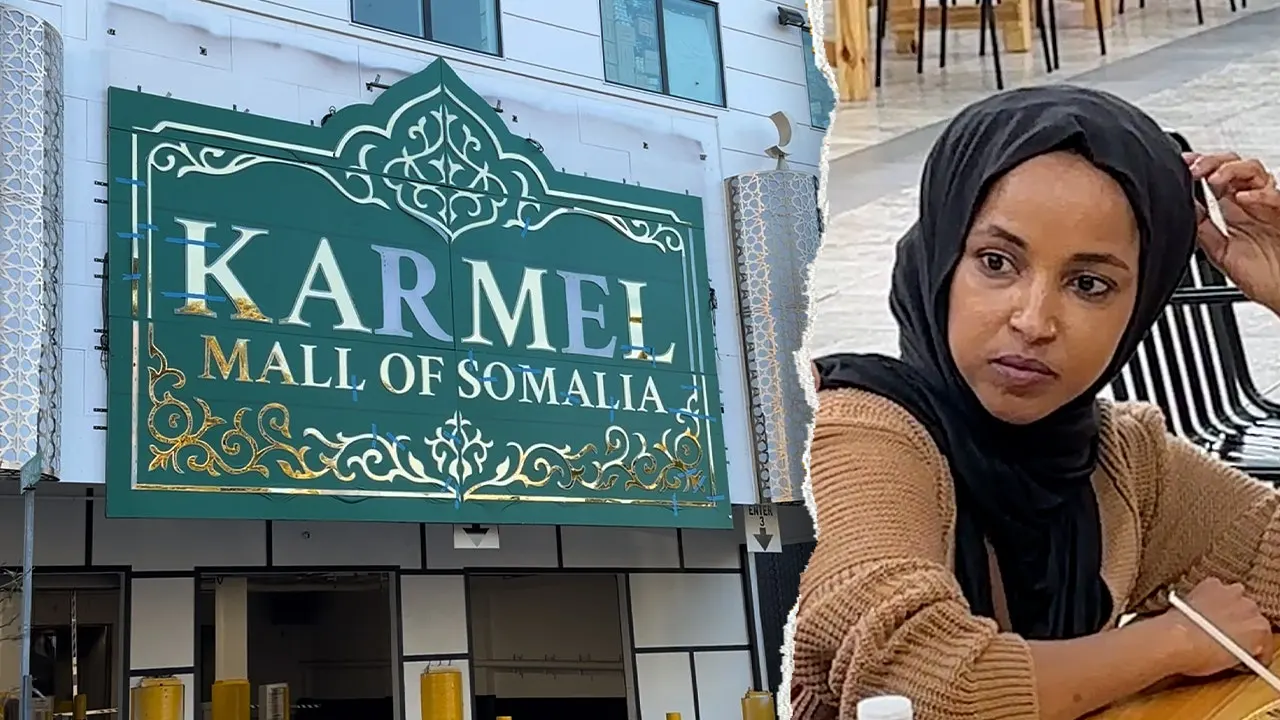
On a brisk Minneapolis afternoon, inside a sprawling commercial building on Lake Street, the sound of lifting metal doors echoed through a maze of aisles—a familiar morning ritual at the Karmel Mall, which its owner proudly calls the largest Somali mall in the world. Shopkeepers arrived at their stalls, tugging garage-style doors upward to signal they were open for business. There are no anchors, no department stores, no glossy food court chains. The structure, four floors and nearly 900 vendor spaces, feels more like a warehouse converted into a bazaar, a place where commerce runs on its own rhythm and schedule. On this particular Friday, however, the mall was not just a commercial hub but a political stage. Rep. Ilhan Omar, D-Minn., spent a significant part of her day there, marking her first public appearance since the Oct. 12 raid on her Washington, D.C., home. She came not to make a speech or hold a press conference, but to sit down for lunch among friends in the Somali community, joined by Minnesota Attorney General Keith Ellison. In the dining area, the flags of Somalia, Palestine and the United States hung together at equal height. Above, a light-blue ceiling emblazoned with a white star echoed the Somali national flag. It was a small but deliberate symbol of a place that is at once deeply rooted in a faraway homeland and undeniably American, even as it stands in the shadow of the Mall of America, the largest mall in the United States, located just a short drive away in nearby Bloomington.
The mall defies easy expectations, and a stroll through its corridors reveals a world designed less for window-shopping than for daily life. In Somali cafes, cooks prepare sambusas—flaky fried pastries stuffed with seasoned meat—alongside bijaye, a fried cornmeal snack resembling a hush puppy or falafel. Heartier plates of goat meat and basmati rice steam on trays, filling the air with the scent of cumin, cardamom and slow-cooked onions. Many diners eat with their hands, a traditional practice, though Omar and her companions used forks during their Friday meal. The mall’s businesses cater to a community that lives with one foot in Minnesota and another in East Africa. Storefronts sell prepaid SIM cards for overseas calling. Money transfer shops, including World Direct Link Corp., advertise simple ways to send remittances to Somalia, Kenya and other East African nations. Travel agencies arrange flights to the Middle East and East Africa. Traditional clothiers display colorful fabrics and garments, while Somali barbers cut hair in cramped shops that also serve as neighborhood gathering places. English, for many visitors, is a second language. Along the open walls, elderly men in traditional clothing and brimless white caps called koofiyad sit silently in metal chairs, watching passersby with quiet, distant eyes. The mall does not adhere to a strict opening or closing time; merchants come and go as they choose, their metal doors groaning throughout the day. It is not a place for tourists, exactly—outsiders, especially those with cameras, are watched carefully by security guards and patrons alike. But it is unmistakably alive, humming with the energy of people building something from the ground up.
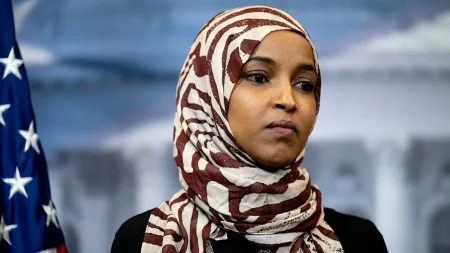
Omar’s presence brought an air of ceremony to that daily hum. She was greeted by smiling patrons, some of whom stopped to embrace her, chat briefly, or pose for photographs. She and Ellison moved through the building surrounded by security guards—a reminder of the tensions that have followed the congresswoman. Earlier in the day, the two had voted early at a Minneapolis polling station, and now they were settling in for a quiet lunch in the mall’s dining area, where the Somali, Palestinian and American flags flew at the same height. The lunch was a small show of solidarity at a moment when Omar’s political world has been shaken. The Oct. 12 FBI raid on her Washington home has cast a shadow over her public schedule, and Republicans, including former President Trump, have continued to attack her. Adding to the scrutiny, sources familiar with the criminal investigation into the congresswoman have said that her “real name” is Ilhan Nur Said Elmi, a detail that has become part of the noisy political battle around her. Yet inside the mall, none of that noise seemed to penetrate. She was treated not as a controversial figure but as a neighbor, a guest, a daughter of the community. Sabri, who is friends with Omar and knew her late father, posed for a photograph with her, Ellison and a fourth man. Earlier in the week, Sabri had told Fox News Digital’s cameras to stand down as reporters walked the mall, an acknowledgment that the space’s insularity is carefully guarded. But for Omar, the doors were open.
The man presiding over all of this is a study in contradictions. Basim Sabri, the mall’s Gaza-born owner, grew up poor in the Middle East and later moved to Minneapolis to study. He has since built a vast real estate empire, owning not only the Karmel Mall but also several apartment complexes in the vicinity of Lake Street, occupied mostly by Somali families. He is a jovial, commanding figure—constantly directing employees, taking calls, greeting passersby. Members of the Somali community stop to shake his hand; everyone seems to know him. He has the ear of local politicians, though he describes them in crude terms, repeatedly calling them “whores” during informal conversations. He once banned Minneapolis Mayor Jacob Frey, a Democrat, from the mall after Frey vetoed a City Council resolution calling for a ceasefire in the Israel-Gaza conflict. Sabri is unapologetically political, unapologetically blunt, and unapologetically proud of his creation. “You are standing at the Karmel Mall,” he told Fox News Digital, “and the surrounding community next to us, and it’s referred to as the Islamic Peace Village by many other people as well. Karmel Mall is the largest Somali mall in the world, and it’s also the largest mall in the city of Minneapolis.” He described the mall as “an incubator setting where many businesses start in here, and then many succeed and grow and move somewhere else, to a bigger space.” It is a declaration of economic self-determination, an immigrant’s monument to the hard work of starting over in a new country.
But Sabri’s story is not without its darker chapters. In 2005, he was sentenced to 33 months in federal prison for bribing a local Minneapolis public official. He spent time, by his own telling, at the Federal Correctional Institution in Leavenworth, Kansas—an infamous name in American corrections—and he speaks of the experience almost boastfully. That past hangs over him, but it has not diminished his standing in the community or his ability to move in political circles. He arranged an interview for Fox News Digital with Minneapolis City Council Vice President Jamal Osman, evidence of his access and influence. During a lengthy informal conversation outside the mall, he was interrupted constantly: an employee needed direction, a Somali elder wanted to greet him, a man described as Rep. Omar’s “security” came by. Sabri handled each interruption with ease, all the while weaving stories about growing up poor, building his empire, and sending his son to Institut Le Rosey in Switzerland—known as the “School of Kings”—with a yearly price tag of about $184,000. The contrast was stark: a man who spent time in federal prison and who presides over a working-class immigrant bazaar, yet who educates his child among royalty. He was, in his own way, living proof of the American dream’s messy, unpredictable arc. Members of the Somali community stopped to greet him during the conversation, and he solicited conversations with passersby, all of whom recognized him. He is clearly well-liked by his staff and known throughout the neighborhood, a larger-than-life figure in a place that thrives on personal connections.
Underneath the bravado, Sabri is keenly aware of the accusations that have been leveled against the Somali community in Minnesota—the massive fraud scandals that have made national headlines and cast a long shadow over the state’s Somali population. “Yes, there’s some crooks in every society,” he said, “just like every other community.” But he insisted that those stories do not define his people. “My experience is that Somalis are very, very intelligent and extremely hard-working people.” He argued that the mall, despite its insular appearance, is evidence of assimilation rather than separatism. “You can see Somalis not only integrating in the community, but also prospering,” he said. “Somalis are very smart business individuals.” He invited outsiders to come and see for themselves: “I would invite anybody to come into the mall, and know that there are many people doing a great job and making a good living, and learning the American dream, and doing business, and opening businesses that eventually tend to be very successful for them.” Whether or not that invitation is accepted, the Karmel Mall stands as a singular American institution—a place where a besieged congresswoman can share a meal, an ex-convict can play the role of statesman, and 900 vendors can lift their garage doors each morning to try, once again, to build something lasting. The flags above the food court flutter together in the open air: Somali, Palestinian, American. It is a complicated, deeply human tableau, full of contradictions and hope, and on that Friday afternoon, it offered a rare moment of warmth in the middle of a very public storm.