


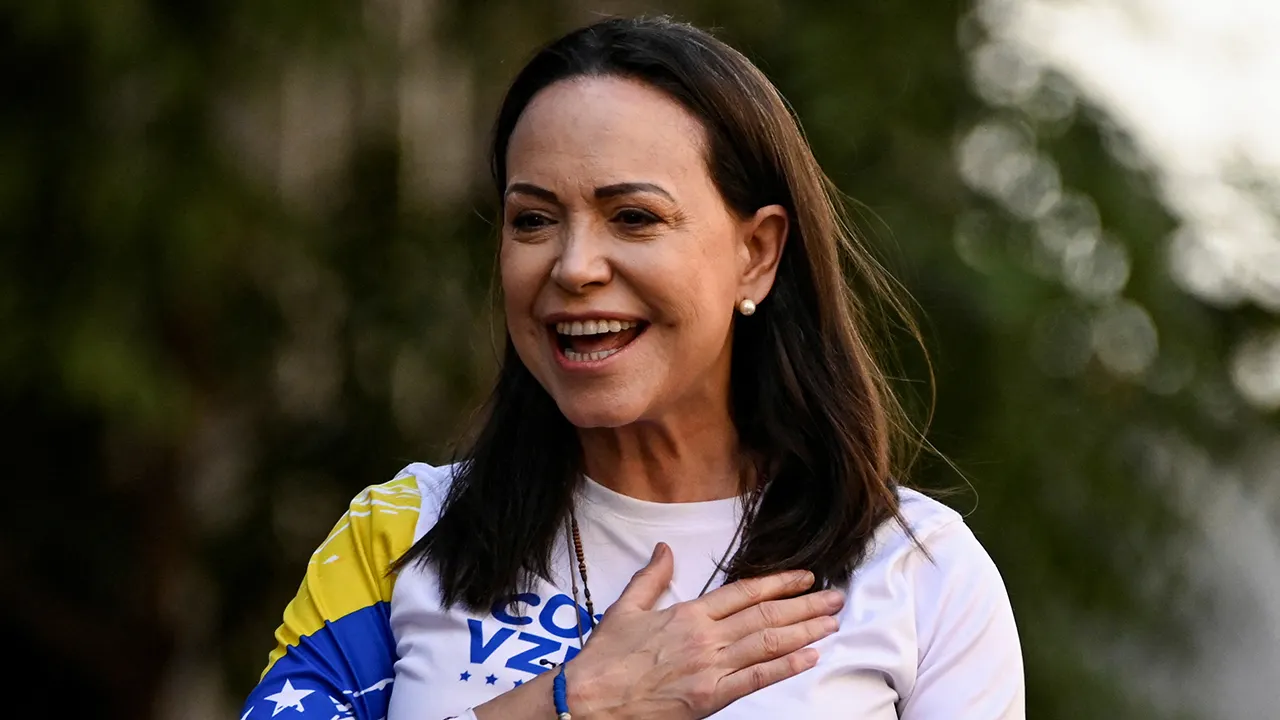
On a Sunday that felt suspended between grief and expectation, María Corina Machado stepped back onto Venezuelan soil and immediately claimed her place in a country that has become almost unrecognizable in her absence. “I’m here. With you all,” she wrote, and those seven words were enough to send a shockwave through a fractured nation, from the exile cafés of Miami to the barrios of Caracas, where people have learned to expect that the ones who leave do not always come back. Machado had been abroad since December, when she secretly resurfaced in Norway after months in hiding to accept the Nobel Peace Prize, an honor the world gave her for leading a nonviolent movement against Nicolás Maduro. But in the months she was gone, Venezuela itself had been upended. The United States had captured Maduro, an act that removed the dictator from power but left a strange and uncertain arrangement in his place. The country is now governed by acting President Delcy Rodríguez, a longtime Maduro loyalist, who has the backing of President Donald Trump and no election on the calendar to challenge her. Machado’s homecoming, then, is not a return to a liberated democracy. It is a return to a political twilight zone, where the old enemy is gone but the architecture he built remains standing, and where the woman who once stirred millions to defy a tyrant must now decide how to confront a new order that claims to be friendly while still refusing to let the people choose their leaders. She did not disclose her exact location or say how she got home, and that secrecy was itself a reminder that the struggle has not ended. Another opposition leader, Edmundo González, who ran for president in 2024 after Machado was barred from the ballot, confirmed her arrival on social media and promised to join her “very soon.” Together they now face the central question that has haunted Venezuela for years: how to turn a movement’s moral force into lasting political power in a place that has yet to hold a free and fair election.
President Trump learned of Machado’s return while in Port Huron, Michigan, and responded in terms that were alternately dismissive, affectionate, and revealing. “I don’t know anything about it, but I think she’s a very nice woman. She gave me her Nobel Prize. So how can I say anything else? And I hope she’s safe. She’s a very nice woman. But we’re doing really well in Venezuela.” The remark, delivered with the rambling candor that has become characteristic of Trump, exposed a tangled web of relationships. Machado, a fierce opponent of Maduro for years, received the Nobel Peace Prize in 2025 for her peaceful opposition, and by giving the medal to Trump, she was perhaps acknowledging the political reality that the U.S. president had intervened in Venezuela in a way no one else had dared. Yet Trump’s focus was not on democracy or elections. It was on his administration’s transactional success: opening Venezuela’s oil reserves to American business, striking agreements to bring barrels to U.S. refineries, and stabilizing a country that had collapsed under years of socialist mismanagement. “We’re doing really well in Venezuela” is the phrase of a man who measures progress in barrels, not ballots. For Machado, that phrase is at once comforting and alarming. On one hand, U.S. intervention ended Maduro’s brutal rule. On the other, the replacement, Delcy Rodríguez, is still a product of the old regime, and the administration’s insistence that it is too soon to think about elections is a direct challenge to everything Machado has spent her life believing. Her return, in that context, is not a celebration but a confrontation with the very people who were meant to be her allies.
To understand what Machado’s return truly costs, one has to retrace the harrowing itinerary of her recent life. After she was prohibited from running in the 2024 presidential election, her movement turned to Edmundo González, a disciplined diplomat who accepted the thankless task of representing the opposition from the campaign trail. The Maduro regime knew that even a stand-in candidate could become a lightning rod, and it responded with arrests and intimidation. Machado herself was briefly detained in January 2025 after an opposition protest, and after that she simply vanished from public view. For much of the year, she lived in hiding, moving between safe houses, relying on a network of ordinary citizens who risked imprisonment to keep her alive. She eventually slipped out of the country, a secret exit that must have felt both like a rescue and a second exile. In December she appeared at the Nobel ceremonies in Norway, a woman worn thin by months of stress but still unbroken. That act—accepting the world’s most prestigious peace prize in a cold, quiet Scandinavian landscape—was a redefinition of her leadership. She returned to public view not as a guerrilla, not as a revolutionary, but as a stateswoman of civil resistance. Still, a Nobel Prize cannot rebuild a country. It cannot schedule an election, cannot disarm a paramilitary group, cannot convince Washington to withdraw its support for an unelected interim president. When González wrote that her arrival marks a “very important day for Venezuelans” and promised to join her “until the end,” he was speaking to a movement that has learned to survive on promises and symbols. Machado herself gave no details about her location or her method of return, and that ambiguity is itself a reminder that the danger has not disappeared simply because Maduro is now in U.S. custody.
The political terrain Machado is stepping back onto is full of traps. Ten months ago, U.S. forces captured Maduro, yanking the longtime leader from power with an operation that stunned the hemisphere. But rather than handing power to the opposition, the Trump administration invested its trust in Delcy Rodríguez, Maduro’s former vice president, who has remained the acting president with Washington’s blessing—even though she has long exceeded the period she was initially authorized to serve. Trump has praised her repeatedly, touting agreements that have brought American companies into the Venezuelan oil industry, including access to an estimated 65 billion barrels of reserves, and promising that these deals will eventually slash gas prices for U.S. consumers. The economic logic is undeniable, and there is something perverse about it: the United States, which spent years trying to suffocate the Maduro regime with sanctions, now finds it convenient to keep one of his top lieutenants in charge, as long as she opens the country’s natural resources to American capital. In September, Trump said it was too soon to consider holding democratic elections, with U.S. officials prioritizing economic stabilization over political transition. Machado and her allies have pushed back, insisting that there can be no legitimate stability without a vote. Meanwhile, a faction of the opposition and Rodríguez’s government held another round of talks this month centered on reforms to the Supreme Court and electoral authorities ahead of eventual elections. Machado’s political movement has not participated in those negotiations, and her refusal to engage was already a statement. The friction finally became visible in June, when Reuters reported that U.S. officials had asked Machado to delay her return. She refused, and her decision to ignore that request is perhaps the most consequential political act she has made since coming home. It tells Washington that she will not be managed, that the Venezuelan opposition is not a branch of U.S. foreign policy, and that genuine democracy cannot wait for a foreign patron or an acting president to decide that it is convenient.
But beyond the politics, the diplomacy, and the oil deals, there is the human scale of this homecoming, and it is here that Machado’s story touches the lives of ordinary Venezuelans. To return to a country after exile is to reencounter the smell of the earth after rain, the voices of street vendors, the particular weight of the afternoon sun. It is also to emerge from hiding and face the eyes of people who have lost husbands, sons, sisters, homes. For many Venezuelans, Machado is not simply a politician; she is the vessel of their own stubborn hope. When she said, “I’m here. With you all,” she was not just announcing her location. She was telling millions of people scattered across six continents that they still exist, that their struggle was not erased by exile, that the country they carry in their memories is still worth fighting for. There is an emotional hazard to this kind of return, too. A leader who has been celebrated at Nobel ceremonies, who has sat with statesmen and received international honors, can easily become detached from the raw suffering of her own people. Machado, by all accounts, has tried not to let that happen. Her social media messages are disciplined and defiant, but the threads of weariness run through them. She knows that the same people who welcome her home today could be disappeared tomorrow, that the phone in her hand could be monitored, that the roof over her head could be borrowed from a family that has already been punished once for its loyalty. The fact that she came anyway, under those conditions, is the most human thing about her. It is the choice of a woman who understands that leadership is not about awards or interviews, but about showing up, in the flesh, among the people who trusted her enough to risk everything themselves.
Venezuela, then, remains a country in search of a destination. For a brief moment, the capture of Maduro seemed like an ending, the final page of a long night. But endings in politics are rarely real; they are simply shifts in the point of view. The transition has now settled into a kind of waiting room, with an acting president who cannot indefinitely govern without legitimacy, and an opposition leader who has refused to wait in line. Machado’s return is a gamble. It could destabilize the fragile economic arrangements that Washington has brokered. It could antagonize a man in the White House who prefers to be told that things are going well. It could invite the kind of reprisals that forced her into hiding in the first place. And yet, it is also the most coherent statement of principle the opposition has made in years. By returning when she was asked to stay away, Machado has made clear that her loyalty is not to the international community, not to a political deal, but to the Venezuelan citizens who have never stopped calling for democracy. She has not presented a detailed plan for elections, nor has she solved the contradiction that her own movement is split between those willing to negotiate and those who insist on resistance. What she has done is to stand in the middle of the road, quietly, once again, and say: here I am. The story is not finished. Tens of millions of Venezuelans at home and abroad are watching her, waiting for the next sentence. And the woman who gave away a Nobel Prize, hid in the shadows, and refused to be delayed, is apparently ready to write it, one dangerous, hopeful day at a time.