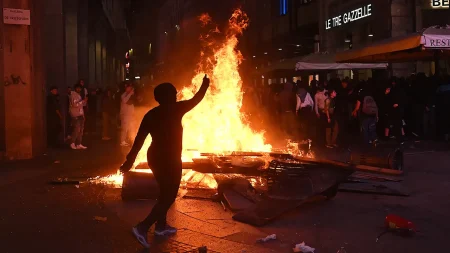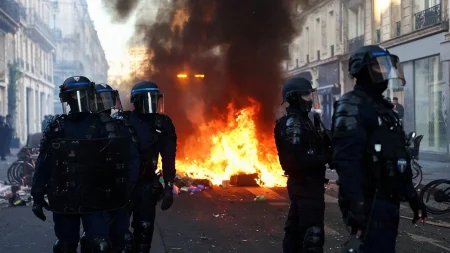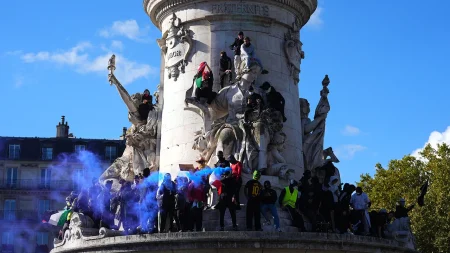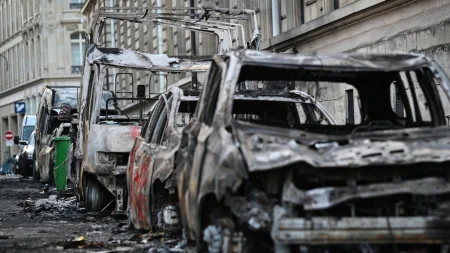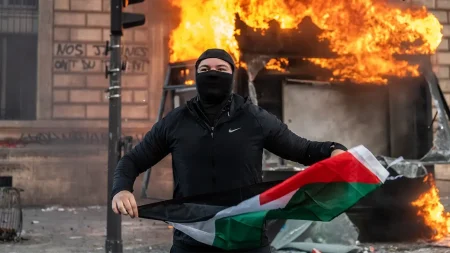



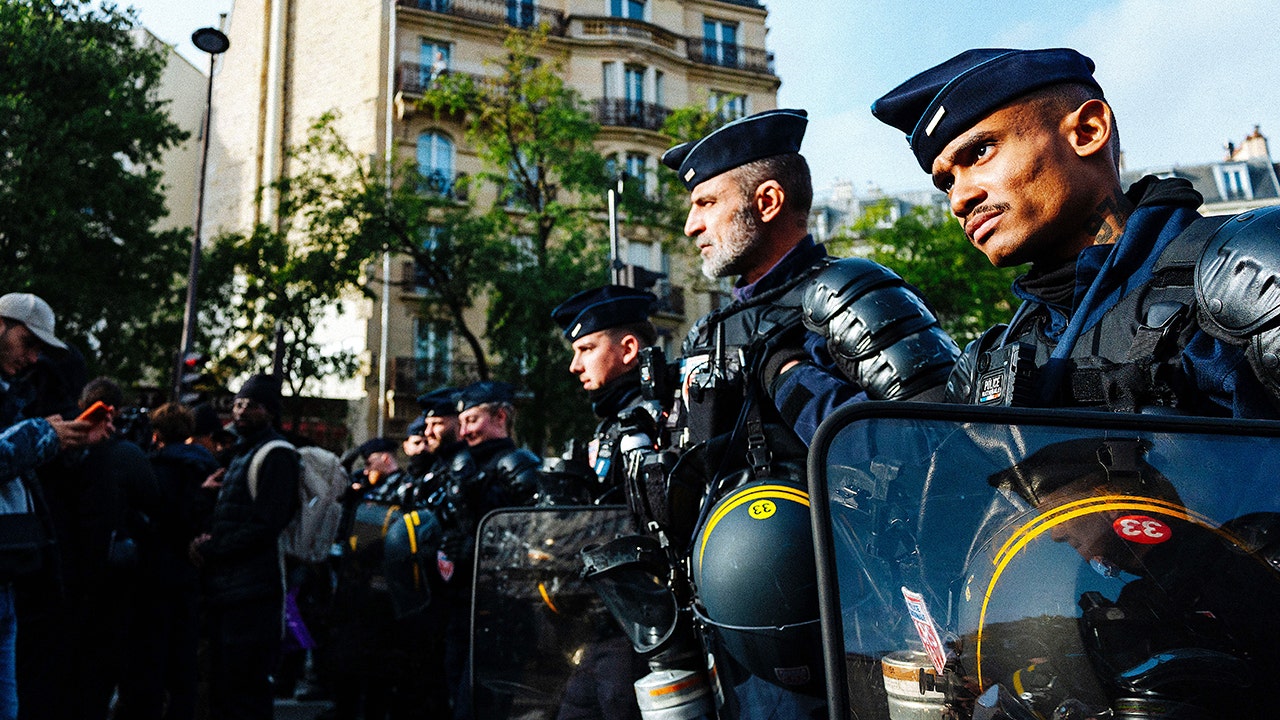
France woke up on Friday to a dangerous new mix of fear and anger. A suspected terrorist attack in Trappes, a town just west of Paris, had shattered the morning calm, leaving one person dead and four others wounded, including a twelve-year-old girl. Within hours, the country was bracing for another weekend of turmoil, with President Emmanuel Macron’s government deploying an overwhelming show of force—seventy thousand law enforcement officers, helicopters circling overhead, armored vehicles rolling into strategic positions, and water cannons ready—to prevent the kind of violent protests that had swept through the nation just seven days earlier. The mood was not simply tense; it was electric with dread. Families who had planned quiet weekends in the capital suddenly wondered whether it was safe to take the Metro, visit a museum, or even walk through their own neighborhoods. Shopkeepers boarded up windows, not because they expected a storm, but because they had seen what happened before. The authorities, too, were on edge, acutely aware that a single spark could turn a demonstration into a battlefield. In this atmosphere, every announcement felt heavy with consequence, and ordinary citizens were left trying to make sense of a country that seemed to be sliding from crisis to crisis, with no clear end in sight.
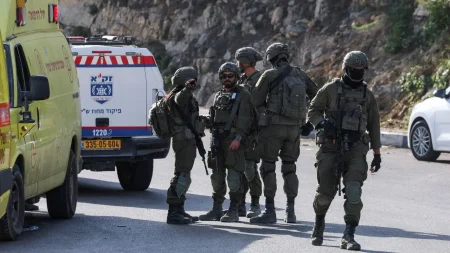
The attack in Trappes was particularly unsettling because it seemed so random. According to police and local officials, a 39-year-old man opened fire from a vehicle, apparently targeting people without any clear pattern or logic. At first, authorities described it as a “relatively random” shooting, a phrase that offered little comfort to a public already worn down by violence. But as the day went on, the picture darkened. Interior Minister Laurent Nuñez told local media that the motive “may be racist” and that, while the investigation was still ongoing, “this is clearly a terrorist crime.” The mayor of Trappes added that the dead victim and at least one of the wounded were “of African origin,” a detail that stoked fears of a racially motivated attack in a country already struggling with deep social divisions. For the community, the shooting was a brutal reminder that tragedy could strike anywhere, anytime, and without warning. A twelve-year-old girl wounded on her way to school or while running an errand is every parent’s worst nightmare made real. President Macron, speaking to the nation, tried to offer some solace, saying that “the nation is standing with” the victims of this “terrible ordeal.” But words, however sincere, could not erase the image of a gunman firing into a crowd, nor the unsettling thought that this attack might be connected to the broader wave of unrest now rolling across France.
Faced with this escalating crisis, Macron’s government adopted a strategy of maximum control. The president cancelled his planned trip to Nigeria and Senegal, a clear signal that he understood the gravity of the situation and would not be seen as fleeing while his country burned. His message was blunt: protests requested by individuals or groups with “no legitimate authority” would be banned. “The rules are simple, and I think they’re just common sense,” he said, urging that there should be no demonstrations in the coming days. For trade unions that did submit formal requests, he promised that prefects would examine them according to the law, but with a crucial caveat—alternative routes would be proposed to keep protesters away from city centers, businesses, and public buildings. It was a careful balancing act, trying to preserve the right to peaceful assembly while preventing the kind of chaos that had exploded the previous weekend. But for many ordinary French people, the government’s response felt less like reassurance and more like a siege. The sight of armored vehicles on the streets of Paris, normally a city of light and freedom, was jarring. The closure of the Louvre and the Musée d’Orsay, two of the world’s most beloved cultural institutions, was a symbolic wound. And the shutdown of twenty-four Metro stations across the capital made it clear that the authorities expected trouble, not just in the usual hot spots, but everywhere. The message was unmistakable: stay home, stay quiet, and wait for the storm to pass.
Beneath the official statements lay a deeper and more painful struggle over who speaks for the people and who is responsible for the violence. The Union Nationale des Étudiants de France, or UNEF, one of the country’s oldest and most respected student unions, refused to cancel its planned rallies, even though police had rejected their permit requests. Police had approved only one union demonstration in Paris, while denying requests from both UNEF and the “Yellow Vest” movement, the anti-establishment force that first emerged in 2018 and has never truly disappeared. This created an impossible situation: the government said it was defending public safety, but activists saw a crackdown on legitimate dissent. Macron, for his part, pointed his finger firmly at the troublemakers, blaming “ultra-left groups whose aim is to bring down the Republic.” He called the previous weekend’s violence “political and seditious acts,” words that sounded more like a declaration of war than a call for calm. Meanwhile, the police were caught in the middle, struggling to maintain order while feeling abandoned by the very state they were sworn to protect. Fabian Vanhemelryck, secretary general of the Alliance Police Nationale union, spoke bitterly about the political figures who, in his view, had made an already impossible job even harder. He criticized “those who excuse the inexcusable, justify violence and prefer to overwrite police officers rather than condemn those who attack them.” He described a state that “abandons its police officers in the face of increasingly uninhibited violence, while demanding that they accept, remain silent and continue to hold the line.” It was a grim portrait of a society at war with itself, where trust had broken down on every side—between citizens and the state, between protesters and police, between the government and the streets.
The disruption reached even into the world of sports and culture, which usually serves as a unifying force in French life. With the weekend approaching, officials made the difficult decision to close the Louvre and the Musée d’Orsay, not because of any specific threat, but simply because they could not guarantee safety. Twenty-four Metro stations in Paris would be shuttered, making it almost impossible for ordinary people to move around the city. The Ligue 1 soccer match between Paris Saint-Germain and Olympique Lyonnais, scheduled for Sunday night at Parc des Princes, was postponed to Monday evening—a move that disappointed millions of fans but was hardly surprising given the circumstances. Perhaps even more striking was the decision to keep the NFL game between the Pittsburgh Steelers and the New Orleans Saints at the Stade de France, just north of central Paris. The game was still set to be played, though some weekend events around it were cancelled, a compromise that reflected the strange new reality of life under the threat of violence. For anyone with a memory of French history, the Stade de France carried a particularly heavy weight. It was the same stadium where, on November 13, 2015, explosions were heard outside during an international soccer match between France and Germany, with then-President François Hollande in attendance. Fans were held inside for hours while terrorists attacked the city around them. Now, nearly a decade later, the stadium was once again at the center of a security crisis, and the echoes of that terrible night were impossible to ignore. For many, the postponement and closures were not just logistical inconveniences; they were reminders that terrorism and unrest can touch every corner of life, even the moments that are supposed to bring joy.
As France braced for Saturday, the country found itself at a defining moment. Macron’s government had promised to be “extremely vigilant, extremely firm,” and to let “absolutely nothing pass,” but that hardline stance alone could not solve the underlying anger that had driven so many people into the streets. The attack in Trappes, the memories of 2015, the wounded pride of the police, the relentless frustration of the Yellow Vests, the idealism of students who refused to be silenced—all of these forces were swirling together, threatening to consume the nation in a cycle of violence and recrimination. The government’s strategy of banning protests and closing public spaces was a desperate attempt to restore order, but it also carried a risk: pushing people indoors might only deepen their resentment, turning a crisis of protests into a crisis of trust. What France needed, beyond security, was a way to listen to the voices that felt unheard, to address the economic inequality, racial injustice, and political alienation that had been festering for years. But in the heat of the moment, with helicopters overhead and armored vehicles on the streets, such long-term thinking seemed almost impossible. What was left was a country holding its breath, hoping that the weekend would pass without further bloodshed, that the suspected terrorist would be brought to justice, that the protests would remain peaceful, and that life could slowly return to normal. The human cost was already high—a life lost, a child wounded, a community shattered, and a nation divided. And the coming days would test not just the strength of French institutions, but the resilience of the French people themselves, as they tried to find their way through the darkness without losing sight of who they were.