

1. A Small-Town Meeting Turns Violent
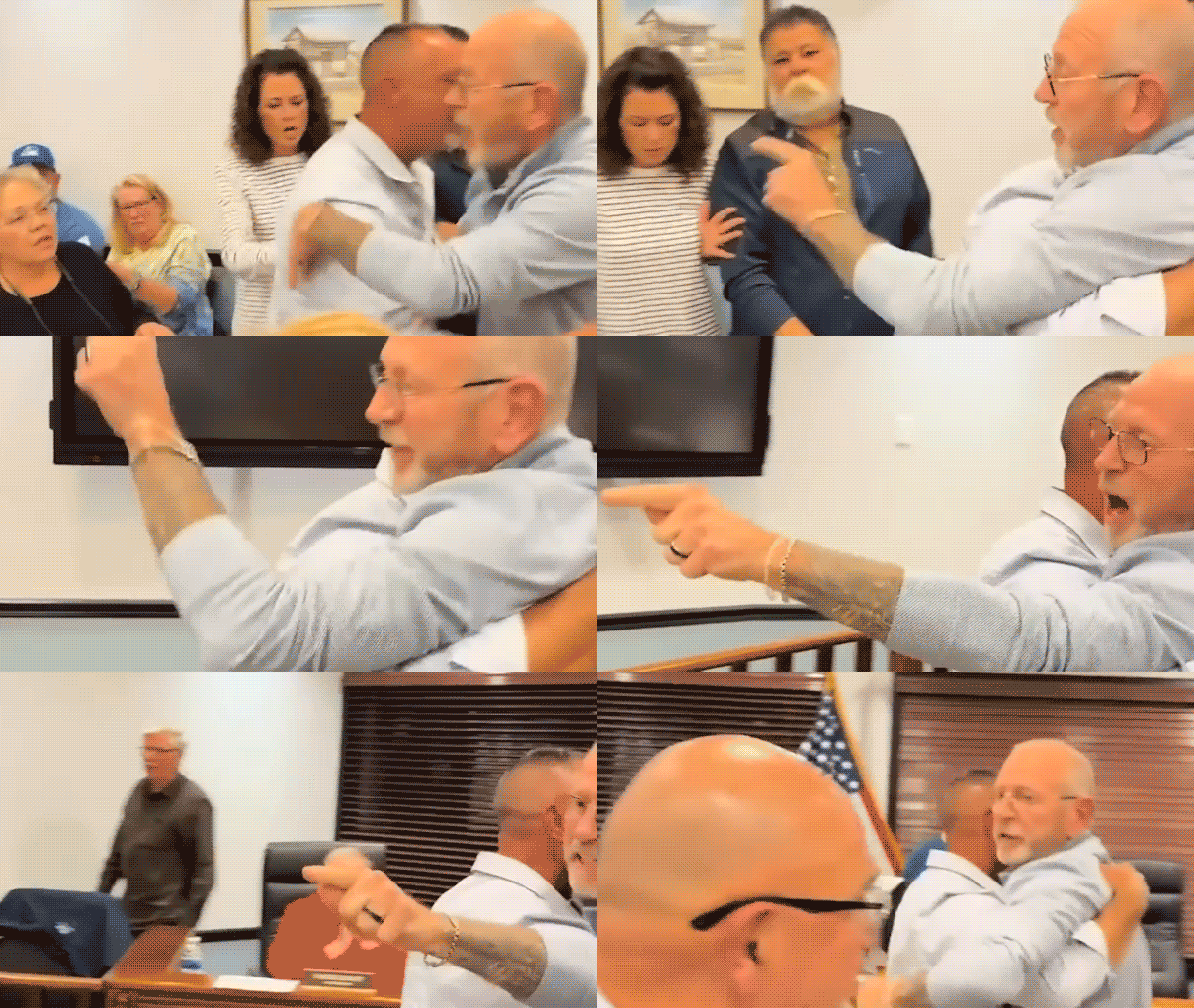
It was supposed to be a routine evening of local governance in Pemberton Township, New Jersey—the kind of modest civic gathering where residents voice grievances, council members nod along, and the agenda drifts between zoning ordinances and budget line items. But Wednesday night’s meeting shattered that expectation in a matter of seconds, leaving an entire community stunned by an eruption of raw anger that was captured on video and quickly spread across the internet. The footage shows Republican Mayor Matthew Bianchini, his face tight with fury, suddenly lunging toward a resident seated in the audience. For a moment, the room seems frozen in disbelief. Then chaos erupts: hands reach out, voices shout, bodies shift to block the mayor’s path. Several people physically restrain Bianchini, holding him back as he strains forward, his finger pointed and his voice sharp with menace. “I’m getting you,” he can be heard shouting, the words slicing through the noise of the chamber. The confrontation lasted only seconds, but its impact rippled far beyond the walls of the meeting room, raising uncomfortable questions about anger, respect, and the fragile boundaries that hold public discourse together. In the aftermath, the mayor himself acknowledged that something inside him had simply broken. “I just basically snapped,” he later admitted to reporters, his voice heavy with a mixture of regret and stubborn justification. “I hate to put it this way, but it’s a long time coming.” That moment of candor only deepened the mystery of how a public official, entrusted with the solemn responsibility of governing a community, could find himself in such an explosive and unseemly confrontation—and why so many residents felt that the explosion was not entirely unexpected.
2. The Long-Festering Grudge Behind the Explosion
To understand why the meeting erupted, one must look beneath the surface of the confrontation at the tangled history between the mayor and his sharpest critic. The resident at the center of the incident is Michael Sawka, a man well known to local officials as a vocal and persistent critic of Mayor Bianchini. According to WPVI-TV, Sawka had repeatedly challenged the administration, showing up at meetings to question decisions, demand transparency, and push back against policies he opposed. His presence had become a fixture at public gatherings, and the tension between him and the mayor’s office had been simmering for months, perhaps even years. On this particular night, the council chamber was already charged with emotion because a recently fired township employee had taken the floor to address the governing body. The employee’s remarks were likely to be pointed, critical, and deeply personal—exactly the kind of public rebuke that makes elected officials uncomfortable. But the flashpoint came not from the employee’s words, but from what Bianchini perceived as an attack on his family. The mayor and members of his family later told reporters that Sawka and another resident in the crowd had made rude comments directed at the mayor’s wife and daughter, who were seated near the back of the room. Whether those comments were audible, accurate, or deliberately provocative is now a matter of bitter dispute. What is certain is that Sawka made an obscene gesture toward the mayor shortly before the mayor charged. In the video, Sawka can be seen gesturing toward the back of the room—where Bianchini’s family was sitting—and then making a crude sign in the mayor’s direction. That gesture, combined with the perceived insults to his loved ones, proved to be the final straw. The mayor exploded, and in that instant, all pretense of civic decorum vanished, replaced by something far more primal: a man protecting his family’s honor at any cost.
3. The Mayor’s Lament: Anger, Regret, and Unwavering Defiance
In the hours after the dust settled, Mayor Bianchini did not hide from the cameras. He spoke openly about his actions, offering a strange mixture of chagrin and unapologetic defiance that revealed the inner conflict roiling inside him. On one hand, he recognized that his behavior was unacceptable for a public official. “I should not have said that,” he told WPVI, referring to the threats and profanity that flew from his mouth during the confrontation. “That was wrong. It was in the heat of the moment.” He also insisted that he never intended to carry through on his threats. “I’m not gonna get anybody,” he said, his tone oscillating between remorse and frustration. But then, in the very same breath, he defended the impulse that drove him forward. “Was it wrong? Absolutely. Was it justified? Absolutely. And I would do it again if I had to,” he declared, before adding the most revealing sentence of all: “Don’t attack my family.” Those words capture the emotional core of the entire incident. For Bianchini, this was not a political disagreement; it was a violation of a sacred boundary. In his mind, he was not acting as a mayor wrestling with a constituent over policy, but as a husband and father responding to an assault on his loved ones’ dignity. That distinction may not excuse his conduct, but it humanizes it. It explains why a man who had presumably weathered countless criticisms and personal attacks over the years finally reached his breaking point. The mayor’s inability to separate his public role from his private instincts is both understandable and deeply troubling. It is the very definition of human frailty—a reminder that even those who hold office are not immune to the emotional currents that sweep through everyday life. Yet it also raises the bar: if elected officials cannot control their impulses in the face of provocation, how can they be trusted to handle the far greater pressures of governing?
4. The Resident’s Account: Calm Denials and the Pursuit of Justice
On the other side of the confrontation stands Michael Sawka, whose version of events paints a very different picture. Sawka insists that he was not the aggressor, nor was he the one making crude remarks about the mayor’s family. “I’m just sitting there. I never got up. I sat there the whole time. I was calm the whole time,” he told WPVI in an interview that emphasized his own restraint. According to Sawka, he did nothing to provoke the mayor’s wrath beyond exercising his right to critique the administration. He denied making any comments directed at Bianchini’s wife or daughter, suggesting that the mayor had either misheard or invented the provocation to justify his outburst. Whether Sawka is telling the truth or shading it to protect himself is impossible to know definitively from the video, but his demeanor during the meeting—at least in the moments captured on camera—appears passive. He remained seated, his hands unthreatening, as the mayor rushed toward him. That visual of a sitting man facing the explosive charge of an angry official is a powerful symbol of the asymmetry between their positions. The mayor was not just an angry citizen; he was the most powerful figure in the township, a man with the authority of the office behind him. Sawka, by contrast, was a private citizen with no platform other than the public comment period. In the days that followed, Sawka moved quickly to turn the incident from a verbal altercation into a legal matter. He filed a municipal court complaint on Thursday seeking assault and terroristic threats charges against the mayor, according to WPVI. The move signaled that he was not willing to let the matter fade into a footnote of local political lore. He wanted accountability, and he wanted it under the full force of the law. For his part, the mayor now faces not only public embarrassment but the possibility of criminal prosecution, a turn of events that could have serious consequences for his political career and his personal freedom.
5. A Community Grapples with the Fallout
As the video continued to circulate, the wider Pemberton Township community began to grapple with what the incident meant for them. The Pemberton Township Democratic Club, representing the opposing political party, issued a measured but pointed statement calling for leaders who can “stay composed and professional.” The club’s message was carefully worded, urging residents to pay attention to the upcoming election, in which Bianchini is seeking to retain his position as mayor. The implication was unmistakable: if a mayor cannot maintain his composure in a public forum, he does not deserve the trust of the electorate. But the reaction was not purely partisan. Many residents, regardless of political affiliation, expressed discomfort with the spectacle of an elected official being physically restrained in front of the community. The image of the mayor being pulled away—his face twisted with rage, his voice cracking with fury—was not the picture of leadership that any town wants to project. It raised fundamental questions about the nature of public service in an era of heightened anger and incivility. Local government, by design, is meant to be the closest and most accessible form of democracy, a place where neighbors can disagree passionately without fear of violence or intimidation. When that space is violated, the social contract begins to fray. The police announced no immediate decision on whether they would pursue charges, leaving the matter in a legal limbo that only added to the uncertainty. For now, both the mayor and Sawka wait in the uneasy silence that follows every public scandal, each man convinced of his own righteousness, each one damaged by the encounter in ways that will not easily heal.
6. Reflections on Power, Provocation, and Civic Forgiveness
Ultimately, the confrontation in Pemberton Township is more than just a viral video or a local political scandal. It is a portrait of the fragile human emotions that underlie public life—pride, shame, love, fear, and the desperate need to be seen and respected. Mayor Bianchini’s outburst was an undeniable failure of judgment, a moment when the weight of accumulated grievances overpowered the restraint that his office demands. Yet his vulnerability, his admission of having “snapped,” also speaks to something universal: the limit of patience, the instinct to defend one’s family, the difficulty of remaining calm in the face of personal insult. Sawka’s response, meanwhile, embodies the growing demand for accountability—a reminder that words have consequences and that those in power cannot simply brush off their mistakes as isolated incidents. The real tragedy is that this encounter has likely hardened both sides, making future reconciliation more difficult. The trust that once held the community together, however imperfect, has been further eroded. In its place stands a cautionary tale for every elected official and every engaged citizen. The meeting room is a stage on which the drama of democracy is performed, but it is also a human space where tempers can flare and raw emotion can spill over. The work of repairing that space—rebuilding the norms of respect, processing anger constructively, and finding ways to disagree without hatred—is perhaps the hardest challenge of all. For Matthew Bianchini, Michael Sawka, and the residents of Pemberton Township, the path forward begins not with righteous declarations or legal complaints, but with the quiet, difficult work of understanding one another’s frayed nerves and wounded hearts. Whether that understanding comes too late remains to be seen. For now, the town must live with the images of that explosive night, pondering what sort of community they wish to be in the days—and elections—ahead.