

1. A Kansas Afternoon Interrupted by a Familiar Refrain
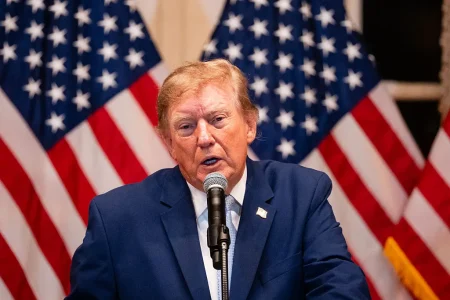
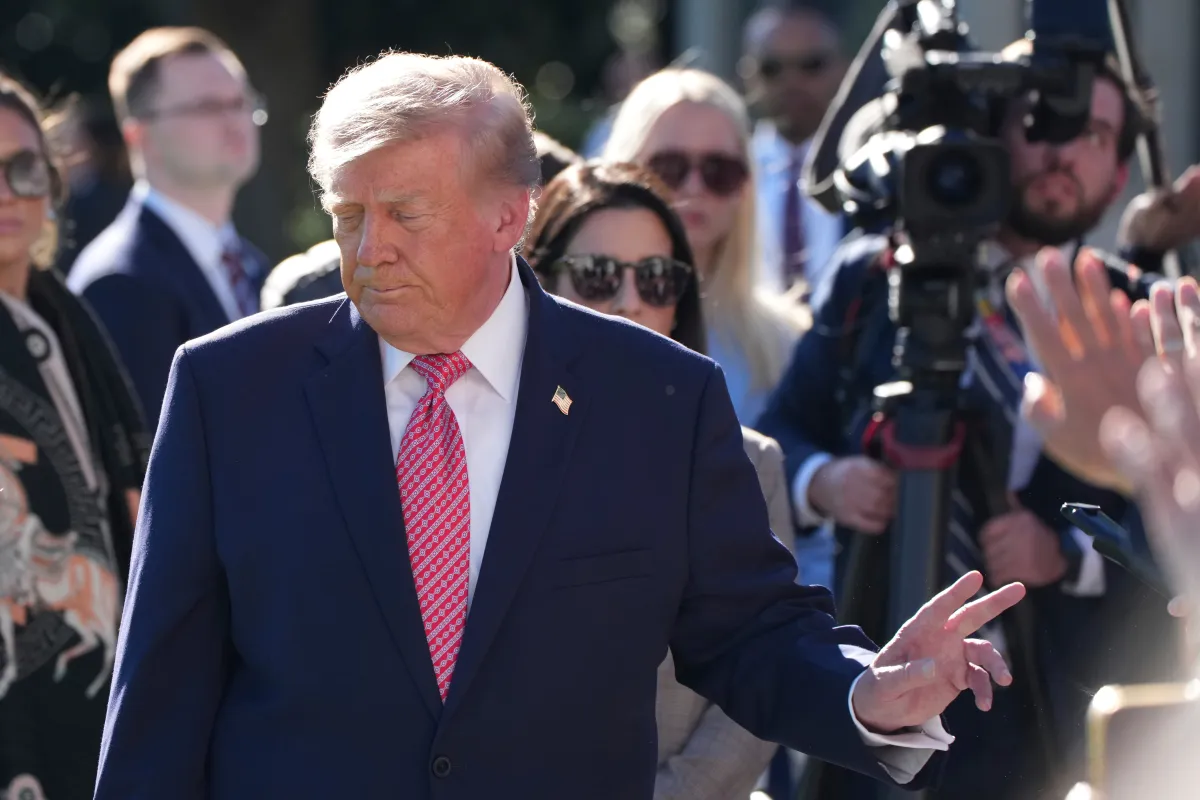
It was an unremarkable late-winter morning in Kansas, the kind of flat, wind-scrubbed landscape where American politics often feels both very far away and strangely immediate. President Donald Trump was preparing to address a rally of supporters, the kind of high-energy, adoring crowd that has become synonymous with his political identity. The air was thick with anticipation, a sense of event, the familiar hum of a political machine warming up. Before the stage lights and the roaring applause, however, there was the quiet, transactional ritual of the press stakeout—a few reporters, some cameras, the muffled shuffle of journalists hoping to catch the President’s ear for a moment, a question, a soundbite. On this particular Monday, a reporter from The Daily Wire, a conservative outlet that has often found itself in a complicated dance with the Trump orbit, stepped forward. She had a specific question, one drawn from the headlines of a distant but turbulent world: France was burning. Protests, riots, and civil unrest were sweeping through its cities, and French President Emmanuel Macron had reportedly made a striking admission—that the chaos was, at least in part, a consequence of the Iran war and, more pointedly, of Trump’s own influence on global politics. It was a provocative line of inquiry, one that invited the former president to engage with a foreign leader’s criticism. But before the question could fully land, Trump did what he has done thousands of times before in his decades in the public eye: he reached for the blunt instrument of dismissal. “I don’t think he is,” Trump interrupted, his voice carrying that familiar edge of defiance. “I think that’s fake news.” The words hung in the air, a reflexive rejection that had become as automatic as breathing, a defensive shield against a narrative he found inconvenient. Then came the follow-up, sharp and direct: “Who are you with?” It was a question that seemed to carry the weight of the entire modern media ecosystem, a president demanding to know which side of the partisan divide the person daring to ask him a difficult question belonged to.
2. The Complicated Crosswinds of a Global Crisis
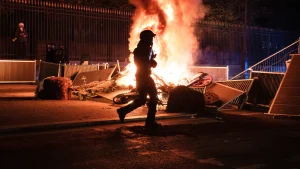
To fully understand the weight of the reporter’s question, one has to step back from the Kansas tarmac and look across the Atlantic to a France in turmoil. The images that had been flickering across television screens and social media feeds were not the postcard Paris of tourist imagination, but a cityscape scarred by smoke, broken glass, and the unmistakable tension of a society in the grip of deep political and economic frustration. The riots, which had erupted with a ferocity that caught many observers off guard, were not a single-issue outburst. They were a tangled knot of grievances—inflation, inequality, a pervasive sense of disenfranchisement, and a growing anger at the political establishment. President Macron, a man who has often cast himself as the great reformer of Europe, found himself facing the most severe domestic challenge of his presidency. In a moment of candor that is rare among world leaders, Macron reportedly attempted to diagnose the root causes of the unrest. He did not simply point to domestic policy failures or the weaknesses of his own governance. Instead, he reached outward, suggesting that the international climate—specifically the ongoing consequences of the conflict with Iran—and the disruptive shadow of Donald Trump had created a volatile cocktail that was now spilling into French streets. Whether Macron’s comments were a diplomatic jab, a strategic deflection, or a genuine geopolitical analysis is a matter of debate. But for the reporter from The Daily Wire, they represented a news hook, a chance to ask Trump directly how he felt about being implicated in the chaos of a close ally. It was, in many ways, the perfect question for a conservative-leaning outlet: an opportunity to elicit a reaction, to draw out Trump on a topic involving a rival leader, a foreign crisis, and his own legacy. But Trump’s initial response revealed a deep-seated instinct—to distrust any narrative that casts him in a negative light, especially one transmitted through the media, a institution he has spent years reframing as an enemy of the people. The phrase “fake news” has become a cultural touchstone, emptying his vocabulary of nuance and, in many cases, of truth itself.
3. The Media Ecosystem’s Surprising Pivot
Then came the crucial moment, a small but revealing pivot that spoke volumes about the modern political landscape. After Trump’s reflexive dismissal, the reporter did not retreat. She did not apologize or back away from her question. Instead, she answered his challenge directly, identifying her outlet: “The Daily Wire.” The name seemed to register in Trump’s mind with almost instantaneous effect. His demeanor shifted, almost imperceptibly at first, but unmistakably to anyone watching closely. The defensive frown softened, the combative set of his shoulders relaxed, and the president’s tone changed from one of dismissal to something approaching cordiality. “Oh. The Daily Wire’s good. Sorry.” It was a brief, almost offhand apology, but it was also deeply revealing. In that single sentence, Trump drew a clear line in the sand of his own media universe. There was, on one side, the so-called mainstream media—the outlets he had spent years vilifying as purveyors of lies, the enemy of the American people. On the other side were the conservative-friendly outlets, publications like The Daily Wire, which, while sometimes critical of him, were generally seen as part of the broader ecosystem of right-wing media that had become his most reliable bulwark against the world. The apology was not merely an admission that he had misjudged the reporter’s affiliation; it was an acknowledgment that his credibility assessment of a news organization was fundamentally based on its political alignment. For a journalist from a mainstream outlet, the question would likely have been met with a curt dismissal, perhaps another round of “fake news” accusations, or a complete stonewalling of the inquiry. But because The Daily Wire existed in a particular professional and ideological safe space, the question was suddenly legitimate, the reporter suddenly worthy of courtesy. It is a political calculus that transcends partisanship and reveals a deeper truth about how information is consumed and validated in our time: the messenger matters more than the message.
4. A Human Moment in the Theater of Politics
For all its political significance, the exchange was also a profoundly human moment, one that unfolded in the blink of an eye but carried the weight of years of accumulated experience. We often think of presidents as monolithic figures, their words carefully scripted, their actions calculated by handlers and advisors. But this interaction had the quality of an impromptu, almost instinctive performance. Trump’s first reaction was not thoughtful, not measured; it was a gut punch. He heard a question he did not like, from a voice he did not recognize, and his instinct was to attack. It is a defense mechanism that has served him well in the rough-and-tumble world of business and politics, where showing weakness is often mistaken for vulnerability. The question about Macron and France, after all, was not an attack, but it carried the potential for embarrassment, a suggestion that his actions on the world stage were contributing to instability. For a man who has always fiercely guarded his image as a master of strength and decisive action, such a framing was unacceptable, and so the first line of defense was to declare the premise a lie. But the moment the reporter identified herself as being from The Daily Wire, the calculus changed. This was not an enemy combatant; this was, in a sense, a friendly fire. The apology that followed—“Oh. The Daily Wire’s good. Sorry.”—was spoken with a tone of almost charming contrition, the kind of quick correction one might make when accidentally insulting a friend’s family member. It was a reminder that, beneath the bluster and the confrontational rhetoric, Trump is a man deeply attuned to the social dynamics of the room. He understands hierarchies, tribes, and loyalties. The apology was not just a matter of politeness; it was a professional gesture, an acknowledgment that in the media jungle, there are allies and there are prey. For the reporter, the moment was likely both awkward and validating—awkward to be the subject of such a public corrective, but validating to have her outlet’s credibility acknowledged by the most powerful man in the room. In that small exchange, the transactional nature of political journalism was laid bare.
5. The Larger Reflection on Journalism and Trust
Stepping back from the scene, the interaction offers a sobering reflection on the state of journalism and public trust in the democratic world. The exchange between Trump and the Daily Wire reporter was not merely a trivial news-cycle footnote; it was a microcosm of a much larger, more troubling dynamic that has come to define modern media consumption. We live in an era where the identity of a news outlet is often more important than the content of its reporting. The same factual story, reported by CNN and by The Daily Wire, can be greeted with radically different levels of trust and hostility by different segments of the public. Trump’s instantaneous apology upon hearing the outlet’s name was a perfect illustration of this phenomenon. He was not apologizing for dismissing a question; he was apologizing for failing to recognize his own side. In doing so, he reinforced the notion that “objective truth” is a chimeric concept, one that is always filtered through the lens of political allegiance. For journalists, this reality is both sobering and disheartening. The profession is built on the ideal of objectivity, on the belief that facts are facts regardless of who reports them. But the marketplace of ideas has increasingly become a battlefield of partisan tribes, where the primary goal is not to inform but to reinforce the preconceived notions of an audience. The Daily Wire, it should be noted, is a conservative outlet that has built a substantial following by offering a right-leaning perspective on news and culture. Trump’s comfort with the outlet was not necessarily because he believes its reporters are more honest than those at the New York Times or CNN, but because he perceives them as being on his side. This tribalization of news has profound consequences for democracy, as it erodes the common ground necessary for productive public discourse. If we cannot even agree on the basic facts of a situation, how can we possibly agree on the solutions?
6. The Unsettling Beauty of an Apology
In the end, the moment in Kansas was a fleeting one, a small ripple in the vast ocean of political discourse. It will likely be remembered, if at all, as just another example of Trump’s turbulent relationship with the press, another strange day in a media landscape that has become increasingly difficult to navigate. But there is a deeper lesson to be gleaned from this brief exchange, one that is both unsettling and strangely hopeful. The hopeful part is the apology. In a world that often feels bereft of accountability, where public figures rarely admit to even small missteps, hearing a president say the word “sorry” to a journalist was a refreshing, if minor, moment of humility. It was a recognition that he had perhaps been too hasty, that his first reaction was unfair, that the reporter deserved better. The unsettling part, however, is the conditionality of that apology. It was not offered because the question was good, but because the questioner came from the right place. It was a reminder that our societal cohesion is increasingly fragile, built not on shared values but on shared affiliations. The reporter did not receive an apology because she had been wronged as a professional; she received an apology because she was one of “us” rather than one of “them.” This distinction haunts modern politics. We watch our leaders, and too often, we mirror their behavior, treating those outside our own tribe with suspicion, dismissing their perspectives as “fake news,” and reserving our courtesy for those who already agree with us. The Trump interchange in Kansas, therefore, can be seen as a parable for our time—a story about the power of words, the fragility of trust, and the deep human need to belong. It is a story about how a question about France, a country half a world away, can expose the fissures in our own society. And it is a reminder that, in the end, the best journalism—and the best politics—requires seeing the human being behind the headline, not just the ally behind the microphone.